We use cookies to ensure that we give you the best experience on our website.
Furnace Type
Furnace Level
Home Size
Results
Furnace Cost Calculator
How much will upgrading your furnace cost? Get a new gas furnace price estimate instantly with this short quiz.
What type of furnace are you considering?
What level of furnace are you likely to choose?
How large is your home (sq ft)?
This helps estimate the right furnace capacity for your home.
2,000 sq ft
800 sq ft4,000 sq ft
Your Price Range
—
Equipment Cost
—
Total Estimated Cost
—
⚠️ This Estimate Alone
Price can change once your home is actually inspected
Ductwork, permits & site conditions not accounted for
No installation-day guarantee
✅ Certified Expert Quote
Price locked in — no surprises later
Free in-home inspection included
Installation-ready, all-in pricing
—
Licensed & Insured Pros No Spam, No Obligation Top-Rated Local Experts
We respect your privacy. You will be connected to one or two hand-picked, top-rated local contractors. No mass sharing, no spam, no obligation.
Join the homeowners who got a transparent, no-hidden-fee quote this month.
No obligation — local certified contractors have limited appointment slots this week.
Get Your Free, Accurate Quote
Enter your details so a certified local contractor can confirm this price with no hidden costs.
This field is required.
Please enter a valid email address.
Please enter your phone number.
Please enter your city or postal code.
By submitting this form, you are giving your consent to receive phone calls and text messages from our contractor partners.
You're All Set!
A certified local contractor will reach out shortly to confirm your accurate, installation-ready quote — no hidden costs, no obligation.
⭐ Top Contractor Program
Want to Stand Out?
Fill out the form below to apply and get featured as one of our Top Contractors. Gain visibility, attract more clients, and showcase your expertise to a wider audience!
🔒 Your information is private and secure
Free to apply
Verified contractors only
Canada-wide visibility
No hidden charges
Free Service
No obligation
Get Your FREE HVAC Quote Today
Compare prices from top-rated local contractors in minutes
If you’re shopping for a new furnace, one of the first questions you’ll face is: what type of fuel should it use?
The answer matters a lot—both for the upfront cost of the furnace and the long-term price of keeping your home warm. In Canada, the most common furnace fuels are natural gas, propane, electricity, and oil. Each has its pros, cons, and very different price points.
This guide breaks down the typical furnace prices, fuel costs, and the advantages and disadvantages of each type so you can make the best decision for your home.
The cost of a new furnace, including installation, usually falls between $4,000 and $6,500. Installation alone can account for over $1,000 of that total.
But keep in mind:
The fuel type plays a big role in the final price.
Your ongoing heating costs depend almost entirely on the fuel you choose.
It’s not always easy to compare fuel costs, since they’re measured in different ways—cubic meters for natural gas, litres for oil and propane, kilowatt-hours for electricity. Still, we can look at averages across Canada to give you a clear idea of what to expect.
What Affects Furnace Prices?
Several factors influence how much you’ll pay for a furnace in Canada:
Brand and model
Efficiency rating (AFUE or HSPF/SEER for heat pumps)
BTU output (size of the furnace)
Type of fuel (gas, propane, electric, or oil)
Advanced features like variable-speed blowers or smart thermostats
Installation and labour (prices are often lower in competitive markets like Toronto, Ottawa, Hamilton, and Kitchener-Waterloo)
Comparing Fuel Types for Furnaces
Here’s a breakdown of the pros and cons of each fuel type:
🔹 Natural Gas Furnaces
Pros:
Cheapest fuel option in most parts of Canada
Widely available in cities and towns
Lower emissions compared to oil or coal
No need for on-site storage
Cons:
Not available in many rural areas
Still produces greenhouse gases
Requires professional hookup
Small risk of carbon monoxide or gas leaks
🔹 Propane Furnaces
Pros:
Cleaner-burning than oil and natural gas
Ideal in areas without natural gas pipelines
Efficient fuel that can also power other appliances
Cons:
More expensive than natural gas
Requires an on-site storage tank with regular refills
Delivery and inspection add to costs
🔹 Oil Furnaces
Pros:
Produces a large amount of heat (high BTUs)
Works in areas without natural gas or propane service
Long-lasting furnace units
Cons:
High emissions and environmental impact
Expensive fuel compared to gas and propane
Requires a storage tank that can leak or corrode
Fewer dealers and service providers compared to gas
🔹 Electric Furnaces
Pros:
Nearly 100% efficient at converting electricity to heat
Widely available everywhere in Canada
Easier and often cheaper installation
Lower maintenance needs
Cleaner if electricity comes from renewable sources
Cons:
Higher monthly heating bills in most provinces
Doesn’t provide as much heating power as fossil fuels
Can lead to uneven heat in very cold climates
Average Furnace Prices & Annual Heating Costs by Fuel
Best suited for rural areas without natural gas service.
Electric Furnaces
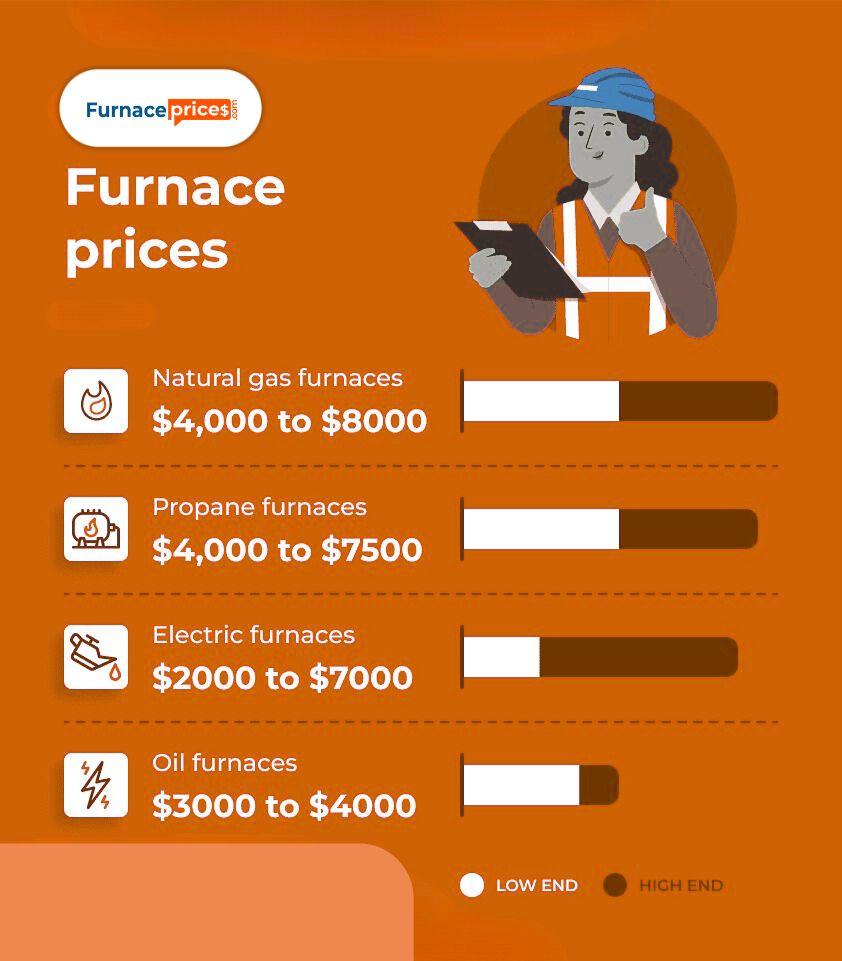
Price: $2,000 – $7,000
Annual fuel cost: $290 – $1,450 per month, depending on electricity rates
More common in milder climates or as backup heating.
Oil Furnaces
Price: $3,000 – $4,500+ (installed)
Annual fuel cost: $2,000 – $5,500
Still used in some regions, but less common today due to high operating costs.
Alternative: Wood-Burning Furnaces
Some rural homeowners opt for wood furnaces, especially if they have easy access to firewood.
Price: $1,500 – $4,500
Annual fuel cost: $800 – $3,200 (depending on supply and usage)
While they can be cheaper if wood is readily available, wood furnaces require more effort, regular maintenance, and don’t match the convenience or efficiency of modern gas or electric furnaces.
FAQs About Furnace Fuel Prices
Which furnace fuel is cheapest in Canada? Natural gas is usually the cheapest option per BTU, followed by propane.
Which furnace fuel is most expensive? Oil tends to be the most expensive, both upfront and for ongoing heating costs.
What’s the most eco-friendly furnace option? Electric furnaces paired with renewable energy sources (like hydro, solar, or wind) have the lowest environmental impact.
Key Takeaway
When comparing furnaces, don’t just look at the upfront price tag—think long term. A cheaper unit might end up costing thousands more each year in fuel bills.
Best for affordability: Natural gas
Best for rural homes: Propane
Best for green energy users: Electricity
Best heat output but costly: Oil
Before making your decision, get multiple quotes from local HVAC contractors to compare installation costs, energy efficiency ratings, and available rebates.
👉 Want expert advice tailored to your home? Get free quotes from trusted HVAC companies near you today.
 USA
USA Canadian