We use cookies to ensure that we give you the best experience on our website.
Furnace Type
Furnace Level
Home Size
Results
Furnace Cost Calculator
How much will upgrading your furnace cost? Get a new gas furnace price estimate instantly with this short quiz.
What type of furnace are you considering?
What level of furnace are you likely to choose?
How large is your home (sq ft)?
This helps estimate the right furnace capacity for your home.
2,000 sq ft
800 sq ft4,000 sq ft
Your Price Range
—
Equipment Cost
—
Total Estimated Cost
—
⚠️ This Estimate Alone
Price can change once your home is actually inspected
Ductwork, permits & site conditions not accounted for
No installation-day guarantee
✅ Certified Expert Quote
Price locked in — no surprises later
Free in-home inspection included
Installation-ready, all-in pricing
—
Licensed & Insured Pros No Spam, No Obligation Top-Rated Local Experts
We respect your privacy. You will be connected to one or two hand-picked, top-rated local contractors. No mass sharing, no spam, no obligation.
Join the homeowners who got a transparent, no-hidden-fee quote this month.
No obligation — local certified contractors have limited appointment slots this week.
Get Your Free, Accurate Quote
Enter your details so a certified local contractor can confirm this price with no hidden costs.
This field is required.
Please enter a valid email address.
Please enter your phone number.
Please enter your city or postal code.
By submitting this form, you are giving your consent to receive phone calls and text messages from our contractor partners.
You're All Set!
A certified local contractor will reach out shortly to confirm your accurate, installation-ready quote — no hidden costs, no obligation.
⭐ Top Contractor Program
Want to Stand Out?
Fill out the form below to apply and get featured as one of our Top Contractors. Gain visibility, attract more clients, and showcase your expertise to a wider audience!
🔒 Your information is private and secure
Free to apply
Verified contractors only
Canada-wide visibility
No hidden charges
Free Service
No obligation
Get Your FREE HVAC Quote Today
Compare prices from top-rated local contractors in minutes
⚠️ Emergency Replacement? If your furnace failed unexpectedly, prioritize safety and heat restoration first—then use this guide to understand fair pricing and avoid rushed decisions.
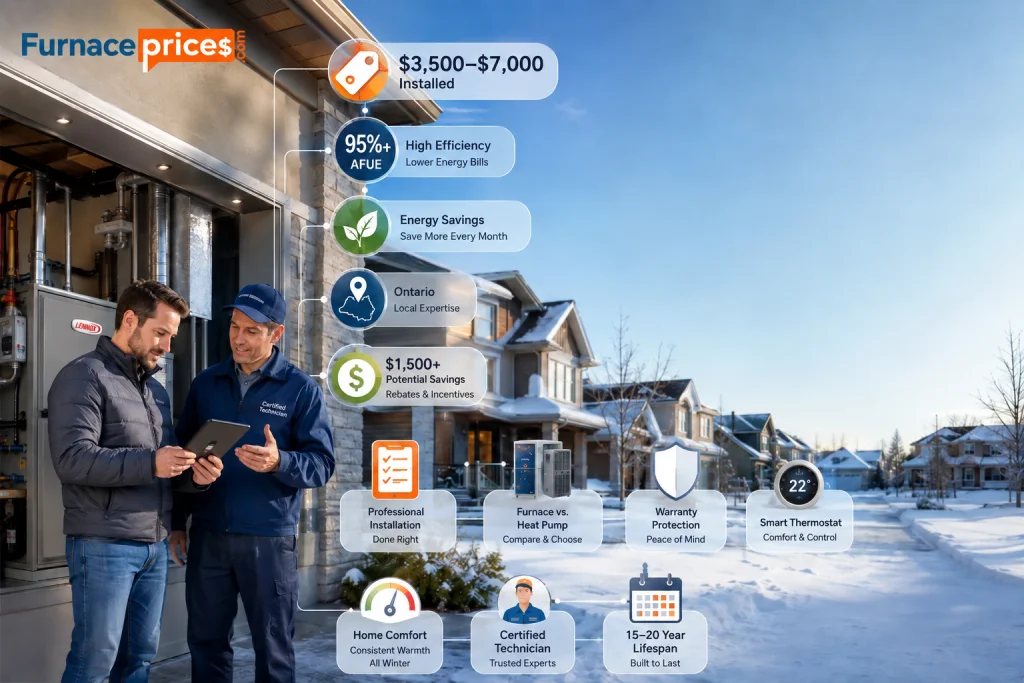
Quick answer: Furnace prices in Ontario range from $2,500–$6,500+ for the unit alone, and $3,500–$7,000 installed — most homeowners pay $4,500–$7,000 for a mid-to-high-efficiency gas system. Already replacing your AC too? A combined furnace + AC installation in Ontario typically runs $7,000–$15,000.
✅ Licensed & TSSA-certified contractor network • 📋 Based on real 2026 Ontario installer quotes • 💬 Free, no-obligation estimates
A new furnace unit in Ontario costs $2,500 to $7,500+, and most homeowners pay $4,000 to $10,000 total once installation is included — typically landing around $4,500–$7,000 for a mid-to-high-efficiency gas system. The exact number depends on fuel type, AFUE efficiency rating, home size, and whether your ductwork needs modification. This guide breaks down real 2026 pricing by fuel type, installation cost, available rebates, and how Ontario’s climate affects your decision between a furnace and a heat pump.
In this guide, you’ll learn the real costs of furnace units across Ontario, what drives pricing differences, installation expenses, available rebates, and how to compare quotes from local contractors. By the end, you’ll have a clear picture of what your new furnace cost in Ontario with installation will actually be—and how to maximize value without overpaying.
New furnace costs in Ontario vary significantly based on fuel type, efficiency rating, and brand. Here’s a realistic breakdown of what homeowners in Toronto, Ottawa, Hamilton, and the GTA typically pay:
Gas Furnaces
Gas furnaces remain the most popular choice in Ontario due to natural gas availability and operating cost efficiency.
Standard Efficiency (80% AFUE): $2,500–$3,800
Mid-Efficiency (90–95% AFUE): $3,500–$5,200
High-Efficiency (96%+ AFUE): $4,500–$7,500+
High-efficiency furnace Ontario prices are higher upfront but deliver long-term savings on energy bills throughout the heating season.
While installation is often simpler, electricity costs in Ontario make these units more expensive to operate annually compared to gas.
Oil Furnaces
Fewer Ontario homes install oil furnaces today, though rural properties still commonly rely on them.
Standard Oil Furnace: $3,200–$5,500
High-Efficiency Oil Models: $4,800–$7,200
Fuel prices fluctuate with these systems, and they require regular maintenance plus scheduled deliveries, which adds to long-term costs.
Furnace Cost by Home Size
Home Size
Recommended BTU Range
Typical Installed Cost
Under 1,200 sq ft
40,000–60,000 BTU
$3,500–$5,500
1,200–2,000 sq ft
60,000–80,000 BTU
$4,500–$7,000
2,000–3,000 sq ft
80,000–100,000 BTU
$4,700–$7,900
3,000+ sq ft
100,000+ BTU
$5,900–$8,500
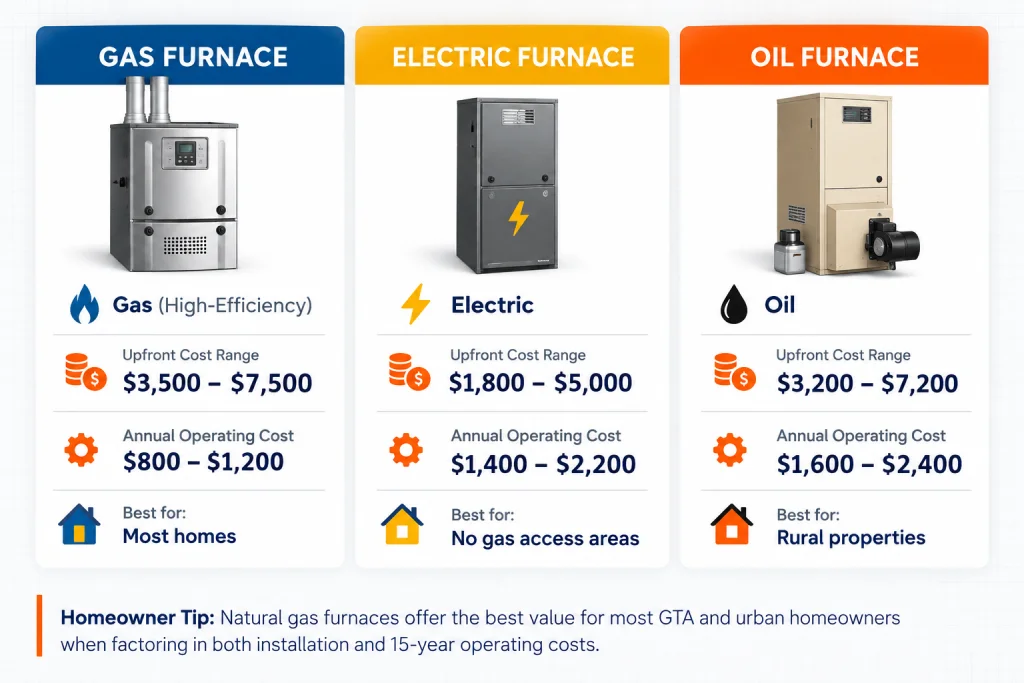
Ontario Furnace Cost Comparison Table
Fuel Type
Upfront Cost Range
Annual Operating Cost
Best For
Gas (High-Efficiency)
$3,500–$7,500
$800–$1,200
Most Ontario homes
Gas (Standard)
$2,500–$3,800
$1,100–$1,500
Budget-conscious buyers
Electric
$1,800–$5,000
$1,400–$2,200
No gas access areas
Oil
$3,200–$7,200
$1,600–$2,400
Rural properties
Ontario Homeowner Tip: Natural gas furnaces offer the best value for most GTA and urban Ontario homeowners when factoring in both installation and 15-year operating costs.
Furnace + AC Combined Installation Cost in Ontario
If you’re replacing an aging air conditioner alongside your furnace, bundling both installs with one contractor visit is usually the better move. A combined furnace and AC installation in Ontario typically runs $7,000–$15,000 depending on efficiency tier and home size — often $500–$1,500 less than booking two separate service calls, since labor, permits, and electrical work overlap.
Combined replacements can also unlock larger rebate bundles under Ontario’s Home Renovation Savings™ program. Ask your contractor to quote furnace-only, AC-only, and combined pricing side by side before deciding.
Estimate your own monthly and annual costs with our operating cost calculator.
🔥
Furnace Operating Cost Calculator
Calculate the estimated monthly operating cost of your furnace with this quick quiz.
Step 1 of 714%
What is the efficiency of your furnace? (AFUE)
AFUE = Annual Fuel Utilization Efficiency. Standard furnaces are ~80–85%, high-efficiency models are 95–98%.
85%
75% (Standard)98% (High-Efficiency)
What is the size of your home?
How well insulated is your home?
Better insulation = your furnace works less = lower monthly cost.
What is your region / climate zone?
Colder climates mean your furnace runs far more hours per heating season.
What is your gas rate?
Check your gas bill for the rate per cubic metre (m³). Average is around $1.20/m³.
$1.20 /m³
$0.50 /m³$2.00 /m³
Would you like a free no-obligation estimate from our local contractor partners?
Our certified partners can quote a newer high-efficiency furnace that could cut your costs significantly.
Great! Almost done — your result is on the next page.
Please enter your contact details so our certified contractors can provide estimates.
This field is required.
Please enter a valid email address.
Please enter your phone number.
Please enter your city or postal code.
By submitting this form, you are giving your consent to receive phone calls and text messages from our contractor partners.
You're almost done!
Please provide your details to see your results.
Name is required.
Email is required.
Please enter your city or postal code.
🔥 ESTIMATE READY
Your Furnace Operating Cost Estimate
Approximate Monthly Cost
—/month
Annual Estimate
—
Furnace Efficiency
—
Gas Rate
—
Home Size Factor
—
Important: This is a general estimate for informational purposes only. Your actual operating costs may vary based on thermostat settings, furnace age, local climate, and usage patterns.
Get Accurate Quotes from Local Pros
These are estimates. Get precise quotes from certified contractors — for free.
What Does Furnace Installation Actually Cost in Ontario?
The furnace unit itself is only part of the total furnace installation cost in Ontario. Labor, materials, and system modifications significantly impact your final bill.
Home Size: Larger homes require higher-capacity furnaces and more extensive ductwork, increasing both equipment and labor costs.
Existing Infrastructure: Older homes may need ductwork repairs, electrical upgrades, or venting changes to accommodate modern high-efficiency systems that meet Ontario building code requirements.
Fuel Type Conversion: Switching from oil to gas or electric to gas requires new gas lines, venting, and permits—adding $1,500–$3,500 to the project.
Brand & Warranty: Premium brands like Carrier, Lennox, and Trane often include extended warranties but come with higher upfront costs. Mid-tier brands like Goodman and Bryant offer solid performance at 15–20% lower prices with comparable reliability.
Seasonal Demand: Installation rates tend to rise during peak heating season (October–January). Scheduling off-season can sometimes reduce labor costs by 10–15%.
Contractor Licensing: Always verify your contractor is TSSA-certified (Technical Standards and Safety Authority) to ensure compliance with Ontario safety regulations and valid warranties.
Not sure what size furnace you need? Try our free furnace size calculator to get a quick BTU estimate, or request quotes with professional heat load calculations to avoid costly oversizing mistakes.
Step 1 of 70%
📐
Furnace Size & BTU Calculator
Not sure what size furnace you need? Answer a few questions about your home and we'll calculate the right BTU output for your situation.
Select your home type
Approximate home square footage of finished living space
What year was your home built?
How well-insulated is your home?
Does your home have lots of large windows, patio doors, skylights, or a sunroom?
Which part of Canada/North America do you live in?
Would you like a free no-obligation estimate from our local contractor partners?
Great! Almost done, your result is on the next page.
Please enter your contact details so our Certified contractors can provide estimates as well.
This field is required.
Please enter a valid email address.
Please enter your phone number.
Please enter your city or postal code.
By submitting this form, you are giving your consent to receive phone calls and text messages from our contractor partners.
You're almost done! Where do we send the results?
Please provide your details to see your results.
Name is required.
Email is required.
Please enter your city or postal code.
📐 BTU Calculation Complete
Your Recommended Furnace Size
Recommended Furnace Output
—
BTUs per hour
What This Means
Get Free Quotes from Local Pros
Certified HVAC contractors in your area will confirm the right size and provide accurate pricing.
What Is AFUE and Why Does It Affect Furnace Price?
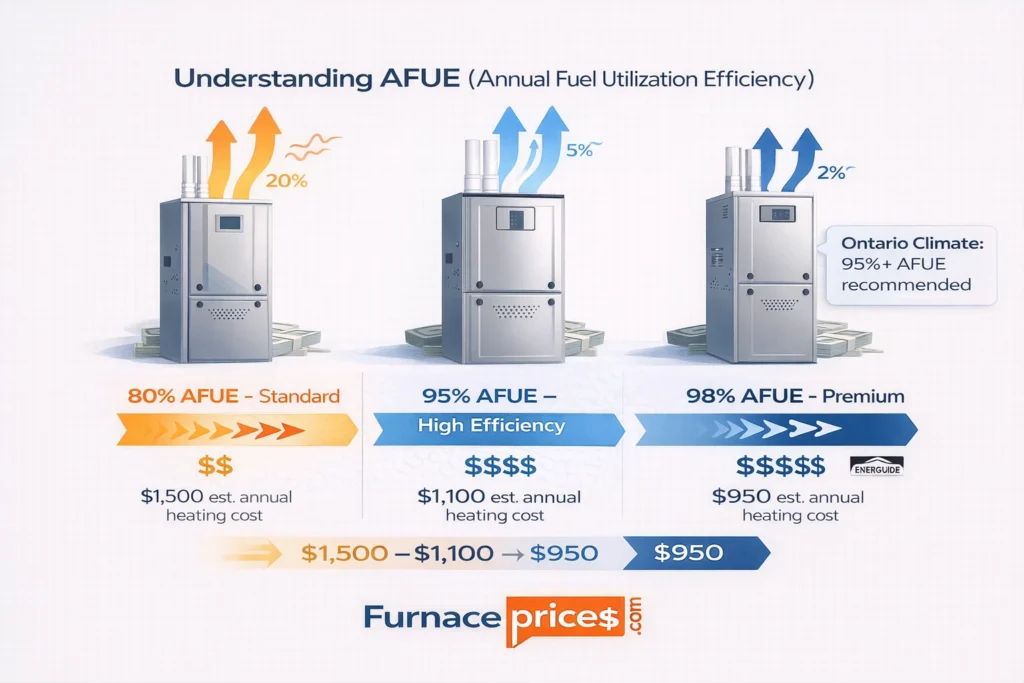
Annual Fuel Utilization Efficiency (AFUE) measures how much fuel converts to usable heat. This single number dramatically affects both upfront costs and long-term savings. The EnerGuide rating system helps Canadian homeowners compare furnace efficiency across brands and models.
How AFUE Works:
80% AFUE = 20% of fuel escapes as waste heat
95% AFUE = Only 5% waste, 95% becomes home heating
98% AFUE = Maximum efficiency available
Ontario Climate Consideration: With heating seasons running October through April, high-efficiency furnaces (95%+ AFUE) typically pay for themselves within 5–7 years through reduced natural gas consumption. According to Natural Resources Canada, upgrading from 80% to 95% AFUE can save Ontario homeowners $300–$500 annually.
Enbridge Gas's previous furnace-specific rebate (Home Efficiency Rebate Plus) closed to new applicants in February 2024, as did the Canada Greener Homes Grant. Both have largely been replaced by the Home Renovation Savings™ program, which now leans toward insulation, heat pump upgrades, smart thermostats, and windows/doors rather than furnace-specific rebates. Furnace eligibility isn't guaranteed under the current program always confirm current amounts directly at homerenovationsavings.ca or with Natural Resources Canada before budgeting for one.
Some Ontario municipalities (Toronto, Ottawa, Hamilton) occasionally run additional seasonal incentives — check with your local utility provider or municipality for region-specific programs.
Quick answer: For most Ontario homes, a gas furnace remains the lower-upfront-cost, more reliable choice in extreme cold, while a cold-climate heat pump costs more to install but qualifies for significantly larger rebates and cuts long-term operating costs — especially when paired with a furnace in a hybrid system.
Gas Furnace
Cold-Climate Heat Pump
Upfront installed cost
$2,500–$7,500
$7,500–$18,000+
Performance below -15°C
Consistent, no drop-off
Reduced efficiency; often needs backup heat
Ontario rebates available
Up to $250 (Enbridge)
Up to $7,500+ (combined federal/provincial)
Annual operating cost (2,000 sq ft home)
$800–$1,500
Varies by electricity rate; can be lower with high COP
Lifespan
15–20 years
10–15 years
Why Ontario's Climate Changes the Calculation
Why this matters for Ontario homeowners specifically: Ontario's climate creates a genuine trade-off that doesn't exist in milder provinces. A furnace delivers steady heat output regardless of outdoor temperature, while even cold-climate heat pumps see efficiency drop as temperatures fall toward -20°C. This is why many Ontario HVAC contractors now recommend hybrid (dual-fuel) systems — a heat pump handles heating down to roughly -10°C to -15°C, with the furnace automatically taking over during extreme cold snaps. This setup lets homeowners capture the larger heat pump rebates while keeping furnace reliability as backup. For a deeper side-by-side breakdown, see our full furnace vs. heat pump comparison guide.
Furnace-Only vs. Hybrid: Which Fits Your Home?
When a furnace alone still makes sense: Older homes without central air infrastructure, homes on a tight upfront budget, or homes in colder northern/rural Ontario regions where heat pump performance drops off more before backup heat kicks in.
When to seriously consider a heat pump or hybrid: If you're already replacing both a furnace and an aging air conditioner, the combined rebate value often closes most of the price gap — ask any contractor you quote to run both scenarios side by side.
What Factors Change Your Final Furnace Quote?
Several factors determine the final cost of your furnace replacement:
Fuel Type
Gas furnaces typically offer the best balance of upfront cost and operating efficiency in Ontario. Electric furnaces have lower installation costs but higher monthly bills. Oil furnaces are costly to run and maintain.
Home Size & Heating Load
Furnace capacity is measured in BTUs (British Thermal Units). Ontario homes typically need 40–60 BTUs per square foot, depending on insulation quality, window efficiency, and layout — use our BTU calculator to get an estimate specific to your home.
depending on insulation quality, window efficiency, and layout. A 2,000 sq ft home in the GTA generally requires a 60,000–80,000 BTU furnace.
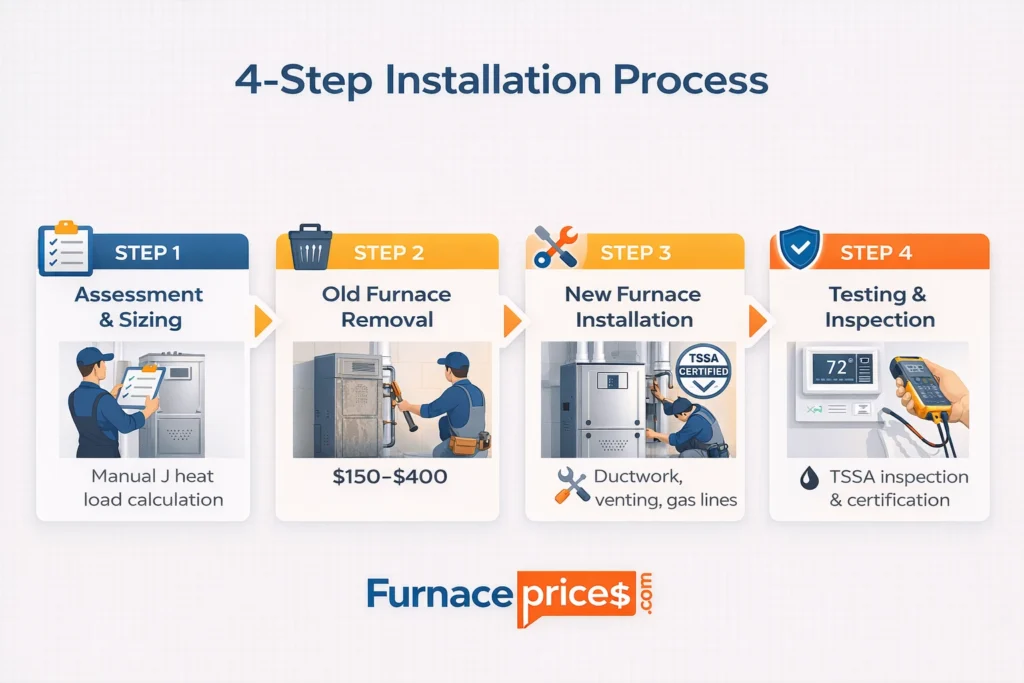
Proper sizing requires a Manual J heat load calculation performed by TSSA-certified contractors—not guesswork based on your old furnace.
Brand Comparison
Premium Tier (Carrier, Lennox, Trane):
Cost: 20–30% higher
Warranty: 10–12 years parts, lifetime heat exchanger
Best for: Long-term homeowners prioritizing reliability
Mid-Tier (Bryant, American Standard, Goodman):
Cost: 15–20% lower than premium
Warranty: 10 years parts
Best for: Value-focused buyers with solid contractor support
Budget Tier (Comfort-Aire, Aire-Flo):
Cost: 25–35% lower than premium
Warranty: 5–10 years parts
Best for: Rental properties or short-term ownership
Note: Brand performance varies significantly based on installation quality and ongoing maintenance. Even premium brands underperform when improperly installed.
Not sure which tier fits your situation? Take our furnace recommendation quiz for a personalized Entry / Mid / High-End suggestion.
Step 1 of 90%
🏆
Which Furnace Is Right for Your Home?
Not sure which furnace to buy? Answer a few quick questions and get a personalized recommendation — Entry Level, Mid Range, or High End.
What is your primary heating source today?
Do you have central ductwork?
How well insulated is your home?
How large is your home?
What region do you live in?
How cold do winters get where you live?
How long are you planning on staying in your home?
How important is energy efficiency to you?
What is your budget for a new furnace?
Would you like a free no-obligation estimate from our local contractor partners?
Great! Almost done, your result is on the next page.
Please enter your contact details so our Certified contractors can provide estimates as well.
This field is required.
Please enter a valid email address.
Please enter your phone number.
Please enter your city or postal code.
By submitting this form, you are giving your consent to receive phone calls and text messages from our contractor partners.
You're almost done! Where do we send the results?
Please provide your details to see your results.
Name is required.
Email is required.
Please enter your city or postal code.
Get a Free Furnace Quote
Connect with certified local HVAC contractors and get precise pricing for your recommended furnace.
Single-Stage: Runs at full capacity only; least expensive ($2,500–$4,000)
Two-Stage: Offers low and high heating modes; better efficiency and comfort ($3,500–$5,500)
Modulating (Variable Speed): Adjusts output incrementally; maximum comfort and efficiency ($5,000–$7,500+)
For homeowners who prioritize quiet, even heat, modulating furnaces are the top-tier choice — they deliver the most consistent temperature control and operate 30–40% more quietly than single-stage units.
Smart & IoT-Enabled Furnaces: Is a Connected System Worth It?
Modern furnaces increasingly ship with, or support, Wi-Fi-connected controls that go beyond a basic programmable thermostat.
What "smart-enabled" actually means for a furnace:
App-based diagnostics: Many modulating and two-stage furnaces from Carrier, Lennox, and Trane now report fault codes and maintenance alerts directly to a contractor or homeowner app, catching problems before a mid-winter breakdown.
Smart thermostat integration: Pairing a furnace with an ecobee or Nest-style thermostat allows learning schedules, geofencing, and room sensors — see our smart thermostat buying guide for a full model comparison.
Remote monitoring for rental/seasonal properties: For cottage owners or landlords, connected furnaces can send low-temperature alerts remotely, reducing frozen-pipe risk during vacancies — a genuinely Ontario-relevant use case given the province's seasonal-property market.
Cost and Value: Is Smart Furnace Tech Worth It?
Does it add to the cost? Smart-capable furnace models typically run 5–10% above a comparable non-connected unit of the same AFUE rating. A separate smart thermostat adds $200–$500 installed, but is often the more cost-effective entry point if you're not replacing the furnace itself yet. check our best smart thermostats in Canada roundup for top-rated options.
Is it worth it? For most homeowners, a smart thermostat delivers the bulk of the savings and convenience — typically 10–15% lower heating costs through better scheduling — without needing a fully IoT-native furnace. Full smart-diagnostic furnaces are most worth the premium for larger homes, rental properties, or anyone who wants remote fault alerts before a failure becomes an emergency.
A commonly used HVAC industry rule of thumb: multiply the repair cost by the furnace's age in years. Try our repair-or-replace quiz for a scored recommendation based on your specific furnace. If the result exceeds roughly $5,000, replacement is typically the smarter long-term investment. A 15-year-old furnace needing a $400 repair (15 × $400 = $6,000) is a strong replacement candidate; a 3-year-old furnace needing the same $400 repair (3 × $400 = $1,200) is worth fixing.
Choosing the Wrong Size
Contractors sometimes oversize furnaces, assuming "bigger is better." Oversized units cycle on and off frequently, wasting energy and shortening lifespan by 3–5 years. Always request a Manual J heat load calculation before installation.
Avoid This Common Installer Upsell: If a contractor recommends a furnace size without measuring your home, calculating heat loss, or reviewing insulation—get a second opinion.
Ignoring Rebates
Failing to research available rebates can cost you $1,000–$2,500. Apply for incentives before installation begins—most programs require pre-approval or enrollment.
Don't Overlook Financing
Many Ontario HVAC contractors and lenders offer 0%–interest financing plans for furnace replacement, often spreading the cost over 12–60 months — see our furnace financing guide for how these plans typically work. Financing can make a high-efficiency unit accessible even when the rebate hasn't been claimed yet — just confirm whether the plan requires a lien on your home (common with some third-party HVAC financing companies) before signing.
Skipping Contractor Comparison
Accepting the first quote without comparing at least three licensed TSSA-certified contractors often results in overpaying by 15–25%. Verify contractor credentials, online reviews, and warranty terms.
Focusing Only on Upfront Cost
The cheapest furnace rarely delivers the best value. A $3,000 furnace with $1,800 annual heating bills costs more over 10 years than a $5,500 high-efficiency model with $1,100 annual bills. Run your own numbers with our savings calculator to see the real 10-year difference.
Step 1 of 50%
💚
New Furnace Savings Calculator
How much money could you save by upgrading to a new high-efficiency furnace? Find out with this quick calculator.
How old is your current furnace?
Older furnaces are significantly less efficient and cost more to run.
What are your approximate total annual natural gas costs?
Take your average monthly gas bill × 12. The average in Canada is about $1,000/year. Include all gas appliances.
$1,000 / year
$400$3,500
How many appliances in your home use natural gas?
Select all that apply — helps estimate what portion of your gas bill is for heating.
Select the efficiency (AFUE) you would choose for your new furnace
Entry-level models start at about 92% and go up to about 98% for high-end models.
92%
92% (Entry)98% (Premium)
Would you like a free no-obligation estimate from our local contractor partners?
Great! Almost done, your result is on the next page.
Please enter your contact details so our Certified contractors can provide estimates as well.
This field is required.
Please enter a valid email address.
Please enter your phone number.
Please enter your city or postal code.
By submitting this form, you are giving your consent to receive phone calls and text messages from our contractor partners.
You're almost done! Where do we send the results?
Please provide your details to see your results.
Name is required.
Email is required.
Please enter your city or postal code.
💚 Savings Calculated
Your Estimated Annual Savings
Annual Savings
—
5-Year Savings
—
10-Year Savings
—
15-Year Savings
—
Ready to Start Saving?
Get free quotes from certified local contractors and find out the exact cost of upgrading your furnace.
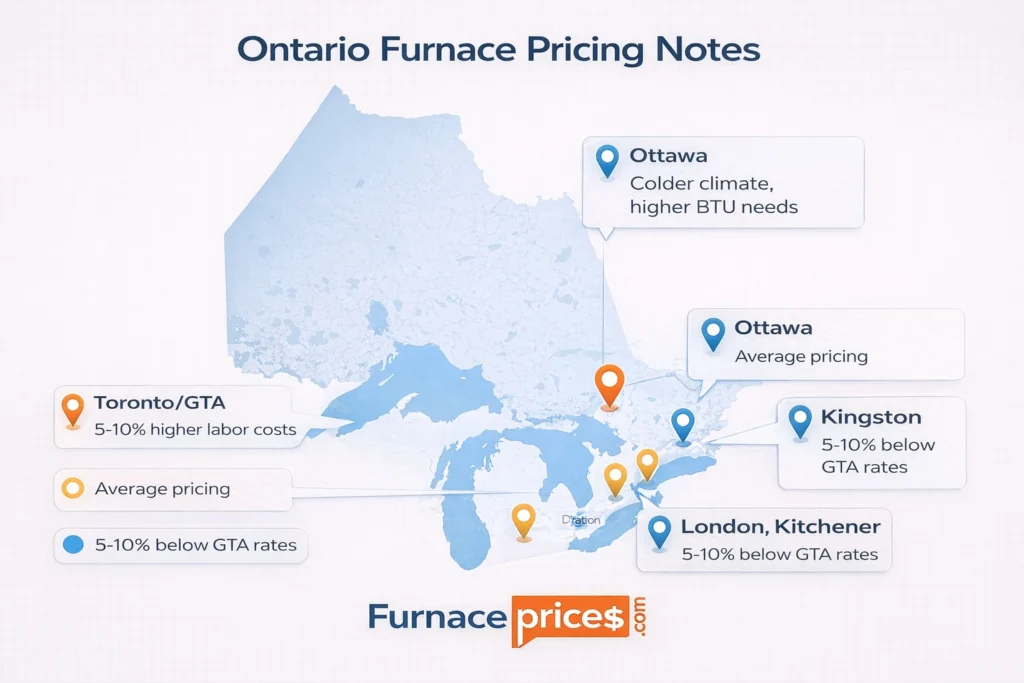
Furnace prices in Ontario typically range from $2,500 to $7,500+ for the unit alone. Including installation, most homeowners pay between $4,000 and $10,000 total, depending on fuel type, efficiency, and home size. Toronto and GTA installations may run 5–10% higher due to labor rates and permitting costs.
Q: What furnace rebates are available in Ontario?
As of 2026, the original Canada Greener Homes Grant and Enbridge's furnace-specific rebate have closed to new applicants. The current active program is Enbridge's Home Renovation Savings™ (with Save on Energy and the Ontario Government), though it focuses primarily on insulation, heat pumps, and smart thermostats rather than gas furnaces specifically. Always confirm current rebate availability before purchasing.
Q: Is a high-efficiency furnace worth it in Ontario?
Yes. Ontario's long, cold winters mean high-efficiency furnaces (95%+ AFUE) pay for themselves through reduced energy bills within 5–8 years. They also qualify for better rebates, reduce environmental impact, and improve home resale value in competitive markets like Toronto and Ottawa.
Q: How long does a furnace last in Ontario?
Most furnaces last 15–20 years with proper maintenance. High-efficiency models may last slightly longer due to advanced technology and better build quality. Annual tune-ups extend lifespan and maintain warranty coverage. Neglecting maintenance can reduce lifespan to 12–15 years.
Q: Can I install a furnace myself in Ontario?
No. Ontario law requires TSSA-licensed HVAC contractors to install furnaces. DIY installations void all manufacturer warranties, violate building codes, fail inspections, and create serious safety risks including carbon monoxide leaks and fire hazards. Unlicensed installations may also complicate home insurance claims.
City-Specific Pricing Considerations
Toronto & GTA
Higher labor costs and stricter permit requirements often add $300–$800 to installation. Older homes in established neighborhoods (The Beaches, High Park, Leslieville) may require additional ductwork modifications.
If you're near Milton or Oakville, see our dedicated Furnace Prices in Milton, Ontario guide for a closer look at new-build vs. older-home cost differences in that market.
Ottawa
Colder climate than southern Ontario means sizing calculations require 10–15% higher capacity. Rural Ottawa properties may face premium charges for service calls.
Hamilton
Mix of older and newer housing stock. Homes built pre-1980 often need extensive duct sealing and insulation upgrades before high-efficiency furnace installation delivers optimal performance.
London, Kingston, Kitchener-Waterloo typically see pricing 5–10% below GTA rates, though contractor availability may be more limited during peak season.
Navigating furnace prices in Ontario doesn't have to be overwhelming. By understanding the cost factors—fuel type, efficiency, installation complexity, and available rebates—you can confidently plan your replacement budget. Remember that the cheapest option isn't always the best value. Investing in a properly-sized, high-efficiency furnace installed by TSSA-certified professionals will deliver comfort, savings, and reliability for 15–20 years.
Ready to get started? Compare local contractor quotes to find the best furnace prices in Ontario for your home. The pricing ranges in this guide reflect current market rates from licensed, TSSA-certified HVAC contractors operating across the GTA and major Ontario cities, cross-checked against manufacturer pricing and industry benchmarks. Request detailed estimates that include equipment specifications, installation costs, rebate eligibility, and heat load calculations — and choose a contractor who prioritizes your long-term comfort and savings, not just a quick sale.
How much will upgrading your furnace cost? Get a new gas furnace price estimate instantly with this short quiz.
What type of furnace are you considering?
What level of furnace are you likely to choose?
How large is your home (sq ft)?
This helps estimate the right furnace capacity for your home.
2,000 sq ft
800 sq ft4,000 sq ft
Your Price Range
—
Equipment Cost
—
Total Estimated Cost
—
⚠️ This Estimate Alone
Price can change once your home is actually inspected
Ductwork, permits & site conditions not accounted for
No installation-day guarantee
✅ Certified Expert Quote
Price locked in — no surprises later
Free in-home inspection included
Installation-ready, all-in pricing
—
Licensed & Insured Pros No Spam, No Obligation Top-Rated Local Experts
We respect your privacy. You will be connected to one or two hand-picked, top-rated local contractors. No mass sharing, no spam, no obligation.
Join the homeowners who got a transparent, no-hidden-fee quote this month.
No obligation — local certified contractors have limited appointment slots this week.
Get Your Free, Accurate Quote
Enter your details so a certified local contractor can confirm this price with no hidden costs.
This field is required.
Please enter a valid email address.
Please enter your phone number.
Please enter your city or postal code.
By submitting this form, you are giving your consent to receive phone calls and text messages from our contractor partners.
You're All Set!
A certified local contractor will reach out shortly to confirm your accurate, installation-ready quote — no hidden costs, no obligation.
What to Do Next
If you're planning ahead:
Get 3–5 quotes from TSSA-certified Ontario contractors
Verify rebate eligibility before signing any contract
Request Manual J calculations to confirm proper sizing
Compare total cost of ownership, not just installation price
Schedule installation during off-peak season if possible (April–September)
If your furnace failed unexpectedly: First, ensure your family is safe and has temporary heat. Once stabilized, use this guide to evaluate emergency quotes fairly—even urgent replacements deserve fair pricing and proper sizing.
Your comfort during Ontario winters is too important to leave to guesswork. Make an informed decision with real data, professional guidance, and fair pricing.
🔧 Connecting Homeowners with Trusted Furnace & AC Contractors Across Ontario
At FurnacePrices.com, we bridge the gap between homeowners and reliable, vetted HVAC contractors — whether you're installing a new furnace, upgrading your air conditioner, or replacing your full home comfort system.
When Are You Planning to Install a New Furnace or Air Conditioner?
Tell us your timeline, and we'll match you with the most suitable HVAC professionals in your area — whether you need an urgent installation in the next 2–3 days, you're planning an upgrade in the coming weeks, or you're still comparing brands, prices, and contractor quotes.
FurnacePrices.com helps homeowners across Ontario compare heating and cooling systems, estimate installation costs, and connect with trustworthy contractors. Frequently supported service areas include:
Our network covers most major and mid-sized regions in Ontario, whether you're replacing an older furnace/AC or upgrading to a high-efficiency model. 👉 See the full list of Ontario service regions
What Affects Furnace & AC Installation Pricing in Ontario?
Installation costs vary depending on home size and heating/cooling load — larger homes require higher-BTU furnaces or higher-tonnage AC units — as well as installation complexity (venting, ductwork, gas lines, and electrical upgrades), brand and efficiency level, regional labour rates, and whether you need a repair or a full system replacement. Understanding these factors helps you plan your installation budget more accurately.
📞 Thinking About Installing a New Furnace or Air Conditioner?
 USA
USA Canadian