Purchasing a new appliance, whether it’s a furnace, air conditioner, or water heater, is no small decision. Beyond the cost of the unit itself, homeowners need to consider long-term operating expenses, environmental impact, and performance. For Canadian households—especially those in Ontario, where heating needs are substantial—energy efficiency is one of the most important factors when choosing new equipment.
That’s where ENERGY STAR® certification and Canada’s EnerGuide program come in. Both provide reliable information to help you understand how a product performs and how much it will cost to run.
This guide explains how ENERGY STAR and EnerGuide work, what they mean for HVAC systems like furnaces, air conditioners, and boilers, and how to read these labels so you can make confident, informed decisions for your home.
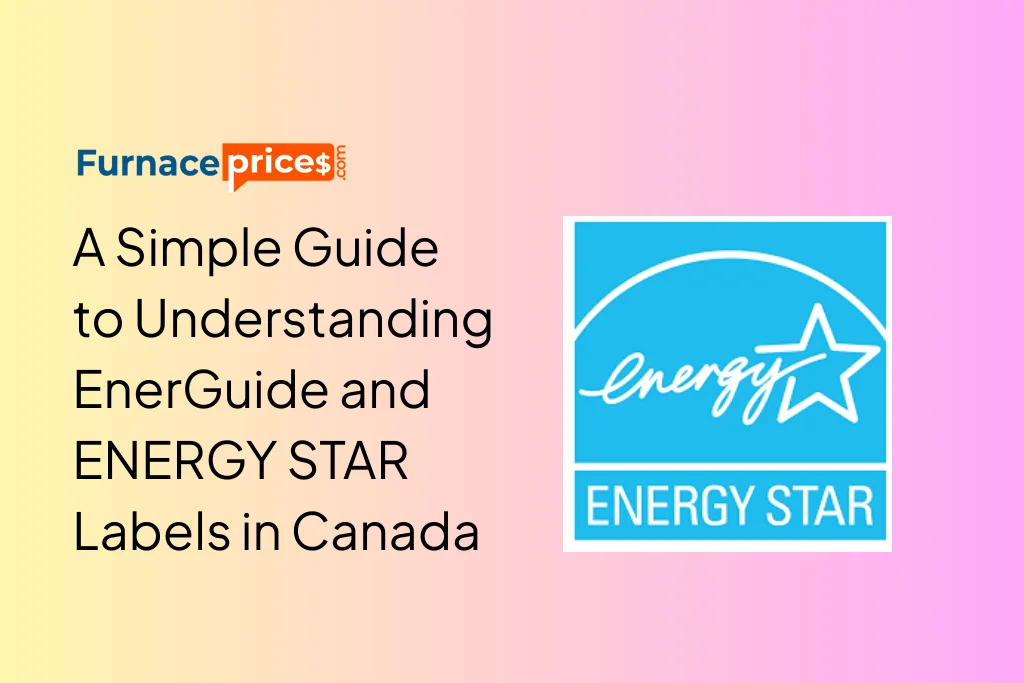
What Is ENERGY STAR?
ENERGY STAR, introduced by the Environmental Protection Agency in 1992, is a voluntary program that helps identify products designed to consume less energy, ultimately reducing utility costs. Canada partnered with the program in 2001, and it’s now administered through Natural Resources Canada (NRCan).
The program helps homeowners and businesses identify high-performing, energy-efficient products. To earn certification, manufacturers must submit verified test results proving that their product meets or exceeds strict technical requirements in its category.
Why this matters to you:
- In Canada, new gas furnaces must meet a minimum Annual Fuel Utilization Efficiency (AFUE) rating of 90% to comply with regulations, ensuring efficient energy use.
- They are better for the environment, producing fewer greenhouse gas emissions.
- The certification is a trusted shortcut—if you see the logo, you know the product is among the most efficient options available.
ENERGY STAR started with office equipment like computers and monitors but quickly expanded. Today, thousands of products carry the label, and more than 1,000 Canadian businesses participate in the program.
What Is EnerGuide?
While ENERGY STAR identifies top-performing products, EnerGuide is a Canadian government program designed to make comparisons between products easier.
An EnerGuide label provides standardized information on a product’s energy use or efficiency, helping you compare models side by side. Unlike ENERGY STAR, an EnerGuide label doesn’t automatically mean a product is the best in its category—it simply provides the data you need to decide.
What an EnerGuide label tells you:
- Model number
- Annual energy consumption (in kilowatt hours, or kWh)
- Efficiency range of similar products
- Where this product falls compared to others in the same category
- Whether the unit is ENERGY STAR certified
EnerGuide is required on many household appliances (like washers and dryers) and is optional for HVAC equipment such as furnaces and central air conditioners.
ENERGY STAR vs. EnerGuide: What’s the Difference?
- ENERGY STAR = a mark of excellence. Only products that meet or exceed strict energy efficiency criteria earn this label, making it an easy way to spot top-performing, eco-friendly options.
- EnerGuide = a comparison tool. It gives you the numbers so you can see how one model stacks up against others, showing efficiency ranges and expected energy use.
When you’re shopping for a new furnace, air conditioner, or boiler, it’s best to look at both labels together. EnerGuide gives you the detailed stats you need for comparison, and ENERGY STAR tells you whether the model is among the very best for energy savings and long-term value.
ENERGY STAR and EnerGuide for Furnaces
Heating accounts for the largest portion of energy use in Canadian homes—in fact, space heating can represent more than 60% of a household’s energy costs. That makes furnace efficiency especially important.
Efficiency is measured using AFUE (Annual Fuel Utilization Efficiency), which compares how much heat a furnace produces to the amount of fuel it consumes.
EnerGuide for Furnaces
- Shows the furnace’s AFUE rating.
- Displays the range of AFUE ratings for similar products.
- Lists the model number and whether the unit is ENERGY STAR certified.
Canadian standards mandate that new gas furnaces must achieve an AFUE rating of at least 90%. The best models today achieve up to 99% AFUE, though EnerGuide labels currently top out at 98%.
ENERGY STAR for Furnaces
To qualify for ENERGY STAR certification in Canada, a furnace must achieve an AFUE of 95% or higher, guaranteeing excellent energy efficiency and reduced energy consumption. That means 95% of the fuel becomes usable heat, with only 5% wasted through exhaust.
Practical takeaway: If you’re replacing an older furnace with an AFUE of 80%, upgrading to a 95%+ ENERGY STAR model could cut your heating bills significantly while lowering your household’s emissions.
ENERGY STAR and EnerGuide for Air Conditioners
Air conditioners are rated using SEER (Seasonal Energy Efficiency Ratio). The Seasonal Energy Efficiency Ratio (SEER) measures a cooling system’s efficiency, where a higher SEER indicates greater cooling output for each unit of energy used, making it more energy-efficient.
EnerGuide for Air Conditioners
- Lists the model’s SEER rating, helping you quickly see how efficient the system is.
- Provides a comparison range of SEER ratings for similar products, so you can evaluate whether the unit is average, below average, or among the most efficient.
- Identifies whether the unit carries the ENERGY STAR logo, which signals above-average energy performance and long-term savings on electricity bills.
In Canada, split-system central air conditioners must have a minimum SEER of 13, though this is being raised to 14. Top-tier systems reach SEER 27, but in Ontario and most of Canada, a SEER of 16–18 typically offers the best balance between upfront cost and performance, ensuring efficiency without overspending on features you may rarely use.
ENERGY STAR for Air Conditioners
To qualify, a central air conditioner in Canada must have a SEER rating of 15 or higher, meaning it operates more efficiently than standard models.
Practical takeaway: While ultra-high SEER units are available, most Canadian households won’t see enough hot days to justify the premium. ENERGY STAR models in the 16–18 SEER range usually provide the most cost-effective option, combining comfort, lower utility bills, and reliable performance for the typical Canadian climate.
ENERGY STAR and EnerGuide for Boilers
Boilers, like furnaces, are also measured using AFUE, which shows how much fuel is converted into usable heat.
EnerGuide for Boilers
- Displays the boiler’s AFUE rating, so you can compare efficiency at a glance.
- Provides the AFUE range of comparable boilers, helping you see where a model stands.
- Lists the model number for easy reference and comparison.
Canadian regulations require gas boilers to achieve at least 80% AFUE. Most modern condensing boilers operate around 95% efficiency, with the best models reaching as high as 98%, offering significant energy savings and reduced emissions compared to older units.
ENERGY STAR for Boilers
In Canada, a gas boiler must achieve an AFUE of 90% or more to qualify for ENERGY STAR certification, signifying superior energy efficiency.
Practical takeaway: Choosing an ENERGY STAR-certified boiler ensures you’re investing in one of the most efficient and environmentally responsible models available, helping lower your heating costs over time while keeping your home comfortable.
ENERGY STAR and EnerGuide for Water Heaters
Water heaters are responsible for approximately 20% of a household’s energy consumption, ranking as the second-largest energy user after space heating.
The way efficiency is measured depends on the type of water heater:
- Electric models: Measured by standby loss (watts). A lower number is better.
- Gas/propane models: Measured using Energy Factor (EF) or the newer Uniform Energy Factor (UEF). Higher numbers indicate better efficiency.
EnerGuide for Water Heaters
- Identifies fuel type (electric, gas, propane).
- Shows standby loss (electric) or EF rating (gas).
- Provides the efficiency range for comparable models.
Canada requires on-demand (tankless) gas water heaters to have a UEF of at least 0.86. Storage models have separate standards.
ENERGY STAR for Water Heaters
ENERGY STAR uses UEF ratings and has different criteria depending on whether the unit is storage, tankless, gas, propane, or electric. Certified models are among the most efficient on the market.
Practical takeaway: Upgrading to an ENERGY STAR-certified water heater can reduce water heating costs by 10–30% annually, depending on household usage.
Why Energy Efficiency Matters in Canadian Homes
Choosing energy-efficient HVAC equipment isn’t just about saving money—though the savings can be substantial. It’s also about comfort, reliability, and environmental responsibility. Energy-efficient systems tend to operate more quietly, require fewer repairs, and maintain consistent indoor temperatures, ensuring year-round comfort for your family.
- Lower utility bills: ENERGY STAR estimates that upgrading to certified appliances could cut energy bills by up to 30%.
- Reduced environmental impact: Less energy use means fewer greenhouse gas emissions, helping reduce your household’s carbon footprint.
- Improved home value: Energy-efficient upgrades can make your home more attractive to future buyers, who increasingly look for modern, eco-friendly features.
Given Canada’s long, cold winters and increasingly hot summers, energy-efficient heating and cooling systems are an investment that pays off year after year by improving both financial savings and overall quality of life.
For more information on energy efficiency standards and incentives in Canada, visit Natural Resources Canada.
FAQs About ENERGY STAR and EnerGuide
How are energy-efficient products better for the environment? All energy use has environmental impacts, but efficient products reduce the total amount of energy required. This translates to lower emissions and helps conserve natural resources.
What’s the difference between SEER and EER? Both measure air conditioner efficiency.
SEER (Seasonal Energy Efficiency Ratio): The Seasonal Energy Efficiency Ratio (SEER) measures a cooling system’s performance over an entire season, accounting for fluctuating temperatures throughout the period.
EER (Energy Efficiency Ratio): Reflects efficiency at a constant temperature.
SEER is best for comparing models in Canada, while EER is more useful for system sizing and estimating performance in consistently hot climates.
Is an ENERGY STAR label always better than a high EnerGuide rating? Yes and no. EnerGuide provides the numbers, but it doesn’t guarantee top-tier performance. ENERGY STAR ensures a product ranks among the most efficient in its category. Ideally, you’ll want to consider both labels together before buying.
Final Thoughts
For Canadian homeowners, understanding ENERGY STAR and EnerGuide labels is an essential step toward making smarter choices when purchasing HVAC systems or other major appliances. These labels go beyond marketing claims, giving you reliable, government-backed information about performance and efficiency.
ENERGY STAR tells you which products are best-in-class for efficiency, often exceeding the minimum standards by a noticeable margin. This means lower utility bills, reduced environmental impact, and in many cases, eligibility for rebates or incentive programs offered by provinces and utility companies.
EnerGuide lets you compare detailed stats between models, such as energy consumption, SEER ratings, or annual operating costs, so you can weigh the benefits of different systems before investing.
Together, these tools help you balance upfront cost, long-term savings, and environmental responsibility. They also empower you to make informed decisions tailored to your climate, household needs, and budget—ensuring your purchase provides comfort today while keeping future energy costs predictable and manageable.
Have questions about choosing the right furnace, air conditioner, or water heater for your home? Our expert-backed guides and contractor directory can help.
Visit FurnacePrices.com to learn more or request a free quote today.
 Canadian