Fill out the form below to apply and get featured as one of our Top Contractors. Gain visibility, attract more clients, and showcase your expertise to a wider audience!
🔒 Your information is private and secure
Free to apply
Verified contractors only
Canada-wide visibility
No hidden charges
Free Service
No obligation
Get Your FREE HVAC Quote Today
Compare prices from top-rated local contractors in minutes
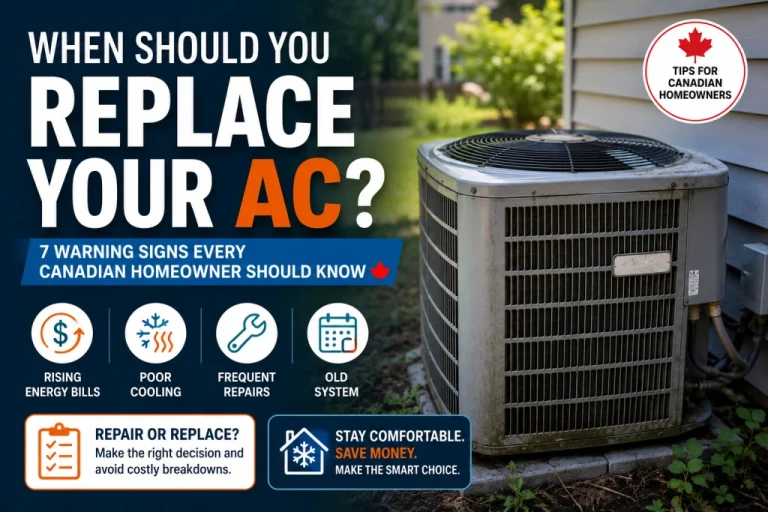
If you’re noticing warning signs your AC needs repair, waiting until peak summer to deal with it is one of the most expensive decisions a Canadian homeowner can make. By the time July arrives, HVAC contractors are booked out for weeks, emergency call rates spike, and your only options are rushed ones.
Every year, thousands of homeowners across Canada — in Toronto, Vancouver, Calgary, Edmonton, and beyond — get caught in exactly this situation. A system that “seemed fine” in May breaks down completely in August. What would have been a $300 repair in spring becomes a $2,500 emergency replacement under pressure.
This guide will help you spot the AC repair warning signs early, understand what each symptom means, know when to call a technician, and make a confident repair-vs-replace decision — before summer forces your hand.
👉 To learn more about our mission, expertise, and how we help homeowners connect with trusted HVAC professionals, visit our About Us page
Don’t wait for a breakdown during a heatwave. Connect with a certified local HVAC technician today — free quotes, no obligation, fast response across Canada.
🔒 100% Free · No sign-up required · Serving homeowners across Canada
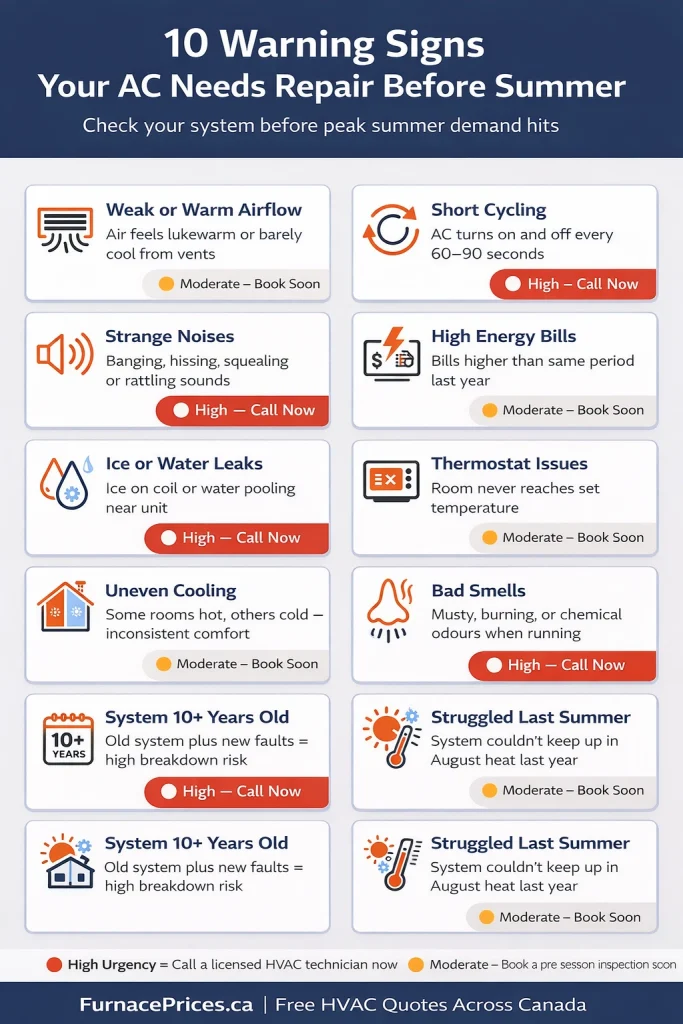
⚡ Quick Reference: 10 AC Repair Warning Signs Before Summer
Use this checklist to self-assess your system right now. Then read the full breakdown below for diagnosis and next steps.
#
Warning Sign
Likely Cause
Urgency
1
Weak or warm airflow from vents
Dirty filter, low refrigerant, failing blower
🟡 Moderate
2
Short cycling (rapid on/off)
Refrigerant leak, oversized unit, bad capacitor
🔴 High
3
Strange noises — banging, hissing, squealing
Compressor, refrigerant leak, worn belt
🔴 High
4
Electricity bills higher than last year
Dirty coils, low refrigerant, duct leaks
🟡 Moderate
5
Moisture, leaks, or ice on the unit
Clogged drain, restricted airflow, refrigerant
🔴 High
6
Thermostat not responding correctly
Calibration, wiring, faulty thermostat
🟡 Moderate
7
Uneven cooling across rooms
Duct leaks, sizing issue, failing blower
🟡 Moderate
8
Bad smells when the AC runs
Mold in coil, electrical fault, refrigerant
🔴 High
9
System is 10+ years old with new faults
Age-related component degradation
🔴 High
10
Poor cooling performance last summer
Accumulated wear, low refrigerant, coil fouling
🟡 Moderate
⚠️ Seeing 2 or more signs on this list? This is not a “monitor it” situation. Get a diagnosis from a certified AC repair technician near you before summer demand spikes and availability disappears.
Why Pre-Summer AC Checks Save Canadian Homeowners Money
Most central air conditioner failures don’t happen without warning. They build quietly — a refrigerant leak gradually reducing cooling capacity, a clogged drain line dripping silently before causing ceiling damage, a weakening capacitor causing repeated short cycling until the compressor finally gives out.
The spring window — roughly March through May — is the best time to schedule professional AC repair in Canada. Contractors have availability. Parts are in stock. And you have the mental space to make an informed decision rather than a panicked one.
Once summer heat arrives in cities like Toronto and Calgary, that flexibility vanishes. Booking windows stretch to 2–3 weeks. Emergency call fees double or triple. And the repair-vs-replace conversation becomes a time-pressured crisis instead of a calm calculation.
💡 Pro Tip: Before calling anyone, use the free AC Troubleshooting Wizard to narrow down your symptoms and identify what’s likely wrong with your system. It takes less than two minutes and can save you a diagnostic service fee.
10 Signs Your AC Needs Repair — Full Breakdown
1. Weak or Warm Airflow from the Vents
Stand near a supply vent while your AC is running. The air should feel noticeably cool, with consistent airflow across all rooms. If it feels weak, lukewarm, or barely different from room temperature — something is wrong.
Weak airflow typically points to a dirty filter, blocked ductwork, or a failing blower motor. Warm air usually signals low refrigerant or a compressor that’s starting to fail. Neither resolves on its own.
💡 Pro Tip: Start by replacing the air filter. If the problem doesn’t improve within 24 hours, that’s your cue to call a licensed HVAC technician near you — not to wait another week.
2. Short Cycling — Rapid On/Off That Wears Down Your Compressor
Short cycling is when your AC kicks on, runs for 60–90 seconds, then shuts off before the home reaches temperature — and repeats this pattern constantly. It’s one of the clearest signs your AC needs repair, and one of the most damaging to your compressor over time.
Common causes: an oversized system, a refrigerant leak, a frozen evaporator coil, or a failing capacitor.
⚠️ Most homeowners ignore short cycling, chalking it up to “it’s just how the unit runs.” This is the mistake that leads to the most expensive AC repair: full compressor replacement at $1,500–$2,500+.
Not sure if your system is properly sized for your home? Use the AC Size Calculator for a quick baseline before you speak with a contractor.
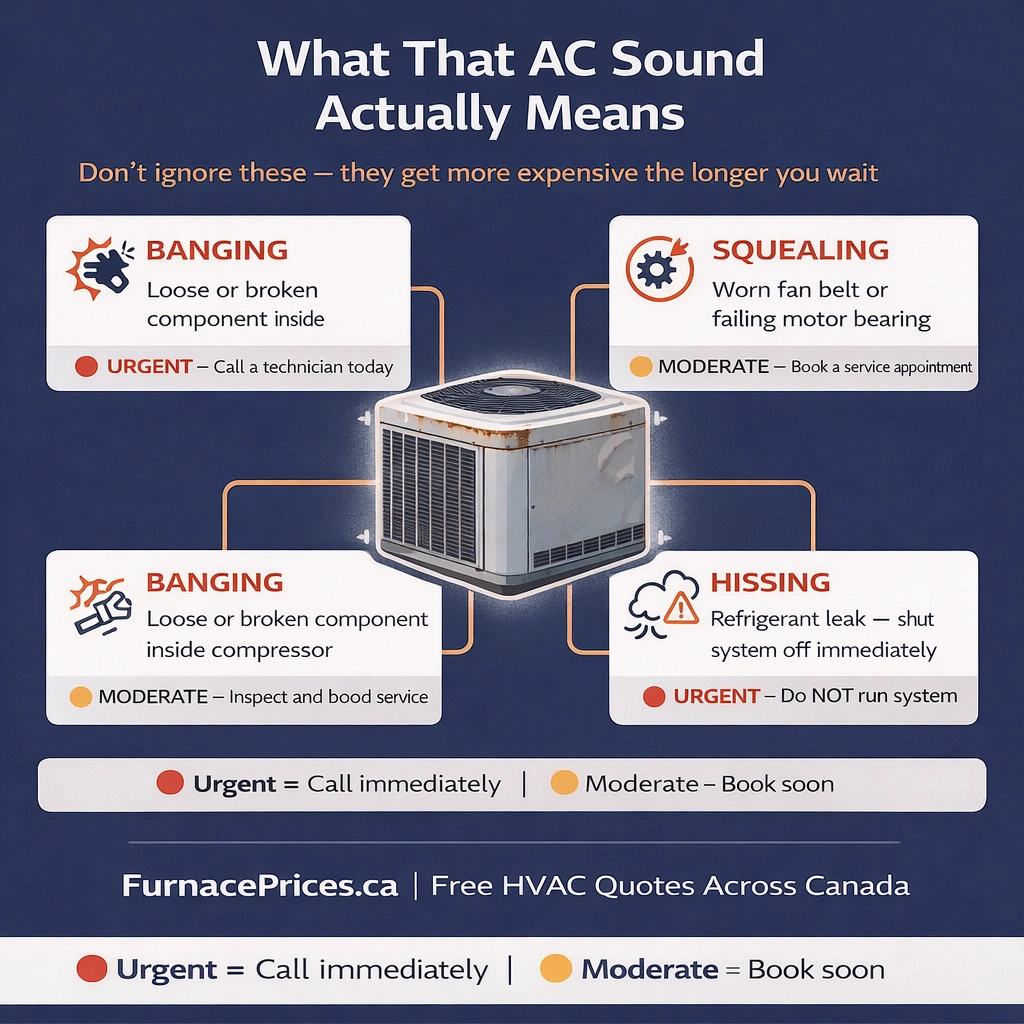
3. Unusual Noises — Banging, Rattling, Squealing, or Hissing
A healthy air conditioner hums. Consistently and quietly. Anything beyond that is a signal, not background noise:
Banging or clanking — a loose or broken component inside the compressor
Squealing — a worn fan belt or failing motor bearing
Rattling — loose panels, debris inside the unit, or a failing motor mount
⚠️ Strange AC noises are early-warning signals before a major failure. Every week you delay acting on them increases the likely repair cost — sometimes significantly. Catching them in spring means a manageable repair bill. Waiting until July means competing with every other homeowner who did the same thing.
4. Your Electricity Bills Climbed Last Summer
If your cooling costs crept up year-over-year — and you can’t explain it with increased usage or rate hikes — your AC is working harder than it should to deliver the same output. That extra effort usually traces back to dirty coils, low refrigerant, a struggling compressor, or duct leaks bleeding conditioned air into your attic or walls.
Use the AC Operating Cost Calculator to benchmark what your system should be costing to run. If real bills are consistently higher, there’s an efficiency problem worth diagnosing. And if the unit is aging, the Repair or Replace AC Quiz helps you decide whether ongoing repair costs still make financial sense.
5. Moisture, Water Pooling, or Ice on the Unit
Some condensation around your AC unit is expected. Pooling water, active leaks, or ice forming on refrigerant lines or the evaporator coil is not.
Ice on the coil almost always means restricted airflow or low refrigerant. Left alone, it leads to compressor damage — the most expensive single repair in an AC system. Water around the indoor air handler typically means a blocked condensate drain line. Caught early: a $100–$200 service call. Ignored: water damage to walls, flooring, and ceilings that can cost thousands.
6. Your Thermostat Isn’t Responding Correctly
If the AC runs continuously without reaching the set temperature, or if different rooms feel wildly inconsistent, the issue may be the thermostat rather than the AC unit itself.
DIY check first: Is the thermostat exposed to direct sunlight? Near a lamp or appliance that generates heat? Are the batteries fresh? Is it set to “Auto” rather than “Fan On”? If none of those explain the problem, the issue is likely deeper — and worth a technician’s assessment.
7. Uneven Cooling — Some Rooms Comfortable, Others Not
If your upstairs feels like a sauna while the main floor is comfortable, or certain rooms simply never cool down properly, your system isn’t distributing air efficiently. Common causes: duct leaks, incorrect system sizing, or a deteriorating blower motor.
Leaky ductwork is more common than most Canadian homeowners expect. According to Natural Resources Canada, poorly sealed ducts can reduce HVAC efficiency by up to 30% — meaning your system is burning fuel and electricity without actually cooling your home.
💡 Pro Tip: If uneven cooling is paired with higher bills and the system is 10+ years old, you’re likely looking at multiple compounding issues — not a single simple fix. Book a full system assessment, not just a quick service call.
8. Bad Smells When the AC Runs
Odours from a running AC unit are diagnostic information:
Musty or mildew smell — mold or bacteria in the evaporator coil or drain pan, which sit in a permanently damp environment ideal for microbial growth
Burning smell — an electrical fault: burnt wiring, a failing capacitor, or an overheating motor. This is urgent. Turn the system off and call a technician immediately.
Sweet or chemical smell (like chlorine) — a refrigerant leak. In Canada, refrigerant handling is regulated under the Federal Halocarbon Regulations — this is never a DIY repair.
9. The System Is 10+ Years Old — With New Problems Appearing
Age alone isn’t a reason to replace an AC. But age combined with new or recurring symptoms is meaningful. Canadian central air conditioners typically last 12–15 years with proper annual maintenance. Past that window, major component failures become increasingly likely — and financially harder to justify repairing.
The standard industry benchmark: if an AC repair costs more than 50% of the price of a new unit and the system is older than 10 years, replacement typically offers better long-term value. Use the AC Savings Calculator to estimate what a newer, higher-efficiency unit could save you annually. If you’re leaning toward replacement, the AC Cost Calculator gives you a realistic budget starting point.
10. It Performed Poorly at the End of Last Summer
This is the sign homeowners most often rationalize away. “It was just a hot year.” But if your system struggled through August — running constantly, failing to hit the set temperature, or shutting off unexpectedly — it’s going to start this season from a worse baseline, not a better one.
A system that “worked okay in spring, limped in July, and barely survived August” is one season away from a full breakdown. A spring inspection now costs a fraction of what an August emergency will.
⚠️ Mid-Check: How Many Signs Apply to Your AC?
🟢 1 sign → Schedule a seasonal inspection. Low urgency, but don’t skip it.
🟡 2–3 signs → Book an AC repair assessment with a certified HVAC technician soon. Something is wrong and compounding.
🔴 4+ signs → Act now. You’re likely heading toward a breakdown before summer ends. Connect with a local HVAC professional and get a proper diagnosis before peak booking season locks you out.
🔧 Free HVAC Quote — No Obligation
Get a Certified AC Technician to Diagnose Your System
Connect with vetted, licensed HVAC professionals across Canada. Free quotes, transparent pricing, and genuine expert advice — before summer demand makes appointments scarce.
If you’ve identified one or more signs from this article, here’s exactly what to do:
Step 1: Check the Basics Yourself
Replace the air filter. Check thermostat settings. Clear any visible debris from around the outdoor unit. These free steps rule out simple causes before spending money on a service call.
Step 2: Identify Your Symptoms Clearly
Which signs from the list above apply? How many? How long have they been present? Write this down — it helps your technician diagnose faster and quote more accurately, and can reduce diagnostic time billed to you.
Step 3: Use a Free Online Tool
Run the AC Troubleshooting Wizard to narrow down the likely issue. If you’re on the fence about repair vs. replacement, the Repair or Replace AC Quiz gives you a clear framework based on your system’s age, condition, and repair cost.
Step 4: Book a Diagnostic Inspection
Contact a certified HVAC contractor near you and request a pre-season AC inspection. Ask for a written diagnosis and quote before any work begins. Don’t authorize repairs without understanding what’s being fixed and why.
Step 5: Compare Quotes If Replacement Is on the Table
If the technician recommends replacement, get at least two quotes. Use the AC Cost Calculator and AC Savings Calculator to evaluate whether a new system makes financial sense for your home and budget.
💡 Pro Tip: The best time to compare quotes is spring — not mid-July when contractors are stretched thin and your negotiating position is zero.
Common Mistakes That Turn a Repair Into a Replacement
Waiting for a total breakdown. Emergency AC repair in Canada costs significantly more than scheduled service. Emergency HVAC calls carry premium rates, and your options narrow considerably when you’re sweating through a 35°C heat advisory.
Dismissing early symptoms. A faint hissing, one warm room, a slightly musty smell — these feel minor. They’re not. They’re early signals of compounding issues that cost more the longer they’re ignored.
Assuming one repair solves everything. A technician who patches a refrigerant leak on a 14-year-old system with a deteriorating coil is buying you one season, not five years. Ask directly: “Is this the only problem you’re seeing, or are there other signs of wear?”
Not using the repair-vs-replace math. The AC Recommendation Quiz factors in your system’s age, the cost of the repair, and your local climate — and gives you a data-based recommendation, not a gut feeling.
AC Repair Services Across Canada
Whether you’re in Ontario, British Columbia, Alberta, or Quebec, summer heat creates the same pressure on the same systems — and the same booking crunch.
Toronto & the GTA
High humidity accelerates coil corrosion and drain line blockages. Pre-summer inspections book up fast by late May. Scheduling in April puts you ahead of the rush.
Vancouver & the Lower Mainland
Milder winters mean AC systems often sit idle for 6–8 months. Seasonal startups that skip inspection frequently reveal refrigerant loss or electrical faults that developed over winter.
Calgary & Edmonton
Short but intense summers mean AC systems get pushed hard for 8–10 weeks straight. A system running at 90% capacity in May will often fail under that load by July.
Ottawa & Montreal
Humid continental summers are among the most demanding for central AC. High humidity loads accelerate drain pan fouling and evaporator coil mold — two issues that get worse quickly without a spring service.
When the Problem Is More Than Just the AC
Your central AC shares core components with your furnace — the blower motor, air handler, and ductwork all serve both systems. If you’re seeing symptoms on the cooling side, it’s worth asking whether there are connected issues on the heating side too.
If your furnace has been acting up, use the Furnace Troubleshooting Wizard to assess it independently. The Furnace Cost Calculator can give you a budget estimate if furnace replacement is becoming part of this conversation.
Conclusion: The Homeowners Who Stay Cool This Summer Are Acting Now
The warning signs your AC needs repair are almost always visible long before the unit fails completely. Weak airflow, short cycling, strange noises, rising energy bills, ice on the coil — these aren’t random quirks. They’re a system telling you it needs attention before summer demands everything it has.
Caught in spring, most of these issues are straightforward and affordable. Caught in August — during a heat advisory, with a three-week wait for a contractor — they become emergencies.
⚠️ Peak summer bookings fill fast. Most Canadian homeowners wait too long — and pay the price in emergency rates, rushed decisions, and preventable stress. Don’t be that homeowner.
Get your AC inspected now, make an informed decision about repair or replacement, and enter summer with a system you can count on.
🏆 Trusted by Canadian Homeowners
Ready to Protect Your Home Before Summer Hits?
Connect with a certified local HVAC professional through FurnacePrices.com — Canada’s trusted resource for honest quotes, expert advice, and vetted contractors. Free, fast, and no obligation.
🔒 100% Free · No obligation · Certified local contractors · Response within 24–48 hrs
100K+Homeowners Helped
15-ptContractor Vetting
FreeNo Obligation
Canada-WideCoverage
Frequently Asked Questions
Q: What are the most common signs an AC needs repair before summer?
Weak or warm airflow, short cycling, unusual noises, ice buildup, water leaks, and higher energy bills. If you notice multiple signs, schedule a professional inspection early.
Q: How much does AC repair cost in Canada?
Typically $150–$600 for minor issues and $1,200–$2,500+ for major repairs like compressor or coil replacement.
Q: When should I call an HVAC technician for AC repair?
Call immediately for refrigerant smells, burning odours, leaks, or no cooling. For minor issues, book a seasonal check before summer.
Q: How often should I have my AC serviced in Canada?
Once per year, ideally in spring, to maintain efficiency and prevent breakdowns.
Q: Is it better to repair or replace an aging AC in Canada?
If repair costs exceed 50% of a new unit and the system is over 10 years old, replacement is usually the better option.
Q: Can I run my AC if it’s making a hissing sound?
No. It likely indicates a refrigerant leak and should be handled by a licensed technician.
Q: What happens if I ignore AC problems until summer?
You risk system failure, higher repair costs, and long wait times during peak HVAC season.
 Canadian