Furnace installation cost is one of the most searched — and most misunderstood — figures in home heating. Whether you are in Ontario, Alberta, British Columbia, or anywhere across the northern United States, prices shift significantly from one quote to the next. Homeowners comparing bids are often left wondering whether a lower number reflects honest pricing or hidden corner-cutting.
This guide answers that question directly. It breaks down every real cost component — labour rates, permit fees, inspection costs, and realistic timelines — with regional figures, a type-by-type comparison, and a clear list of red flags that separate trustworthy contractors from risky ones. By the end, you will be equipped to evaluate any furnace installation quote with genuine confidence.
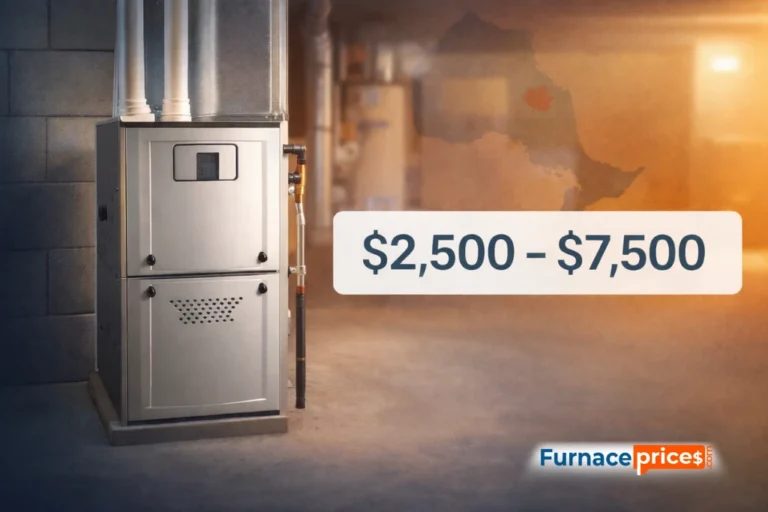
Before diving into the details, here is what a complete furnace installation typically costs across Canada and the northern U.S.:
Component
Typical Cost Range
Equipment (unit only)
$1,200 – $3,500
Labour
$800 – $2,000
Permits & Inspections
$75 – $400
Additional Materials
$150 – $600
Total (installed)
$2,800 – $6,500
High-efficiency gas furnaces — the most commonly installed type in Canada — typically land between $3,500 and $5,500 when professional installation is included.
These are real-world ranges based on current market conditions, not manufacturer estimates. Understanding what sits behind each line item is what allows you to compare quotes meaningfully rather than just choosing the lowest number.
Before approving any installation quote, compare line items using our free furnace quote comparison checklist. It takes five minutes and can save you from a costly mistake.
How Much Does Furnace Installation Cost? Labour Rates Explained
Labour is where most homeowners are left guessing — and where unscrupulous contractors hide their margins. A standard furnace swap typically takes 4 to 8 hours for a qualified HVAC technician. At trade rates of $85 to $150 per hour, legitimate labour costs fall between $800 and $1,200 for a straightforward installation.
More complex jobs — those involving new ductwork connections, gas line modifications, or upgraded venting for a high-efficiency condensing unit — can extend to 10 to 14 hours, pushing labour costs to $1,400 to $2,000.
What legitimately drives labour costs higher:
Switching from mid-efficiency to high-efficiency (requires new PVC condensate venting)
Relocating the furnace within the mechanical room or elsewhere in the home
Working in a tight, cramped, or low-clearance mechanical space
Upgrading the electrical supply connection for the new unit
Adding a smart thermostat or multi-zone control system
Extending or modifying an existing gas line
What should never drive labour costs higher is a vague line item such as “system complexity fee — $300” with no explanation. A professional contractor will itemize labour hours and task descriptions without hesitation. If they resist providing this, that reluctance is itself diagnostic.
Always request a written breakdown of: estimated hours, tasks included, and any contingency assumptions built into the quote.
Gas vs. Electric vs. Oil: Does Furnace Type Affect Labour Cost?
Yes — and the difference can be significant depending on your existing infrastructure.
Furnace Type
Labour Complexity
Typical Labour Cost
Gas (standard, 80% AFUE)
Moderate
$800 – $1,400
Gas (high-efficiency, 90%+ AFUE)
Moderate-High
$1,000 – $2,000
Electric
Low-Moderate
$600 – $1,200
Oil
High
$1,200 – $2,200
Gas furnaces are the most common in Canada and the northern U.S. and represent the majority of residential installations. Oil furnaces require additional handling of fuel lines and storage system considerations, which increases labour time. Electric furnaces avoid gas line work entirely but may require electrical panel upgrades, which adds a separate electrical labour cost.
Understanding AFUE ratings helps estimate long-term operating savings alongside installation cost. In our detailed [AFUE Ratings Explained: What the Numbers Mean for Your Heating Bill] guide, we break down how efficiency ratings translate into real dollar differences on your annual heating bill — useful context before you commit to a specific unit.
Gas Furnace Installation Cost: Permit & Inspection Requirements
Why Furnace Permits Are Mandatory
Permits are not optional. They are legal requirements.
Any work involving gas-fired heating equipment must comply with local building codes and be verified by a certified inspection authority. This applies across virtually every municipality in Canada and the United States. According to Natural Resources Canada’s residential heating equipment guidelines, permitted installation is a baseline requirement — not a premium add-on.
Furnace Permit Cost in Canada & the U.S.
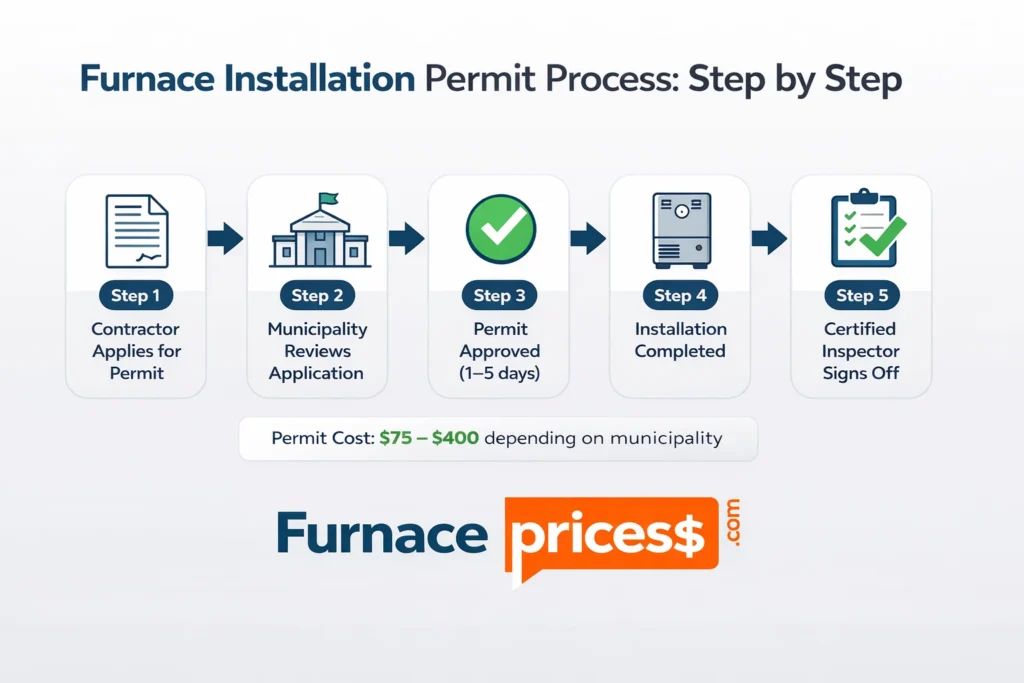
Permit fees vary by municipality but generally range from $75 to $300. In larger urban centres where both a gas permit and a separate electrical permit are required, total fees can reach $350 to $400.
What the post-installation inspection verifies:
Gas line connections are leak-free and meet code
Venting is correctly sized and properly exhausted to the exterior
The unit is appropriately rated for the home’s square footage
All safety controls, pressure switches, and shut-offs are fully functional
Carbon monoxide risks have been assessed and mitigated
A permit protects you — not your contractor. If a furnace is installed without one and a fire, gas leak, or carbon monoxide incident occurs, your home insurance policy may deny the claim entirely. This is not a hypothetical. It is a documented outcome that affects homeowners every year.
If you’re in Ontario, verify that your contractor holds a valid TSSA (Technical Standards and Safety Authority) gas technician licence before authorizing any work. Alberta contractors must be licensed through AGLC and ABSA regulations. Licensing requirements in the U.S. vary by state, so always check with your state contractor licensing board before signing any agreement.
Note on HST/GST: In Canada, furnace installation services are subject to applicable federal and provincial taxes. Ensure your quote specifies whether pricing is before or after tax, particularly when comparing bids from contractors operating across provincial lines.
For certified furnace products that qualify for efficiency rebates, the Energy Star Canada product database is the authoritative reference for eligible equipment by AFUE rating.
Furnace Installation Timeline: What to Expect
Understanding the installation timeline helps you plan appropriately and resist pressure to make a rushed decision.
Phase
Typical Timeframe
Quote review and equipment selection
1 – 3 business days
Equipment sourcing and delivery
2 – 7 business days
Permit application and approval
1 – 5 business days
Installation day (on-site work)
4 – 8 hours
Post-installation inspection
1 – 5 business days
Total: quote to operational heat
7 – 14 business days
Permit approval timelines vary significantly by municipality. Urban centres with high permit volume — such as Toronto, Calgary, or Vancouver — often have longer processing windows than smaller towns. Ask your contractor what the current local permit lead time looks like before finalizing your schedule.
Emergency or priority service is available from most HVAC companies and can compress this timeline, typically at a premium of $150 to $400.
If a contractor promises same-day installation and assures you permits will be “sorted out later,” treat that as an immediate disqualifier. In most regions, permits must be approved before gas work begins legally.
Red Flags in Cheap Furnace Installation Quotes
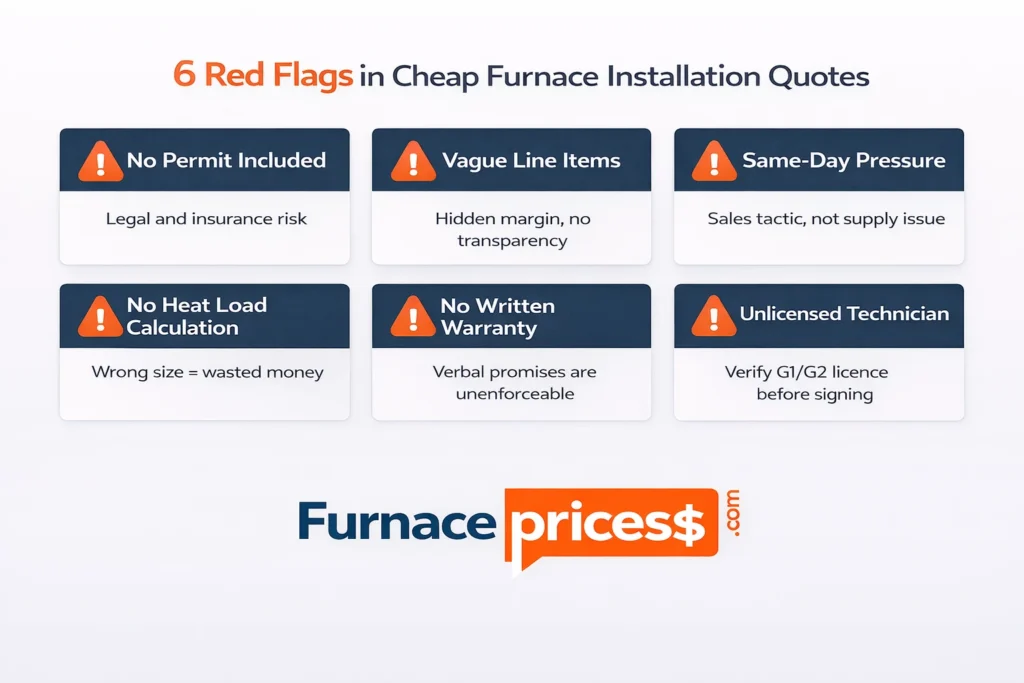
A low quote is not always a good quote. The following warning signs indicate that cost-cutting is occurring somewhere — and that somewhere typically becomes your problem later.
1. No Permit Included
Any quote that excludes permit costs — or discourages obtaining them — exposes you to legal and insurance liability. Permits are not negotiable. A contractor who treats them as optional is either unlicensed, inexperienced, or operating outside their certified scope. This is a non-starter.
2. Vague or Bundled Line Items
“Installation and labour: $950” with no further breakdown is not transparency. It is an opportunity to obscure margins you cannot see. A legitimate quote separates equipment, labour hours, materials, and permit fees as individual line items — full stop.
3. Same-Day Pressure Tactics
Reputable contractors do not pressure you to sign immediately. If a salesperson insists the price is valid “today only,” that is a sales tactic, not a supply constraint. Take your time. Collect a minimum of three quotes before making any decision.
4. No Heat Load Calculation or AFUE Discussion
Installing a furnace without calculating the correct size for your home leads to short-cycling, insufficient heat, premature equipment wear, and wasted energy costs for the life of the system.
A qualified contractor will ask about your home’s square footage, ceiling height, insulation level, and window area before recommending a unit. If they skip this step, the sizing is a guess — and you will live with that guess for 15 to 20 years.
For a detailed breakdown of how sizing affects long-term costs, read our guide: [How to Choose the Right Furnace for Your Home].
5. No Written Warranty Terms
Equipment manufacturers typically offer 5 to 10 years on heat exchangers and 1 to 2 years on parts. Contractor labour warranties should cover at minimum 1 year on the installation itself. If a quote omits warranty terms, ask specifically — and get them in writing. Verbal warranties are legally unenforceable.
6. Unlicensed or Unverified Technicians
In Canada, gas work must be performed by a licensed gas technician (G1 or G2 certified, depending on province). In the U.S., licensing requirements vary by state but are universally required for gas appliance work.
Before authorizing any installation, request the technician’s licence number and verify it with the relevant provincial or state authority. This takes five minutes and protects you from significant liability.
Average Furnace Installation Cost by Region
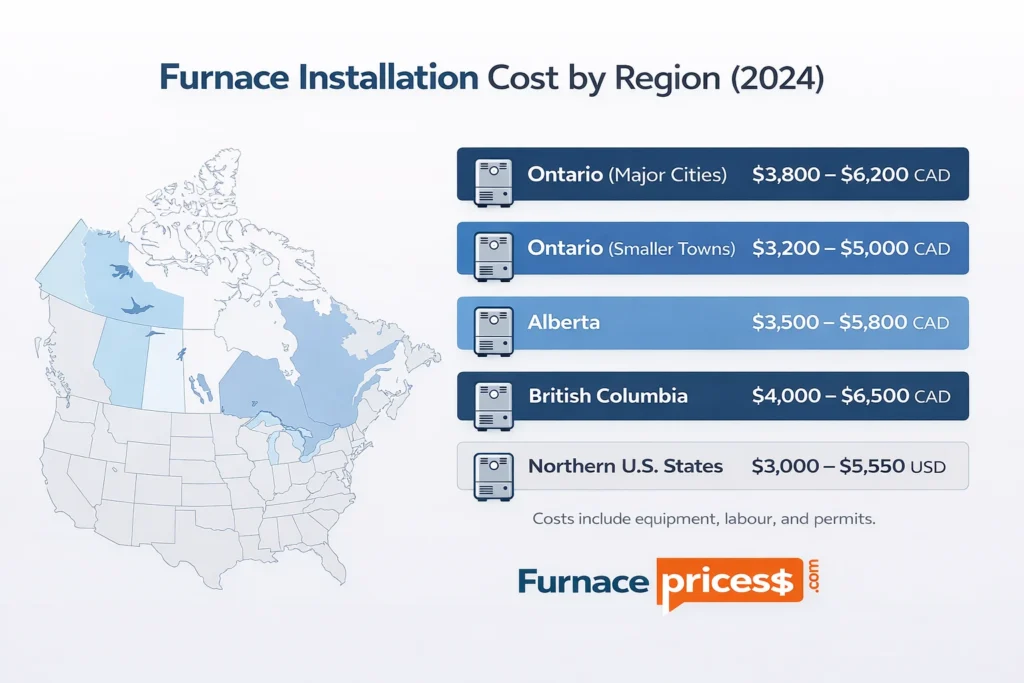
Regional variation is real and worth factoring in before gathering quotes. Labour rates, permit fees, and equipment pricing all shift based on geography.
Region
Estimated Total Installed Cost
Ontario (major cities)
$3,800 – $6,200 CAD
Ontario (smaller towns)
$3,200 – $5,000 CAD
Alberta
$3,500 – $5,800 CAD
British Columbia
$4,000 – $6,500 CAD
Northern U.S. states
$3,000 – $5,500 USD
These are general estimates based on current market conditions. Your actual cost will depend on your home’s specific situation, the contractor selected, and current equipment availability in your area.
If you are installing a furnace in Ontario, verify your contractor’s TSSA licence before signing anything. If you are in Alberta, the same step applies through ABSA. Homeowners in any Canadian province can cross-reference certified HVAC contractors through their provincial technical standards authority.
Homes in municipalities experiencing rapid suburban growth — common in the Greater Toronto Area, Metro Vancouver, and Calgary’s outer ring — may face longer permit processing timelines and tighter contractor availability, particularly between October and December when heating season demand peaks.
DIY vs. Professional Furnace Installation: The Real Answer
This comes up in nearly every homeowner cost conversation, so it deserves a direct answer.
Furnace installation is not a DIY project in Canada or most U.S. states.
Here is why:
Gas line connections legally require a licensed gas technician in all Canadian provinces
Work performed without a permit is not insurable and voids coverage
Improper venting is the leading cause of residential carbon monoxide incidents
Manufacturer warranties are void if installation is not performed by a certified professional
Resale disclosure requirements in most provinces and states require documentation of permitted HVAC work
The only legitimate DIY component of a furnace project is thermostat replacement on low-voltage systems — and even that carries risk if your wiring is older or non-standard.
The money saved on DIY labour is not worth the safety, legal, and insurance exposure. Hire licensed, verified professionals. It is not a recommendation — in most jurisdictions, it is a legal requirement.
Furnace Replacement Cost Amortization: The Long View
A furnace that costs $4,500 installed and lasts 18 years works out to roughly $250 per year in capital cost — before accounting for operating efficiency savings.
A high-efficiency furnace (90%+ AFUE) versus a standard unit (80% AFUE) can reduce annual heating costs by 15% to 30% in colder climates. In Ontario or Alberta, where annual heating costs can exceed $1,800 to $2,400 for a mid-sized home, that efficiency gap represents a real-dollar saving of $270 to $720 per year.
This means a high-efficiency unit that costs $400 to $600 more to install than a standard model will typically recover that premium within one to two heating seasons in a cold climate — and continue generating savings for the remaining lifespan of the unit.
Understanding this amortization logic is useful when evaluating quotes that feature significantly different equipment tiers. The cheapest installed price is not always the lowest long-term cost.
Financing & Rebates: Reducing Your Net Furnace Installation Cost
Many homeowners researching furnace installation cost are simultaneously evaluating financing options. This is a practical reality — and there are legitimate programs designed to help.
Canadian rebate programs currently available:
Canada Greener Homes Grant — up to $5,000 for qualifying high-efficiency heating upgrades, subject to a pre- and post-installation home energy audit
Provincial utility rebate programs — Enbridge, FortisBC, and other regional utilities offer rebates of $500 to $2,000 for qualifying furnace upgrades
Municipal green energy incentive programs — some municipalities offer additional property tax-linked incentives for efficiency upgrades
Key points on timing:
Many rebate programs have annual application deadlines, seasonal funding caps, or equipment eligibility changes that affect what qualifies
A pre-installation energy audit is required for most federal programs — this must be booked before the new equipment is installed, not after
0% financing options are available through most major HVAC contractors for qualified applicants, typically for terms of 12 to 36 months
Ask your contractor directly about current rebate eligibility before selecting equipment. Choosing a qualifying unit at the same price point as a non-qualifying one can reduce your net installation cost by $500 to $5,000 — a difference that significantly changes the true cost comparison between bids.
Frequently Asked Questions
Furnace Installation Cost Questions
Q: What is the average furnace installation cost for a mid-sized Canadian home?
For a 1,200–2,000 sq ft home, expect $3,500–$5,000 installed for a mid-to-high efficiency gas furnace. Homes needing ductwork, venting, or gas line upgrades will cost more.
Q: Is a permit required for furnace installation in Canada?
Yes. A permit and inspection are required in almost all municipalities. Skipping this can void warranties and create insurance or resale issues.
Q: How long does furnace installation take?
Installation takes 4–8 hours on-site. The full process, including permits, usually takes 7–14 business days. Emergency service may cost an extra $150–$400.
Q: Should I get multiple quotes?
Yes. Get at least three quotes to compare pricing, permits, and proper sizing. Avoid unusually low or inflated estimates.
Q: Does a high-efficiency furnace cost more to install?
Yes. Condensing models (90%+ AFUE) may add $150–$400 for venting. However, energy savings (15–30%) often recover the extra cost quickly.
Q: Are rebates available in Canada?
Yes. The Canada Greener Homes Grant offers up to $5,000, plus provincial rebates of $500–$2,000 depending on efficiency and eligibility.
Conclusion
Furnace installation cost is not a single number. It is a combination of equipment, skilled labour, legally required permits, regional market conditions, and realistic timelines — each of which varies based on your home, your location, and the contractor you choose.
The homeowners who get the best outcomes are those who understand what each line item represents, ask the right questions before signing anything, and treat suspiciously low quotes as a warning rather than a win. A properly permitted installation, performed by a licensed technician with documented credentials, protects your home, your warranty, your insurance coverage, and your family’s safety for the next 15 to 20 years.
Key takeaways:
Total installed cost ranges from $2,800 to $6,500 depending on equipment, region, and home complexity
Labour for a standard swap runs $800 to $1,200; complex installations reach $2,000
Permits are legally required and cost $75 to $400 — skipping them creates insurance and legal liability
Expect 7 to 14 business days from quote approval to inspection sign-off
Red flags include missing permits, vague line items, no sizing calculation, and same-day pressure tactics
Rebates and 0% financing can meaningfully reduce your net furnace installation cost
Ready to move forward? Explore our [HVAC Installation Services] page for licensed, permitted furnace installation, or read our related guide: [How to Choose the Right Furnace for Your Home] — both designed to help you make a fully informed decision before you commit.
For regional permit requirements and energy efficiency standards, visit Natural Resources Canada — the authoritative source on residential heating regulations and equipment guidelines in Canada. For certified efficient equipment listings, see the Energy Star Canada product database.
Connecting Homeowners with Trusted Furnace & AC Contractors Across Ontario
At FurnacePrices.com, we bridge the gap between homeowners and reliable, vetted HVAC contractors—whether you’re installing a new furnace, upgrading your air conditioner, or replacing your full home comfort system.
📌 When Are You Planning to Install a New Furnace or Air Conditioner?
Tell us your installation timeline, and we’ll match you with the most suitable HVAC professionals in your area:
🔥 Need an urgent installation? (Next 2–3 days) ⏳ Planning your upgrade in the coming weeks? 🤔 Still comparing brands, prices, or contractor quotes?
👉 Request personalized furnace or AC quotes based on your timeline and Ontario location.
📍 Ontario Cities We Commonly Serve
FurnacePrices.com helps homeowners across Ontario compare heating and cooling systems, estimate installation costs, and connect with trustworthy contractors.
Our network covers most major and mid-sized regions in Ontario, ensuring expert assistance whether you’re replacing an older furnace/AC or upgrading to a high-efficiency model.
👉 See the full list of Ontario service regions
🏆Trusted by Leading Canadian HVAC Associations
Many companies in our contractor network are active members of respected national and provincial HVAC organisations, such as: