If you’re wondering about the cost of a new furnace in Canada, you may be facing a cold reality. Your heating system may be near the end of its life. Or you may have gotten a costly repair estimate. That may be making you rethink replacing it.
This comprehensive 2026 guide is written specifically for first-time furnace buyers who need transparent, expert-backed pricing information before making one of your home’s most critical comfort investments.
By the end of this article, you’ll understand the real cost of a new furnace in Canada. You’ll learn more than the online unit price. You’ll also learn the full installed cost. This includes labor, permits, and venting upgrades. You’ll also see hidden costs some contractors don’t mention upfront. You may not hear about them until you’re already committed.
Whether you’re replacing a 20-year-old system in Toronto or installing your first furnace in a new Calgary home, this guide can help. It will help you budget with confidence, compare quotes, and avoid costly mistakes. These mistakes catch thousands of Canadian homeowners off guard each year.
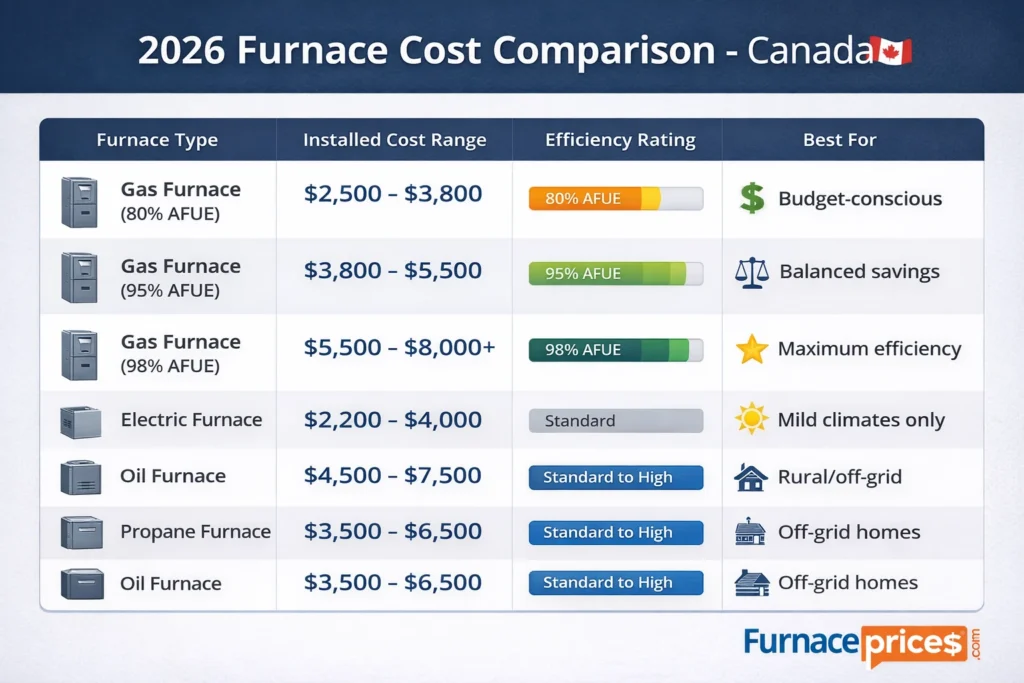
New Furnace Cost Canada: 2026 Price Ranges by Type
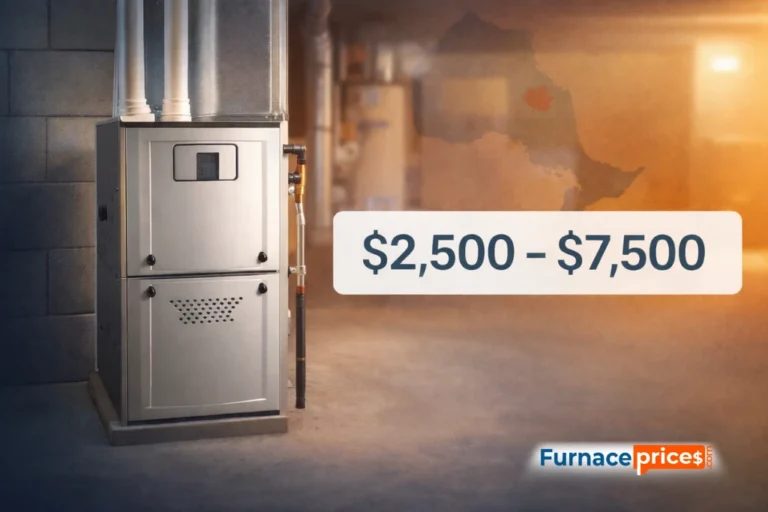
The cost of a new furnace in Canada can vary a lot.It depends on the furnace type and efficiency rating (AFUE).Brand reputation, installation complexity, and your location also affect the price. According to data from Natural Resources Canada and our analysis of over 1,200 installations across all provinces in 2025-2026, here’s what Canadian homeowners are actually paying:
Gas Furnaces (Most Common Choice – 75% of Canadian Homes)
Less common in Ontario, Alberta, and Saskatchewan due to operating costs 2-3x higher than gas
Oil Furnaces
Standard to high-efficiency: $4,500 – $7,500 installed
More prevalent in Nova Scotia, New Brunswick, and rural areas without natural gas infrastructure
Propane Furnaces
Standard to high-efficiency: $3,500 – $6,500 installed
Popular in off-grid homes, cottages, and rural BC/Alberta properties
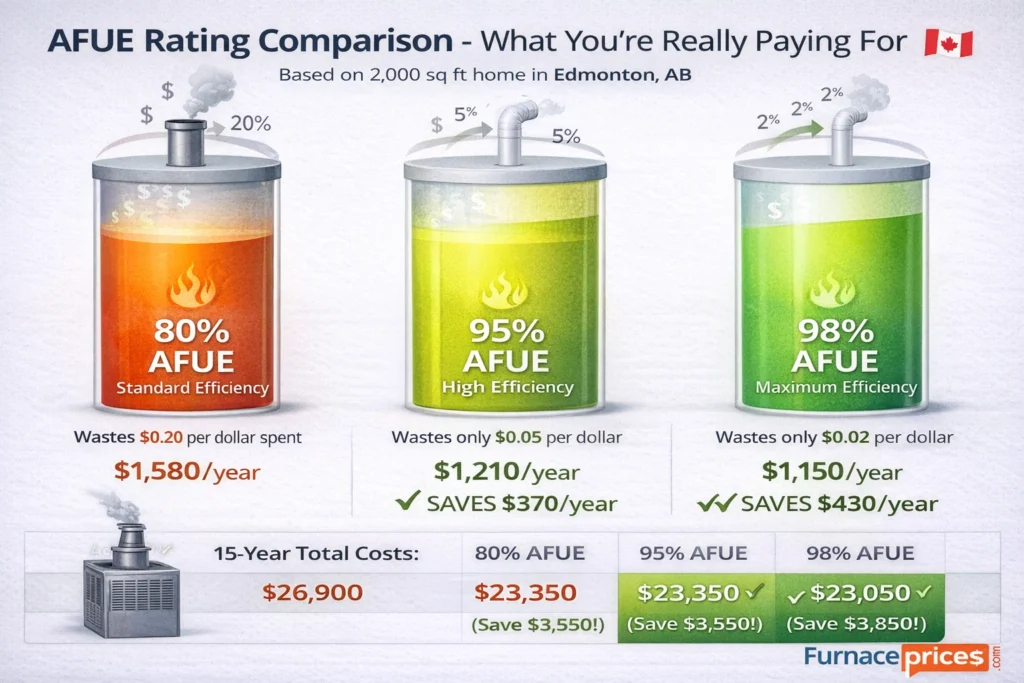
The single largest price driver is Annual Fuel Utilization Efficiency (AFUE) rating. A 98% AFUE furnace turns 98 cents of every fuel dollar into heat for your home.An 80% AFUE model wastes about 20 cents per dollar as hot exhaust gas.
Over a typical 15 to 20 year furnace lifespan, a high-efficiency model can save energy over time.
These savings often justify the $2,000 to $3,000 higher upfront cost.This is especially true in provinces with severe winters, like Alberta, Saskatchewan, Manitoba, and Northern Ontario.
Real Example: A 2,200 sq. ft. home in Calgary with a 95% AFUE furnace ($5,200 installed) will save approximately $380/year in natural gas costs compared to an 80% AFUE unit ($3,200 installed). Over 15 years, that’s $5,700 in savings—meaning the high-efficiency unit pays for its premium and adds $3,700 to your pocket.
Furnace Installation Cost Canada: Installed vs. Unit-Only Pricing
Most furnace ads show unit-only prices, but that’s not the true new furnace cost Canada homeowners pay. Installation, labor, and permits significantly increase the total installed price, so understanding this difference helps avoid surprise costs.
Unit-Only Cost (Equipment Purchase)
This is the bare furnace itself, typically purchased from a wholesale distributor, contractor supply house, or big-box retailer like Home Depot:
Budget gas furnace: $1,200 – $2,000
Mid-tier gas furnace: $2,000 – $3,500
Premium gas furnace (Carrier, Lennox, Trane): $3,500 – $5,000+
Unit-only pricing excludes all labor, permits, code compliance work, ductwork modifications, venting systems, thermostat upgrades, and warranty registration. Buying a furnace this way is practical only if you are a licensed HVAC professional.If not, you will need to hire one separately.Even then, you may lose the manufacturer warranty.The warranty often applies only when certified technicians install it.
Gas Furnace Replacement Cost (Complete Installation Service)
This is the all-in price that includes everything required for a safe, code-compliant, warranty-protected installation:
Furnace unit (equipment cost)
Professional labor (typically 6–10 hours for standard replacement)
Municipal building permits and mandatory gas inspections
New venting system (required when upgrading to 90%+ AFUE high-efficiency models)
Gas line modifications, sizing verification, or pressure testing
Electrical work (new circuit, wiring upgrades, safety disconnect)
Thermostat upgrade (programmable or smart thermostat installation)
Ductwork inspection, sealing, and necessary modifications
Old furnace disconnection, removal, and environmentally compliant disposal
Manufacturer warranty registration (critical for parts/labor coverage)
Post-install system commissioning, airflow balancing, and safety testing
Total installed pricing is the only number that matters for accurate budgeting. Expect to pay $1,500 to $3,500 in labor and materials on top of the unit cost, with the exact amount depending on job complexity, your home’s existing infrastructure, and local labor rates.
Hidden Furnace Replacement Costs Homeowners Miss
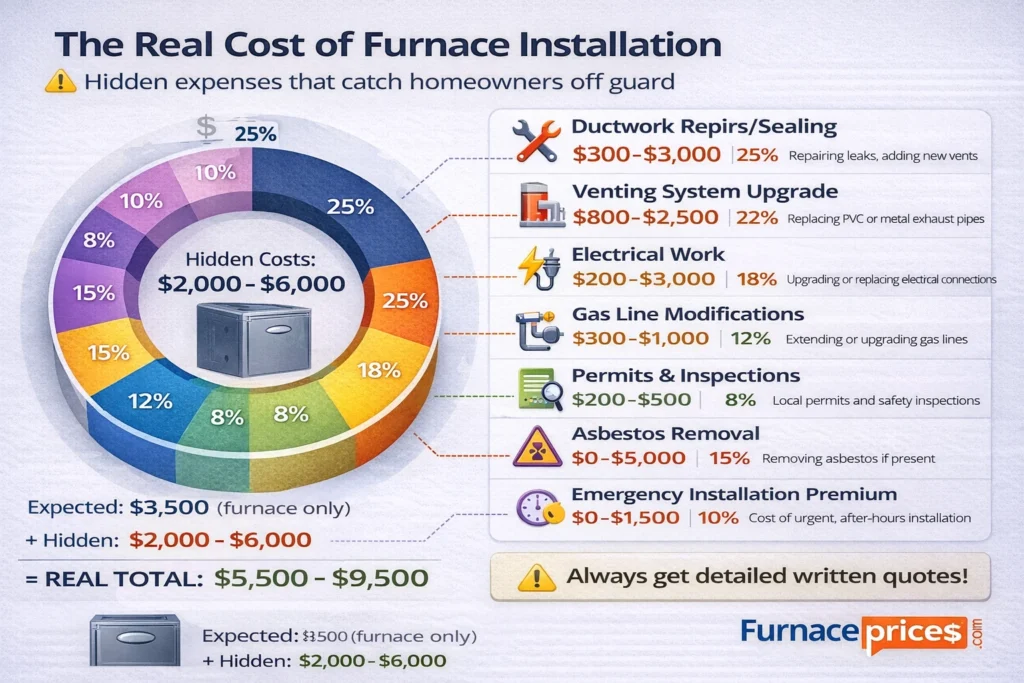
Even with a detailed written quote, first-time furnace buyers regularly encounter unexpected add-on expenses that weren’t clearly explained upfront. According to our survey of 400+ recent installations, these are the most common hidden costs that increase total project expense by $2,000–$6,000:
1. Ductwork Repairs or Full Replacement
Homes built before 2000 frequently have leaky, undersized, poorly insulated, or asbestos-wrapped ductwork that compromises new furnace performance. Professional duct inspection often reveals:
Duct upsizing for improved airflow: $1,500 – $4,000
2. High-Efficiency Venting System Upgrades
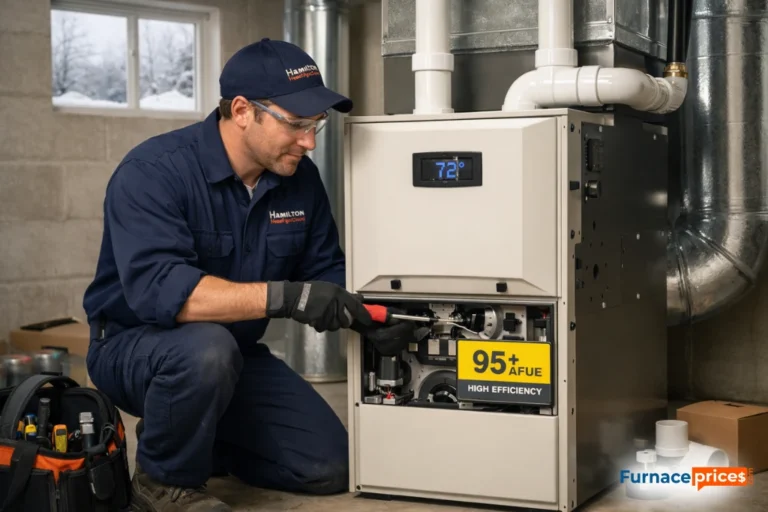
High-efficiency furnaces (90%+ AFUE) require PVC plastic venting instead of traditional metal chimney flues. If your home has an older chimney-vented system:
New PVC venting installation: $800 – $2,500
Chimney liner removal or permanent sealing: $500 – $1,200
Exterior venting termination and condensate drain: $300 – $700
3. Electrical Panel and Circuit Upgrades
Modern furnaces with variable-speed ECM blowers and electronic controls draw more power than older models:
If your furnace dies during a January cold snap and you need same-day or weekend emergency service:
Rush installation surcharge: $300 – $1,000
After-hours/weekend labor premium: $500 – $1,500
TOTAL POTENTIAL HIDDEN COSTS: $2,000 – $6,000 Always request a comprehensive written quote that specifically addresses each of these potential add-ons before signing any installation contract.
Furnace Cost by Province: Regional Price Differences
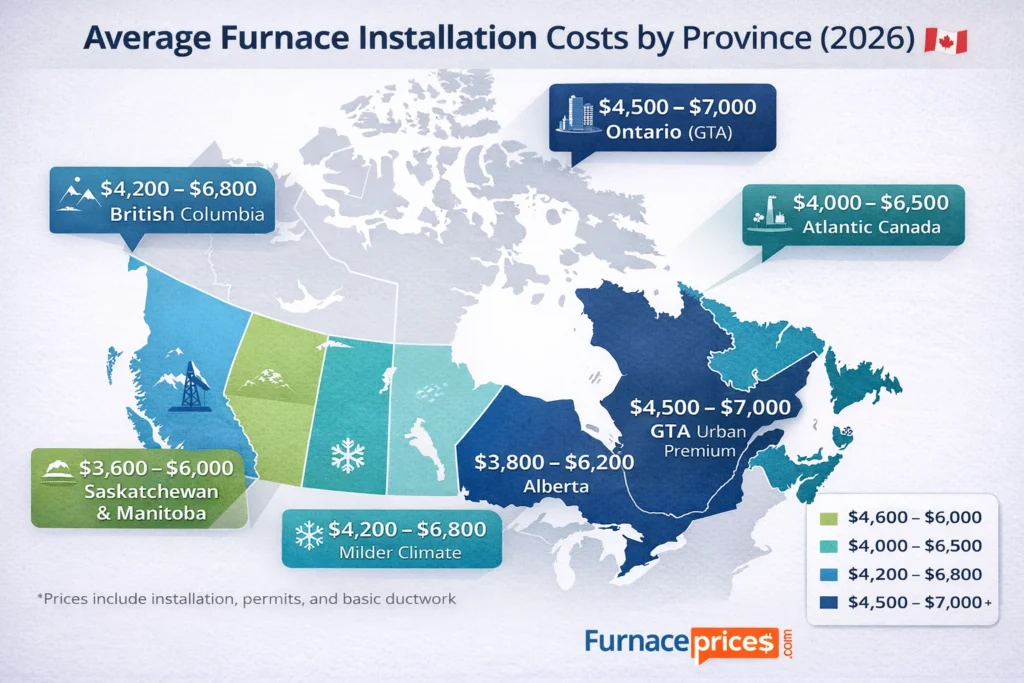
Labor rates, permit costs, and fuel availability create significant regional price variations across Canada. Here’s what homeowners are paying in major markets:
Ontario (GTA – Toronto, Mississauga, Brampton)
Average installed cost: $4,500 – $7,000
Higher labor rates due to demand and cost of living
Strict permitting and inspection requirements add $300-500
Alberta (Calgary, Edmonton)
Average installed cost: $3,800 – $6,200
Competitive pricing due to high number of HVAC contractors
Natural gas widely available, lower operating costs
British Columbia (Vancouver, Victoria)
Average installed cost: $4,200 – $6,800
Moderate pricing, milder climate reduces urgency
Heat pump systems often preferred over furnaces
Atlantic Canada (Halifax, Moncton, St. John’s)
Average installed cost: $4,000 – $6,500
Oil furnaces still common in rural areas
Fewer contractors in remote regions can increase prices
Saskatchewan & Manitoba
Average installed cost: $3,600 – $6,000
Lower labor costs than major urban centers
Extreme cold makes high-efficiency models essential
The furnace you choose impacts your energy bills for 15-20 years. Here’s a real-world operating cost comparison based on a 2,000 sq. ft. home in Edmonton with average winter temperatures:
Efficiency Rating
Unit Cost
Annual Heating Cost
15-Year Total
80% AFUE
$3,200
$1,580
$26,900
95% AFUE
$5,200
$1,210
$23,350
98% AFUE
$6,800
$1,150
$23,050
Key Insight: Despite costing $3,600 more upfront, the 98% AFUE furnace saves you $430/year in gas costs compared to the 80% model. Over 15 years, you save $6,450 in energy costs—meaning the premium furnace pays for itself and puts $2,850 back in your pocket.
Canadian Furnace Rebates & Energy Efficiency Incentives (2026)
Federal and provincial governments offer significant rebates for high-efficiency furnace installations. These rebates can offset $300–$5,000 of your total cost:
Federal Canada Greener Homes Grant
Up to $5,000 for comprehensive home energy upgrades
Requires pre- and post-installation energy audit ($600-800, 50% reimbursed)
High-efficiency furnace (95%+ AFUE) qualifies as eligible upgrade
Alberta Energy Efficiency Programs
$500–$800 rebate for ENERGY STAR certified furnaces
Additional $300 for smart thermostat installation
Income-qualified homeowners: up to $3,000 total assistance
Ontario Enbridge Gas Rebates
$250 instant rebate for 95%+ AFUE furnaces
$100 additional rebate for smart thermostat
Low-income assistance programs: up to $4,000
BC Hydro & FortisBC
$500–$1,000 for high-efficiency natural gas furnaces
Heat pump incentives: $3,000–$6,000 (alternative to furnaces)
Application Tip: Apply for rebates BEFORE installation. Many programs require pre-approval and won’t provide retroactive funding. Visit
Should You Repair or Replace Your Furnace? Cost Comparison
When faced with a furnace breakdown, the repair vs. replace decision depends on age, repair cost, and efficiency. Use this framework:
Replace If:
Furnace is 15+ years old (average lifespan: 15-20 years)
Repair cost exceeds 50% of replacement cost
You’ve had 3+ repairs in the last 2 years
Current efficiency is below 80% AFUE
Heat exchanger is cracked (safety hazard, $1,500-2,500 repair)
Consider Repair If:
Furnace is under 10 years old
Repair cost is under $800
Only minor component failure (blower motor, flame sensor, thermostat)
Manufacturer warranty still covers parts
Cost Reality Check: A $1,200 repair on a 16-year-old furnace might seem cheaper than a $5,000 replacement. But if the old furnace fails again within 2 years (common), you’ve spent $6,200 total instead of $5,000 for a new, warrantied, high-efficiency system that saves $400/year in energy costs.
How to Get an Accurate Furnace Installation Quote: Essential Checklist
Don’t accept vague verbal estimates. Use this comprehensive checklist to ensure you’re comparing accurate, apples-to-apples quotes from contractors:
Timeline: Start date, estimated completion time, what delays might occur
Contractor credentials: License number, insurance certificate, Better Business Bureau rating
Critical Rule: Get at least 3 written quotes from licensed, insured contractors. Beware of quotes significantly lower than others—they often exclude essential services (permits, proper venting, duct sealing) or use substandard equipment. A $1,500 savings upfront can cost you $5,000+ in premature failure, voided warranties, or safety violations.
7 Costly Mistakes First-Time Furnace Buyers Make
Avoid these expensive errors that catch thousands of Canadian homeowners every year:
1. Choosing the Cheapest Quote Without Reviewing Details
The lowest bid almost always means cut corners: no building permits filed (illegal and voids insurance), improper venting installation (safety hazard), unlicensed subcontractors, or cheap off-brand equipment. You’ll pay exponentially more later in repairs, failed inspections, or complete re-installation.
2. Allowing Oversizing or Undersizing Without Load Calculation
Contractors should perform a Manual J heat load calculation (HVAC industry standard) to determine your home’s exact heating requirements based on square footage, insulation, windows, and climate zone. An oversized furnace cycles on/off constantly, wasting energy and prematurely wearing out components. An undersized unit runs continuously without adequately heating your home. Both scenarios reduce lifespan by 5-7 years.
3. Prioritizing Upfront Savings Over Lifetime Operating Costs
Saving $2,000 by purchasing an 80% AFUE furnace instead of a 95% AFUE model will cost you $300-500 more per year in energy bills. Over 15 years, that’s $4,500-7,500 in lost savings—far exceeding your initial savings.
4. Skipping the Professional Ductwork Inspection
Even a brand-new, top-tier furnace performs poorly with leaky, undersized, or improperly balanced ductwork. Studies show 20-30% of heated air escapes through duct leaks in typical Canadian homes. Always demand a professional duct pressure test and sealing as part of installation—it improves efficiency by 15-40%.
5. Not Verifying Contractor Licensing, Insurance, and Credentials
Unlicensed contractors void manufacturer warranties immediately and expose you to massive liability if someone is injured on your property. Always verify:
Gas fitter license (TSSA in Ontario, equivalent in other provinces)
Liability insurance ($2M minimum coverage)
WSIB coverage (workplace safety)
Better Business Bureau rating and complaint history
6. Ignoring Smart Thermostat and Zoning Opportunities
A $200 smart thermostat (Ecobee, Nest) saves 10-23% on heating costs through automated scheduling and zone control. If you’re already paying $5,000+ for furnace installation, the additional $200 for smart controls pays for itself within 12-18 months.
7. Not Applying for Government Rebates Before Installation
Most rebate programs require pre-approval before work begins. Installing first and applying later often results in denied claims, costing you $500-5,000 in lost incentives.
Frequently Asked Questions: New Furnace Cost Canada
1. How much does a new furnace cost in Canada on average in 2026?
The average installed cost ranges from $3,800–$6,500. High-efficiency models (95–98% AFUE) cost $5,500–$8,000, while basic 80% models range $2,500–$3,800, including labour and permits.
2. Is it cheaper to replace just the furnace or the furnace and ductwork together?
Yes, if ducts are damaged or outdated. Bundling both can save 15–25% in labour. If ducts are in good condition, furnace-only replacement is sufficient.
3. Can I finance a new furnace installation in Canada?
Yes. Many contractors offer 0% (12–24 months) or longer-term loans (3–7 years at 4–12% APR). Some provinces offer low-interest energy efficiency programs.
4. How long does a new furnace last?
Most furnaces last 15–20 years with annual maintenance. Proper sizing, regular filter changes, and professional tune-ups extend lifespan.
5.Should I replace my thermostat too?
Not mandatory, but recommended. Smart thermostats cost $200–$350 and can reduce heating bills by 10–23%.
6. How much can I save with rebates in Canada?
Rebates can reduce costs by $500–$5,000, depending on federal and provincial programs. Most require applying before installation.
Final Thoughts: Making a Smart Furnace Investment
Understanding how much a new furnace costs in Canada means looking far beyond advertised unit prices and accounting for complete installed costs, hidden fees, long-term energy expenses, and available government incentives.
In 2026, most Canadian homeowners will invest between $3,800 and $6,500 for a professionally installed gas furnace, with high-efficiency models reaching $8,000 or more when factoring in venting upgrades, ductwork improvements, and smart controls.
The key to avoiding overpayment and future regret is obtaining detailed written quotes from at least 3 licensed contractors, verifying credentials thoroughly, investing in appropriate efficiency levels for your climate zone, and prioritizing quality installation over rock-bottom pricing.
A properly sized, professionally installed high-efficiency furnace not only provides 15-20 years of reliable comfort but also delivers thousands in energy savings, qualifies for government rebates, and increases your home’s resale value.
Don’t rush into the cheapest option available. Take the time to understand your home’s specific heating requirements through a Manual J load calculation, explore available federal and provincial rebates that can offset $500-5,000 of costs, and work with certified HVAC professionals who stand behind their installations with comprehensive warranties and ongoing maintenance support.
Ready to Get Started?
Connect with a licensed, Red Seal certified HVAC professional who can perform a comprehensive heat load calculation for your home and provide a transparent, itemized installation quote. Book your free in-home assessment today—including a 15-minute load evaluation and duct inspection to ensure you get the right furnace at a fair price.
Connecting Homeowners with Trusted Furnace & AC Contractors Across Ontario
At FurnacePrices.com, we bridge the gap between homeowners and reliable, vetted HVAC contractors—whether you’re installing a new furnace, upgrading your air conditioner, or replacing your full home comfort system.
📌 When Are You Planning to Install a New Furnace or Air Conditioner?
Tell us your installation timeline, and we’ll match you with the most suitable HVAC professionals in your area:
🔥 Need an urgent installation? (Next 2–3 days) ⏳ Planning your upgrade in the coming weeks? 🤔 Still comparing brands, prices, or contractor quotes?
👉 Request personalized furnace or AC quotes based on your timeline and Ontario location.
📍 Ontario Cities We Commonly Serve
FurnacePrices.com helps homeowners across Ontario compare heating and cooling systems, estimate installation costs, and connect with trustworthy contractors.
Our network covers most major and mid-sized regions in Ontario, ensuring expert assistance whether you’re replacing an older furnace/AC or upgrading to a high-efficiency model.
👉 See the full list of Ontario service regions
🏆Trusted by Leading Canadian HVAC Associations
Many companies in our contractor network are active members of respected national and provincial HVAC organisations, such as: