Fill out the form below to apply and get featured as one of our Top Contractors. Gain visibility, attract more clients, and showcase your expertise to a wider audience!
🔒 Your information is private and secure
Free to apply
Verified contractors only
Canada-wide visibility
No hidden charges
Free Service
No obligation
Get Your FREE HVAC Quote Today
Compare prices from top-rated local contractors in minutes
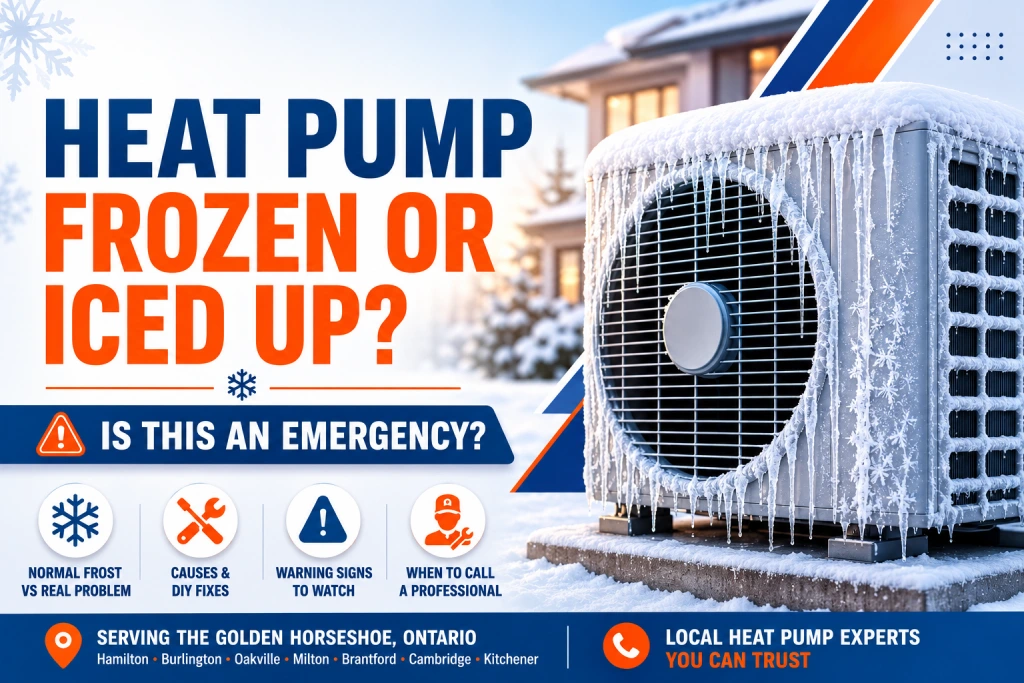
If your heat pump is frozen or iced over right now, take a breath first: most of the time this is normal winter behaviour, not a breakdown. Your outdoor unit is designed to build a light layer of frost in cold, humid weather and clear it automatically every 30 to 90 minutes through a built-in defrost cycle. This guide walks you through how to tell normal frost from a real fault, what’s causing the ice if it isn’t clearing, what you should never do to a frozen unit, and exactly when to stop troubleshooting and call an HVAC technician.
By the FurnacePrices.com Editorial Team•✔ Reviewed by a licensed HVAC technician•Updated: August 2026
This is written for homeowners, not technicians, so we’ll skip the jargon. In our experience servicing systems across Hamilton, Burlington, Oakville, Milton, Brantford, Cambridge, and Kitchener, roughly one in three “frozen heat pump” calls in a Golden Horseshoe winter turns out to be a thick but perfectly normal frost layer after a wet snowfall. The rest trace back to one of five mechanical causes covered below.
Is Your Heat Pump Frozen? Start Here
Before you touch the unit, run this quick safety check. Most iced-up heat pumps are a simple wait-it-out situation, but a small number point to something that needs a technician right away.
⚠️ Stop and call for help if: you hear a hissing or gurgling sound near the outdoor unit, notice a sweet or chemical odor (possible refrigerant leak), see ice covering the electrical disconnect box or wiring, or have large icicles hanging that could fall. Switch the system off at the thermostat and don’t touch the unit until a technician has looked at it.
If none of those apply, it’s safe to keep reading and work through the checklist below. The flowchart gives you the same decision path our technicians walk through on a service call.
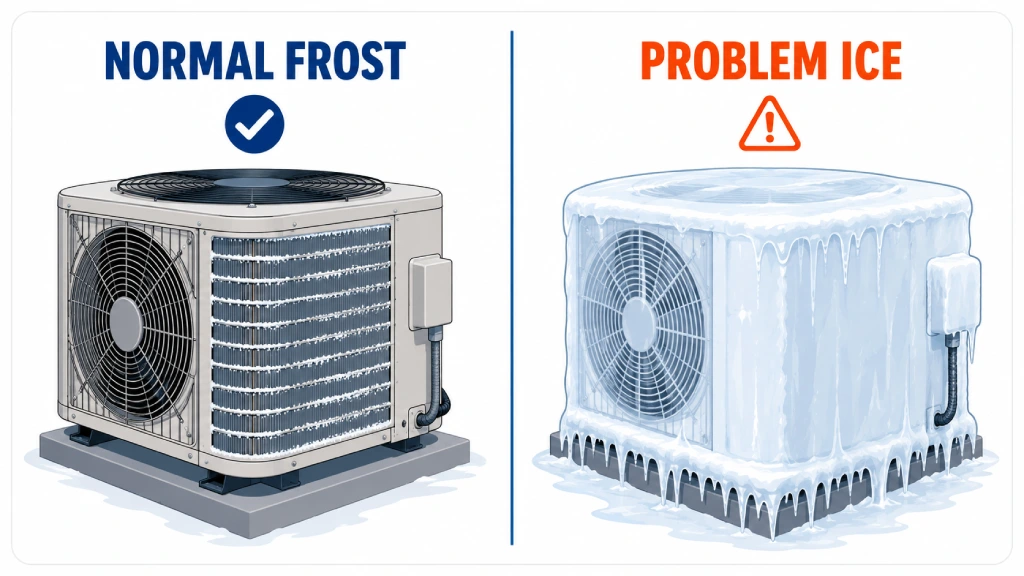
Every air-source heat pump pulls heat out of cold outdoor air, which chills the outdoor coil below the surrounding air temperature. Moisture condenses on the coil and, in freezing conditions, turns to frost. That part is expected. What separates normal operation from a fault is thickness, coverage, and whether the defrost cycle actually clears it.
Signal
Normal Frost
Real Icing Problem
Coverage
Thin, patchy layer on the coil fins
Solid sheet covering the whole unit
Thickness
Under roughly 6 mm (a quarter inch)
Fins and fan blades aren’t visible
Defrost behaviour
Clears within 30 to 90 minutes
Returns in minutes, or never clears
Heating performance
Home stays warm through the cycle
Airflow feels cool, system stops heating
Sound
Normal fan hum, brief whoosh in defrost
Hissing, clicking, or grinding
According to Natural Resources Canada, a heat pump’s defrost cycle is triggered either by a timer set to run every 30, 60, or 90 minutes, or by a sensor that reads coil temperature and starts the cycle only once frost is detected. Natural Resources Canada notes this timing varies by climate and system design. If your unit hasn’t visibly defrosted in over 90 minutes and the ice keeps thickening, that’s your cue to move from “normal” to “problem.”
💡 Golden Horseshoe Insight: homes near Lake Ontario and Lake Erie see sharper humidity swings than drier inland climates, so coils in Hamilton, Burlington, and Oakville often carry heavier frost after a lake-effect squall than the same model would inland. A thicker-than-usual layer right after one of these systems passes through isn’t automatically a defect; give the defrost cycle a chance to catch up first.
Why Heat Pumps Freeze More Often in Ontario Weather
A heat pump frozen after a snowstorm isn’t the same situation as one iced over during a dry cold snap, and Ontario’s weather patterns make certain types of icing more common than they’d be elsewhere in Canada. Three conditions do most of the damage:
Freezing rain coats the outdoor coil in a solid glaze before the defrost cycle even gets a chance to run, which is why a heat pump can look frozen solid within an hour of a freezing rain warning.
Lake-effect snow squalls off Lake Ontario and Lake Erie combine heavy, wet snowfall with high humidity, the two ingredients that build ice fastest on a coil.
Rapid temperature swings, common in the Golden Horseshoe in November and March, can catch a defrost sensor off guard if it’s calibrated for a steadier cold.
Wind adds a secondary effect: a stiff breeze strips heat off the coil faster, which can make a borderline defrost cycle fall behind. None of this means your heat pump is failing. It means Ontario’s specific mix of humidity and lake-driven weather asks more of the defrost cycle than a drier climate would, which is also why cold-climate-rated heat pumps hold up better here than standard models. Our essential heating tips for Canadian winters guide covers broader cold-weather prep if you want the full picture beyond just icing.
Regardless of brand, this pattern and the troubleshooting steps in this guide apply the same way. Lennox, Carrier, Trane, Mitsubishi, Goodman, and every other major manufacturer builds a defrost cycle around the same core logic, so the difference is in parts and pricing, not in how you diagnose the problem. Lennox’s own guidance on frozen heat pumps confirms the same normal-frost-versus-real-problem distinction covered above.
What Causes a Heat Pump to Ice Up?
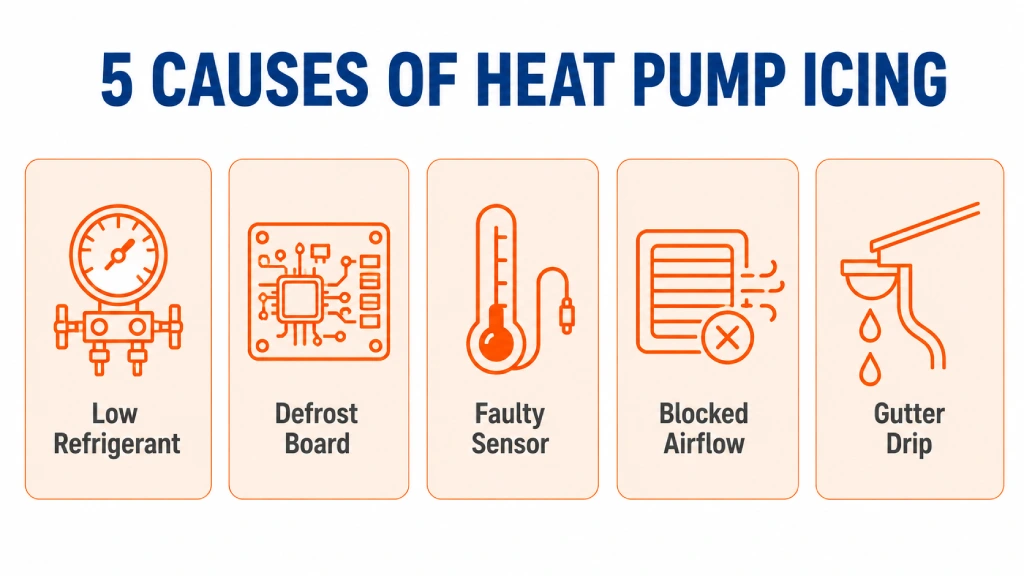
When a heat pump won’t clear ice on its own, the cause almost always traces to one of five things. If your unit has stopped responding altogether rather than just icing over, our heat pump not working guide covers the broader checklist; this section focuses on what specifically triggers excess icing.
1. Low Refrigerant Charge
A slow leak drops coil pressure, chilling it further than the design allows and freezing moisture faster than the defrost cycle can keep up. This is a licensed-technician-only fix: federal ozone-layer rules and provincial halocarbon regulations restrict who can legally purchase, recover, or top up refrigerant. Environment and Climate Change Canada outlines these rules by province. Suspect a leak if icing pairs with weak heating and hissing at the lines.
2. Failed Defrost Control Board
The defrost board decides when to trigger a defrost cycle. When it fails, the cycle never starts or never ends properly, so ice builds evenly instead of in the light, patchy way normal frost does. It’s one of the more affordable outdoor-unit repairs, typically CAD $250 to $650 for parts and labour.
3. Faulty Defrost Sensor or Thermostat
Even with a healthy board, a corroded or misreading coil-temperature sensor can tell the system the coil is warmer than it is, so defrost never triggers. It’s easy to confuse with a board failure, which is why technicians test both together rather than swapping parts on a guess.
4. Blocked Airflow
Snow drifts, fallen leaves, a dirty return-air filter, or a coil caked in dust all force the refrigerant colder than it should run, accelerating frost. This is the one cause a homeowner can usually confirm and fix without a technician; see the safe steps below.
5. Gutter or Downspout Dripping Onto the Unit
If your outdoor unit sits under an eave, dripping meltwater can refreeze on the coil and base pan, building an ice dam that has nothing to do with the refrigeration cycle. It’s easy to overlook because it mimics a mechanical fault, so look up before you look at the unit itself.
🔍 Free Troubleshooting Tool
Which of These 5 Causes Matches Your Heat Pump?
Answer a few quick questions about what you’re seeing and hearing, and get the most likely cause plus your next step, instantly.
🔍
Heat Pump Troubleshooting Wizard
Answer 5 quick questions about your heat pump symptoms and get a likely diagnosis with recommended next steps.
Step 1 of 520%
What is the main issue you're experiencing with your heat pump?
When does the problem mainly occur?
What sound do you hear from your heat pump?
What's happening with your indoor temperatures?
When was your last professional maintenance?
Would you like a free no-obligation estimate from our local contractor partners?
Great! Almost done, your result is on the next page.
Please enter your contact details so our certified contractors can provide estimates.
This field is required.
Please enter a valid email address.
Please enter your phone number.
Please enter your city or postal code.
By submitting this form, you are giving your consent to receive phone calls and text messages from our contractor partners.
You're almost done!
Please provide your details to see your results.
Name is required.
Email is required.
Please enter your city or postal code.
🔍 DIAGNOSIS READY
—
—
—
Recommended Next Steps
—
⚠️ Urgency Level: —
Note: This diagnosis is based on common symptom patterns and is for informational purposes only. A certified HVAC technician should inspect your system for an accurate diagnosis.
Get a Professional Diagnosis
Connect with certified local contractors who can diagnose and fix your heat pump — for free quotes.
⚠️ Never chip, pick, or hack at the ice with a screwdriver or chisel. The coil fins are thin aluminum and puncture easily, and a punctured coil means a refrigerant leak on top of the ice you started with.
Don't pour boiling water on the unit. Thermal shock can crack coils, and runoff often refreezes at the base into a drainage-blocking ice dam.
Don't cover the unit while it's still running. Airflow gets restricted, which can make icing worse within minutes.
Don't keep cycling "Heat" if ice isn't clearing. Forcing a frozen unit to keep running strains the compressor, your most expensive part.
Don't assume it's fine because the house still feels warm. A heat pump iced over but still running on backup heat can mask a unit that's doing nothing useful at all.
Safe Steps to Try Before Calling a Pro
If the ice is moderate rather than a solid block, and the system still responds to the thermostat, these steps are safe to try.
Switch to "Off," then "Fan Only" or "Emergency Heat" if available, so the unit can thaw without fighting itself while backup elements keep the house warm.
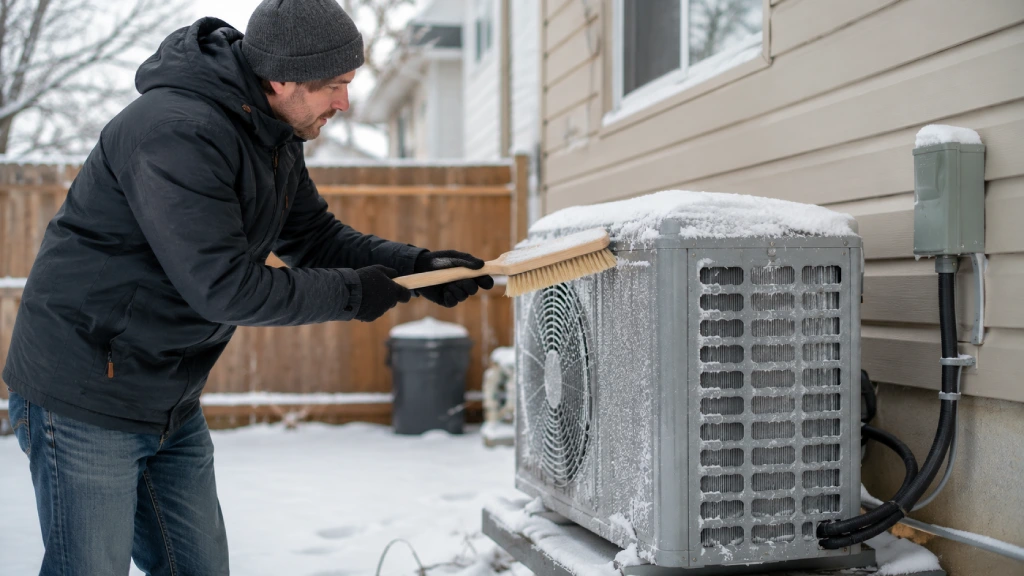
Clear snow and debris by hand or soft broom, leaving at least 30 cm of clearance on all sides.
Check your furnace or air handler filter and replace it if it's grey or clogged, a five-minute fix.
Let it thaw naturally, or rinse with lukewarm hose water. Natural thawing takes two to four hours above freezing.
Look overhead for a dripping gutter and redirect or repair it so the ice doesn't reform tonight.
Restart on "Heat" once the coil is clear. If ice returns within an hour or two, stop troubleshooting and book a technician.
💡 Pro Insight: think of it like a car's rear window defroster. Fog clearing over a few minutes is normal, but a window that stays frosted no matter how long the defroster runs means something has failed. The same logic applies to your outdoor coil.
🔧 Free Decision Tools
Ice Not Clearing? Get a Real Diagnosis
Our free troubleshooting wizard helps you narrow down the cause in under a minute, or connect directly with a licensed technician near you.
Free tools · No obligation · Built for Ontario homeowners
When to Call an HVAC Pro
Call the same day if the ice is a solid block, reforms within an hour or two of clearing, your home isn't heating even with backup heat, you hear hissing or clicking, or the coil ices even in mild, dry weather. Any of these point to a defrost board, sensor, or refrigerant issue outside safe DIY territory.
For budgeting, most icing-related repairs in Ontario fall into a fairly predictable range:
Likely Repair
Typical Cost (CAD)
Defrost control board replacement
$250 – $650
Defrost sensor or thermostat replacement
$150 – $400
Airflow clearing / filter replacement (DIY)
$0 – $50
Refrigerant leak diagnosis and recharge
$300 – $1,200+
Gutter or drainage correction
$100 – $400
Ranges reflect typical Ontario service quotes (CAD) as of 2026 and vary by region, brand, and labour rates. Always confirm with a local estimate.
If your system is over 10 to 12 years old and keeps icing despite repairs, weigh repair against replacement rather than sinking money into an aging unit. Our heat pump buying guide for Canadian homeowners covers what a newer, cold-climate-rated system costs, and heat pumps in Canada looks at why more homes across the province are switching.
💰 Free Repair-or-Replace Quiz
Is Repairing Your Heat Pump Worth It?
Weighing another repair against replacing an older unit? Answer a few quick questions about age, repair history, and cost to get a clear recommendation.
🏠
Is a Heat Pump Worth It? Quiz
Answer 5 quick questions and find out if switching to a heat pump makes sense for your home, climate, and lifestyle.
Step 1 of 520%
How do you primarily heat your home currently?
Do you have ductwork and heating vents in your home?
Central duct systems allow for a ducted heat pump. Without ducts, a ductless mini-split is still an option but at higher cost.
Which region do you live in?
Heat pumps perform best in moderate climates. Cold-climate models now work well even in very cold regions.
How well insulated is your home?
How long are you planning on staying in your home?
A heat pump is a long-term investment. Longer stays mean better return on investment.
Would you like a free no-obligation estimate from local contractor partners?
Great! Almost done, your result is on the next page.
Please enter your contact details so our certified contractors can provide estimates.
This field is required.
Please enter a valid email address.
Please enter your phone number.
Please enter your city or postal code.
By submitting this form, you are giving your consent to receive phone calls and text messages from our contractor partners.
You're almost done!
Please provide your details to see your results.
Name is required.
Email is required.
Please enter your city or postal code.
🏠 RESULTS READY
—
—
—
Your Score
—
Max Possible
10 pts
Heating System
—
Region Suitability
—
Key factors from your answers
—
Note: This quiz provides a general recommendation. A certified HVAC contractor can assess your specific home and provide a tailored recommendation.
Get a Free Quote from Local Pros
Find out exactly how much a heat pump would cost for your home — for free.
Most icing problems are preventable with a small amount of routine care. These habits catch most problems before they leave you troubleshooting in the cold.
Change the filter every 1 to 3 months, depending on your household and filter type.
Book an annual fall tune-up before the heating season starts, so a technician can catch a weak defrost sensor before it fails outright.
Keep at least 30 cm of clearance around the outdoor unit, including underneath it after heavy snow.
Check your gutters each fall to make sure nothing drains directly onto the outdoor unit.
If you're weighing whether a heat pump still makes sense for a home that ices up every winter, our heat pump vs. furnace comparison breaks down how each system handles Ontario's coldest months.
Other Common Heat Pump Icing Situations
If your situation is a little different from a standard winter icing call, one of these related scenarios might match what you're seeing.
If the unit won't respond to the thermostat at all and is fully iced over, don't force it. Switch it off, let it thaw completely, then check the basics in our heat pump not working guide before restarting.
Ice on the Indoor Coil Instead of the Outdoor Unit
Frost on the indoor coil usually points to restricted airflow, most often a dirty filter or a partially closed vent, rather than a defrost cycle problem. Shut the system off and let it thaw before restarting with a clean filter.
Ductless Mini-Split Frozen
Wall-mounted ductless units ice up for the same core reasons as central systems, but their smaller outdoor condensers are more sensitive to snow drifts and low clearance. Check that the outdoor unit is mounted high enough to stay clear of snowbanks.
Heat Pump Icing Up Every Few Days
Occasional icing after a storm is normal. If you're asking "why does my heat pump keep freezing" after the third or fourth time in a couple of weeks, that pattern usually means the defrost board or sensor is degrading rather than failing outright, and it's worth a diagnostic before it strands you on the coldest night of the season.
Heat Pump Frozen in Mild, Above-Freezing Weather
Ice forming when it isn't cold enough for frost to make sense is one of the clearer signs of a mechanical fault, usually low refrigerant or a stuck reversing valve, rather than normal weather-driven frost. This one is a call-a-technician situation, not a DIY fix.
The Bottom Line
A frosted heat pump is normal winter behaviour; a solid, unmelting block of ice is your system telling you something specific has failed. Walk through the frost-versus-ice check, clear obvious airflow blockers, and give the defrost cycle a fair chance before assuming the worst. If ice keeps returning despite doing everything right, that's no longer a DIY problem, and a same-day diagnostic costs far less than a compressor strained through a winter of fighting solid ice.
🚀 Still Icing Up?
Get a Free Quote From Trusted Local HVAC Pros
Whether it's a quick defrost-board fix or a full system replacement, compare options with transparent pricing and no obligation. We connect you with licensed, background-checked contractors across the Golden Horseshoe.
Usually not. Light frost is normal and clears within 90 minutes. It becomes urgent only if the ice is solid, keeps returning, or your home stops heating.
How long should a defrost cycle take?
A normal cycle runs every 30 to 90 minutes and finishes within about 10 to 15 minutes once triggered, clearing visible frost from the coil.
Can I pour hot water on a frozen heat pump?
No. Hot water can crack coils through thermal shock and often refreezes at the base. Use lukewarm water or let the unit thaw naturally instead.
Why does my heat pump ice up more than my neighbour's?
Humidity, sun exposure, gutter placement, and shelter around the unit all vary house to house, so identical systems can frost differently.
How much does it cost to fix a heat pump icing problem in Ontario?
Most fixes run CAD $150 to $650 for sensors or defrost boards, though a refrigerant leak can run $300 to $1,200 or more depending on severity.
Should I turn off a frozen heat pump?
Yes, switch it off or to emergency heat if it's fully iced over. Running a heating cycle against solid ice strains the compressor unnecessarily.
Can I run emergency heat while my heat pump is frozen?
Yes. Emergency heat bypasses the heat pump and uses backup electric elements, keeping your home warm while the outdoor unit thaws on its own.
Can I use cooling mode to thaw my heat pump faster?
Don't switch it manually. The defrost cycle already borrows this same reverse-cycle trick automatically. Manually running cooling mode in winter can trigger other faults.
Can a dirty filter alone cause a heat pump to freeze?
Yes. A clogged filter restricts airflow enough to drop coil temperature and accelerate frost, even when every other component is working correctly.
Should I turn off the breaker to a frozen heat pump?
Thermostat off is usually enough. Cut power at the breaker only if you hear hissing, smell something chemical, or a technician advises it.
Does home insurance cover heat pump ice damage?
It depends on your policy and the cause. Sudden mechanical failure is often covered; damage from neglected maintenance usually isn't. Check with your insurer directly.
HV
Reviewed by a Licensed HVAC Technician
This article was technically reviewed for accuracy before publishing. Our editorial process combines field experience from licensed technicians with guidance from manufacturer documentation and government safety resources.
 Canadian