Fill out the form below to apply and get featured as one of our Top Contractors. Gain visibility, attract more clients, and showcase your expertise to a wider audience!
🔒 Your information is private and secure
Free to apply
Verified contractors only
Canada-wide visibility
No hidden charges
Free Service
No obligation
Get Your FREE HVAC Quote Today
Compare prices from top-rated local contractors in minutes
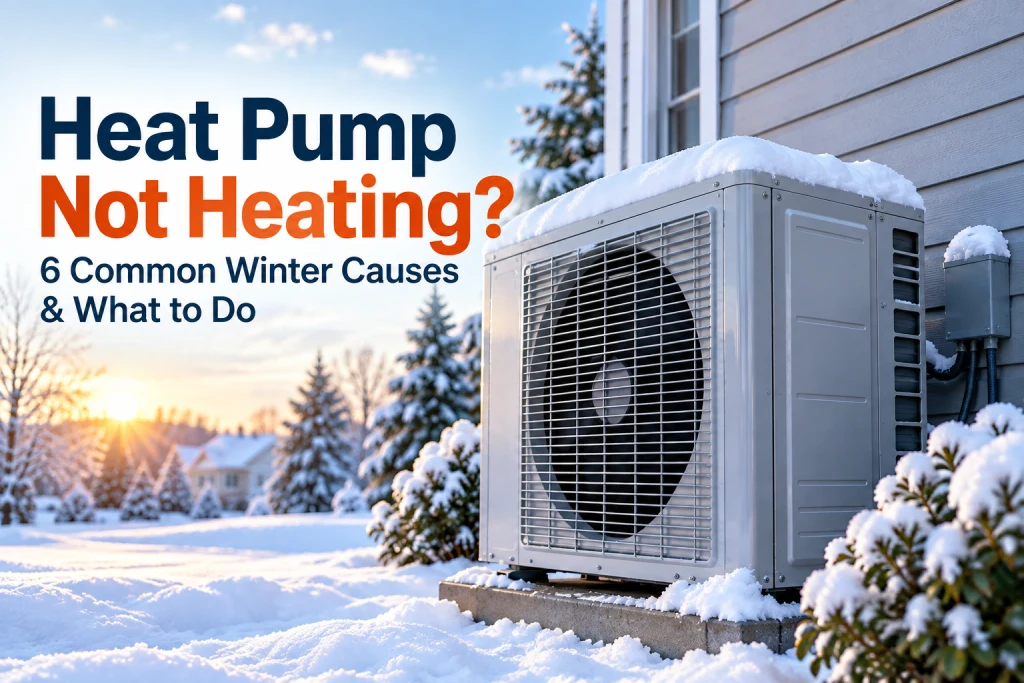
If your heat pump is running but your home still isn’t warming up, don’t assume the system has failed. A heat pump not heating winter complaint is very often a normal defrost cycle catching you at the wrong moment, not a breakdown. But persistent cold air, ice buildup, or a steadily falling indoor temperature is a different story. This guide is built for Ontario homeowners across the Golden Horseshoe. It walks through five things you can safely check right now, how to tell a normal defrost cycle from an actual fault, the six causes a technician actually looks for, what AUX and EM HEAT are doing on your thermostat, and when a cold night genuinely calls for an emergency call instead of a next-morning appointment.
By the FurnacePrices.com Editorial Team•✔ Reviewed by a licensed HVAC technician•Updated: September 2026
This is written for homeowners across Hamilton, Burlington, Oakville, Milton, Brantford, Cambridge, and Kitchener, not technicians, so we’ll keep the jargon to a minimum. Everything below assumes your heat pump is running but not heating well. If the outdoor unit won’t start at all, the thermostat display is dead, or nothing happens when you adjust the temperature, that’s a different problem, and our heat pump not working guide covers the power, breaker, and thermostat checks for that scenario specifically.
Before you dig into defrost cycles or reversing valves, rule out the simple stuff first. These five checks take less than ten minutes and resolve a surprising number of heat pump not heating winter calls on their own.
Confirm the thermostat is set to Heat, not Cool or Fan Only, and that the display isn’t blank or frozen.
Raise the setpoint a few degrees above the current room temperature and wait 10 to 15 minutes for a response.
Set the fan mode to Auto rather than On, so it isn’t blowing unheated air between cycles.
Pull the air filter and hold it up to a light. Replace it if you can’t see light through it clearly.
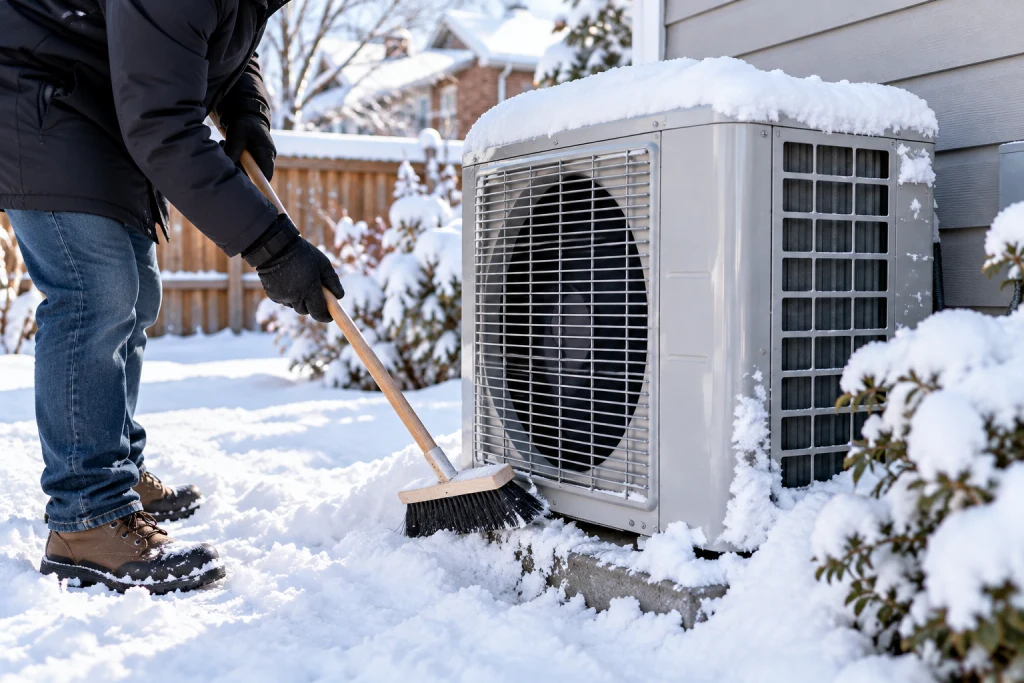
Walk outside and check whether the outdoor unit is buried in snow or blocked by a drift.
⚠️ Where to stop: Don’t open electrical panels, handle refrigerant lines, bypass safety controls, or reset a tripped breaker more than once. If these five checks don’t bring the system back within 15 to 20 minutes, move on to the causes below or book a technician.
Heat Pump Defrost Cycle: Normal or Actually Broken?
A normal defrost cycle lasts 5 to 15 minutes, repeats roughly every 30 to 90 minutes in cold, humid weather, and briefly blows cool air while steam rises off the outdoor unit. None of that is a fault. It becomes one when a single cycle runs past 15 to 20 minutes, the system seems to defrost almost constantly, or the coil stays coated in solid ice rather than clearing after each cycle.
Natural Resources Canada explains that heat pumps decide when to defrost one of two ways: an older time-temperature timer that fires every 30, 60, or 90 minutes whether the coil actually needs it or not, or a demand-defrost control that only triggers once sensors detect real frost buildup. Budget and older systems tend to run the simpler timer, which is one reason your unit might seem to defrost more often than a neighbour’s newer one during the exact same cold snap.
🧊 What that steam actually is: During defrost, the reversing valve sends hot refrigerant to the outdoor coil and the fan stops so the coil heats up faster. The melting frost turns to visible water vapour rising off the unit. It looks dramatic on a cold, dark night, but it’s the system doing exactly what it’s built to do.
Normal defrost cycle: the outdoor coil frosts, the reversing valve sends hot refrigerant outside while the fan pauses, steam rises as the frost melts, then the valve resets and heating resumes, typically within 5 to 15 minutes total.
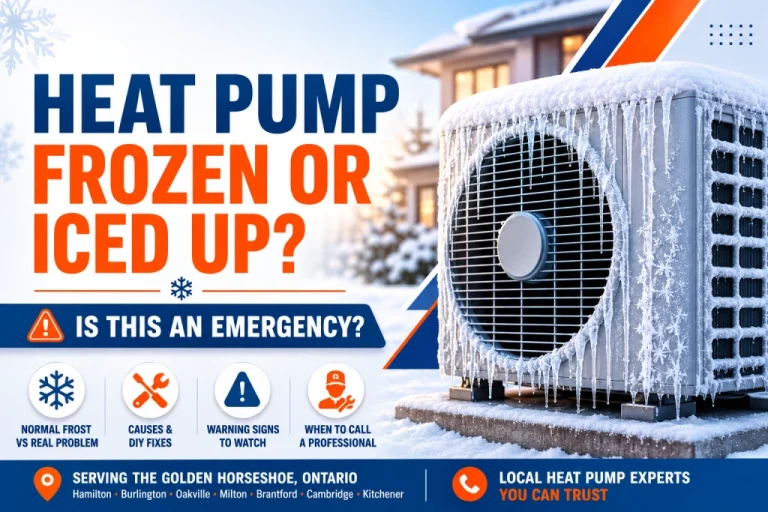
If your unit is stuck in this pattern for more than 20 minutes at a stretch, never seems to come out of defrost, or the coil is coated in solid ice rather than a light frost between cycles, that points to a defrost control board or refrigerant problem, not normal operation. Our heat pump frozen or iced up guide covers the specific ice patterns that separate a normal frost from a real fault in more detail.
6 Real Causes Your Heat Pump Isn’t Heating This Winter
Once a normal defrost cycle is ruled out, these six components are among the causes technicians investigate most often across the Golden Horseshoe this time of year.
Low refrigerant or a slow leak. Refrigerant doesn’t get used up, so a low charge almost always means a leak somewhere in the line set or coil. It shows up as reduced heat output, longer run times, and sometimes ice on the indoor coil. Topping up or repairing a leak has to go through a certified technician under Canada’s provincial and territorial halocarbon regulations, not something to attempt yourself.
A failed defrost control board. This is the sensor and relay assembly that tells the unit when to start and stop defrosting. When it fails, the system either never defrosts and ices over completely, or gets stuck defrosting and never returns to heating.
A dirty filter or iced-over indoor coil. A clogged filter restricts airflow across the coil, which drags down heat transfer and can freeze the coil solid over time. Change the filter every one to three months regardless of how it looks, which matches Natural Resources Canada’s general maintenance guidance for heat pump systems.
A snow-packed or blocked outdoor unit. The outdoor coil needs unobstructed airflow to pull heat from the air at all. Keep roughly two feet of clearance on every side, and clear snowdrifts and ice gently, never with a shovel or hot water against the fins.
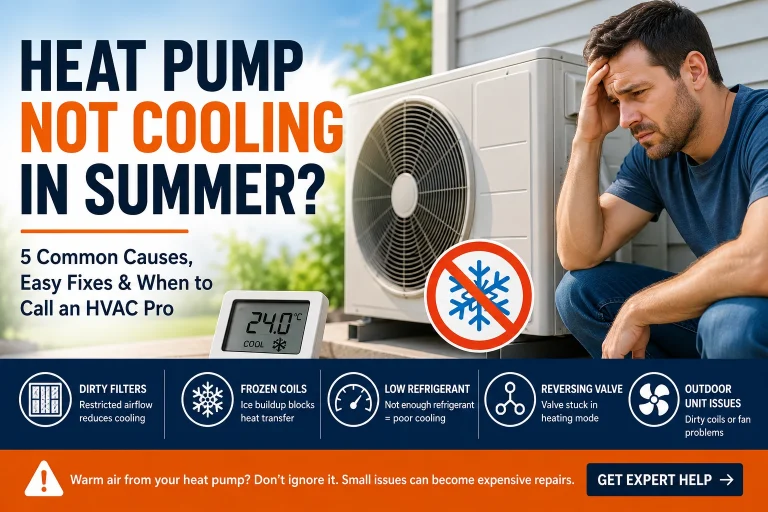
A reversing valve stuck in cooling position. This is the same valve that runs the defrost cycle, and when it sticks, the system runs but blows only cool air no matter what the thermostat says. Our heat pump not cooling guide shows this same valve and coil layout from the opposite season if you want to see exactly where it sits in the system.
An undersized system for the home. Every heat pump has a thermal balance point, the outdoor temperature at which its heating capacity exactly matches the home’s heat loss. An undersized unit hits that point well before the coldest night of the year and leans on backup heat constantly rather than just during isolated cold snaps.
Not sure which of these matches what you’re seeing, hearing, or smelling? The free tool below asks the same questions a technician would over the phone before dispatching anyone.
🔍 Free Diagnostic Tool
Not Sure Which Cause Fits Your Situation?
Answer a few quick questions about what your heat pump is doing to get a likely cause and next step before you book anyone.
🔍
Heat Pump Troubleshooting Wizard
Answer 5 quick questions about your heat pump symptoms and get a likely diagnosis with recommended next steps.
Step 1 of 520%
What is the main issue you're experiencing with your heat pump?
When does the problem mainly occur?
What sound do you hear from your heat pump?
What's happening with your indoor temperatures?
When was your last professional maintenance?
Would you like a free no-obligation estimate from our local contractor partners?
Great! Almost done, your result is on the next page.
Please enter your contact details so our certified contractors can provide estimates.
This field is required.
Please enter a valid email address.
Please enter your phone number.
Please enter your city or postal code.
By submitting this form, you are giving your consent to receive phone calls and text messages from our contractor partners.
You're almost done!
Please provide your details to see your results.
Name is required.
Email is required.
Please enter your city or postal code.
🔍 DIAGNOSIS READY
—
—
—
Recommended Next Steps
—
⚠️ Urgency Level: —
Note: This diagnosis is based on common symptom patterns and is for informational purposes only. A certified HVAC technician should inspect your system for an accurate diagnosis.
Get a Professional Diagnosis
Connect with certified local contractors who can diagnose and fix your heat pump — for free quotes.
The Golden Horseshoe's freeze-thaw swings and lake-effect humidity make several of the six causes above show up more often here than in a drier, steadier cold climate. Wet snow packs harder around outdoor units than dry powder, and damp air puts more frost on the coil in the first place, which is why demand-defrost controls tend to earn their keep in this region more than in a place like the Prairies.
Ontario Condition
What Homeowners May Notice
Wet snow or freezing rain
Faster frost or ice buildup on the outdoor coil
Extended cold snap
Longer run times and more frequent AUX heat
Snowdrift around the unit
Restricted outdoor airflow, reduced heat output
Mild, damp weather
More frequent, usually shorter defrost cycles
Rapid freeze-thaw swings
Ice re-forming faster after each defrost cycle
Older, single-speed heat pumps generally lose more capacity in this kind of weather than newer cold-climate models built with variable-speed compressors and demand-defrost controls. If you're chasing a not-heating problem every time the temperature swings through freezing, that pattern itself is worth mentioning to your technician, since it can point toward equipment age as much as a specific broken part.
Auxiliary Heat vs Emergency Heat: What's the Difference?
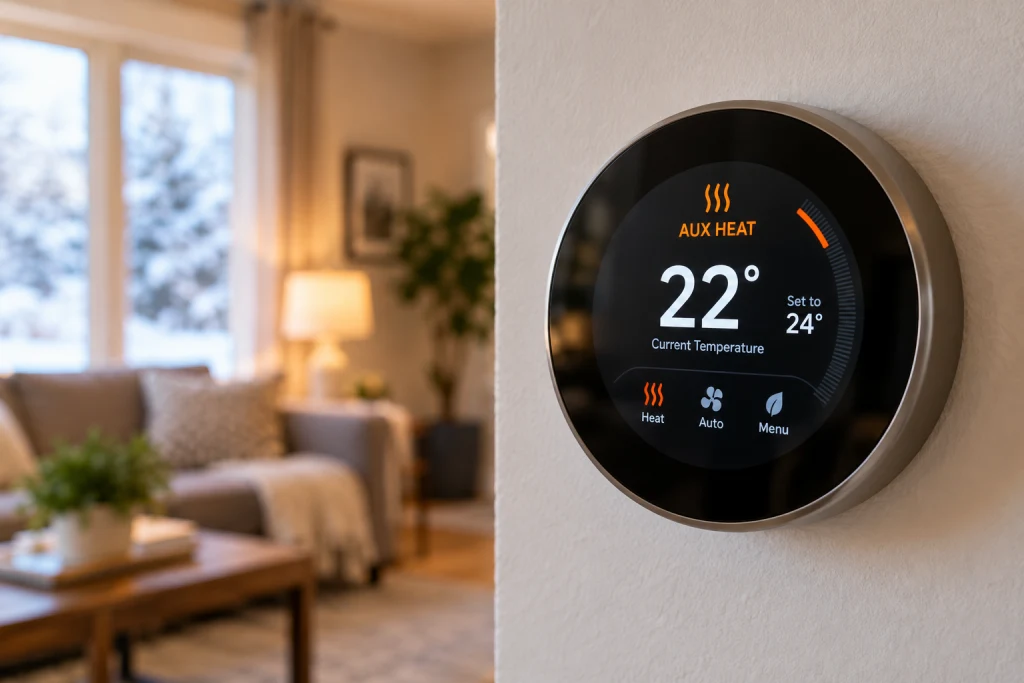
Auxiliary heat (AUX) turns on automatically, running alongside the heat pump when the system can't close the gap between room temperature and the thermostat setting fast enough, commonly during a defrost cycle or a hard cold snap. Emergency heat (EM HEAT) works differently. It's a setting you switch on manually, and it shuts the heat pump off completely, running only the backup furnace or electric elements until you switch it back.
Many Canadian ducted installations use what Natural Resources Canada calls a two-stage thermostat: stage one calls on the heat pump alone, and stage two brings in the backup system only if the room keeps falling behind after that. Seeing AUX light up occasionally on a cold night is that second stage doing exactly its job, not a fault worth worrying about.
⚠️ When AUX is a warning sign, not a setting: Auxiliary electric heat can cost substantially more to run than the heat pump alone, depending on your electricity rates and the backup system's efficiency. If it's running constantly rather than during occasional cold snaps or defrost cycles, that usually points to a heat pump problem underneath, not a thermostat quirk to leave alone. Don't leave a system on EM HEAT for more than a day or two without booking a repair either. It bypasses the heat pump entirely, so a small compressor or valve issue can quietly get worse while backup heat masks the symptom.
Should You Call for Repair Now, or Wait Until Morning?
Call now if indoor temperature is dropping steadily with no backup heat running, or if you notice burning smells, sparking, or grinding from the outdoor unit. If your home is holding a comfortable temperature on AUX or a furnace backup, a same-day or next-morning appointment is almost always the cheaper, equally safe choice.
What's Happening
Call Now or Wait?
Indoor temperature holding steady on AUX or furnace backup
Wait, book a routine appointment
Indoor temperature dropping steadily with no backup running
Call now
Sparking, burning smell, or grinding from the outdoor unit
Call now, shut the system off first
One-time breaker trip, system otherwise running fine since
Wait, book a routine appointment
We cover the full emergency triage checklist, after-hours pricing, and repair cost by part in our heat pump emergency repair guide. The short version for a winter not heating call specifically is that a normal defrost cycle and the six causes above explain most of what looks alarming late at night but genuinely isn't.
💰 Weighing a Repair Against a New System?
Compare Costs Before You Commit to a Fix
If your technician quotes a major repair on an older unit, it's worth knowing what a new cold-climate heat pump costs after current rebates before you decide.
Free tools · No obligation · Built for Ontario homeowners
Do You Have Backup Heat for Nights Like This?
Whether tonight's issue turns into an emergency call comes down almost entirely to what backup heat your system has, more than how cold it actually is outside. Every air-source heat pump has manufacturer-specified operating and capacity limits, and Natural Resources Canada notes that newer cold-climate models typically hold a minimum operating temperature of -15°C to -25°C, though heating capacity generally declines well before that cutoff. Check your specific model's performance data rather than assuming a single number. Whatever that limit is for your system, a supplemental source has to carry the load below it, and that same backup kicks in the moment the heat pump itself has a problem rather than just a cold night.
Hybrid (heat pump + gas furnace). These two systems can't run at the same time, but the thermostat can typically be set to run the furnace alone, so a heat pump fault rarely turns into an emergency call.
Ducted with electric backup elements. These strip heaters can run at the same time as the heat pump and keep the ductwork warm automatically, at a higher cost per hour, until the unit is repaired.
Ductless mini-split, no backup. There's no fallback heat source at all, so a failure during real cold weather is a genuine emergency. Electric baseboards in one or two key rooms are a relatively inexpensive way to close that gap.
If you're adding electric backup heat to a system that doesn't currently have it, any new circuit or panel work needs to go through a licensed electrician under Ontario's electrical safety rules, not a DIY breaker swap. And if you're weighing whether a hybrid setup makes sense for your next system altogether, our heat pump vs furnace comparison breaks down when each one wins on its own.
🥶 Heat Pump Not Heating Right Now?
Get a Free Quote From Trusted Local HVAC Pros
Whether it's a quick same-visit fix or something bigger, compare options with transparent pricing and no obligation. We connect you with licensed, background-checked contractors across the Golden Horseshoe.
Why is my heat pump not heating even though it's running?
Most often it's a normal defrost cycle, a dirty filter, a blocked outdoor unit, low refrigerant, a failed defrost board, or a reversing valve stuck in cooling mode.
How long should a heat pump defrost cycle last?
A normal cycle runs 5 to 15 minutes and repeats every 30 to 90 minutes in cold, humid weather. Anything longer or constant points to a fault.
Is it normal for a heat pump to blow cold air in winter?
Yes, briefly during a defrost cycle. If cool air runs longer than 15 to 20 minutes at a stretch, that's a sign to call for service.
What's the difference between auxiliary heat and emergency heat?
Auxiliary heat turns on automatically alongside the heat pump. Emergency heat is a manual setting that shuts the heat pump off and runs backup heat alone.
Should I run my heat pump on emergency heat all winter?
No. Emergency heat masks a heat pump problem and costs several times more to run. Book a repair rather than leaving the system on EM HEAT.
When should I call for emergency repair instead of waiting?
Call now if indoor temperature is dropping with no backup heat, or you notice sparking, burning smells, or grinding. Otherwise, a same-day appointment is usually enough.
HV
Reviewed by a Licensed HVAC Technician
This article was technically reviewed for accuracy before publishing. Our editorial process combines field experience from licensed technicians with guidance from manufacturer documentation and government resources.
 Canadian