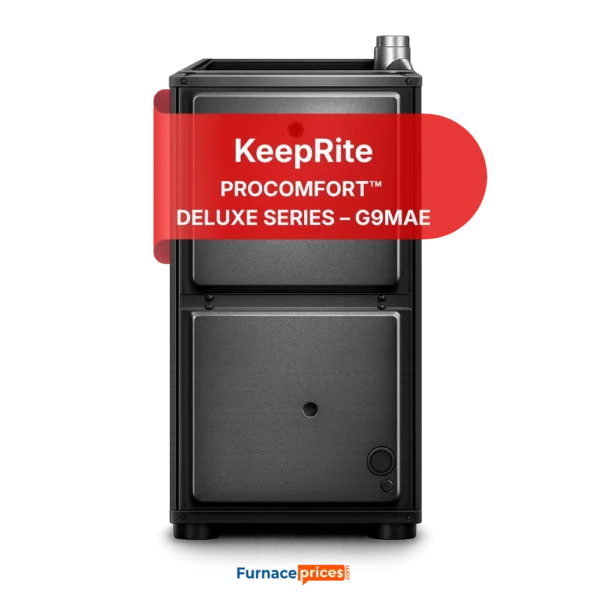
KeepRite ProComfort Deluxe Series G9MAE Review: Price, Modulating Performance & Is the Premium Worth It?
⚠️ According to this KeepRite G9MAE Review, the model has been discontinued by the manufacturer. It may still be available through select KeepRite distributors and contractors clearing existing stock. Current alternatives are listed at the bottom of this page.
What Is the G9MAE and Who Is It Actually For?
That continuous adjustment is not a marketing feature. It is the reason modulating furnaces run quieter, maintain more even temperatures, and put less wear on the system over time.
The honest caveat in this KeepRite G9MAE Review is that the G9MAE has been discontinued. If you can source a new, unregistered unit through a licensed contractor, it remains a genuinely competitive purchase. If you cannot, the current KeepRite equivalents listed at the bottom of this page deliver the same technology with active production support.
Quick Verdict
Best for: homeowners in cold Canadian climates who want the quietest, most efficient heating available and plan to stay in the home long enough to recover the premium cost
Not ideal for: buyers who cannot confirm new stock availability, or those whose annual heating bill is low enough that the efficiency gains never pay back
This KeepRite G9MAE Review shows that if efficiency, comfort, and smart home control are your top three priorities — and the unit is available new — the G9MAE is one of the strongest discontinued buys in the KeepRite catalogue.
Who Should Seriously Consider the G9MAE?
This furnace makes sense if you:
- Heat a mid-to-large Canadian home through genuine winters (Ontario, Alberta, Prairies)
- Have a current furnace running at 80% AFUE or lower — the efficiency gap is large enough to generate real savings
- Want whole-home comfort management through the ION System Control
- Prioritize quiet operation — especially relevant for open-concept homes where the furnace runs during conversations and sleep
- Plan to stay in the home 8 to 10+ years, giving the efficiency upgrade time to pay back
Walk away if:
- New stock is unavailable or the unit cannot be warranty-registered within 90 days
- Your home is under 1,000 sq ft — the modulating advantage is less pronounced in small spaces
- You are replacing a 95%+ AFUE furnace — the savings delta between 96% and 98% is roughly $40 to $80 per year, which is a long payback on a premium model
What Does the G9MAE Cost Installed in Canada?
According to this KeepRite G9MAE Review, most homeowners pay between $4,670 and $5,500 for a fully installed G9MAE. That is the real number — not the equipment-only figure some contractors quote to appear competitive.
What actually moves that range:
BTU size: The jump from a 60,000 BTU unit to a 120,000 BTU unit is not just the equipment cost — larger units often require additional gas line work. That alone can add $300 to $600 to the invoice.
Installation complexity: A clean swap where your existing furnace is the same size and venting configuration is the low end. New two-pipe PVC venting, ductwork modifications, or permit complications push toward the high end.
City: Contractors in Hamilton and Kitchener price differently than those in Oakville or North York. Always get three quotes from licensed KeepRite dealers.
Stock availability: Discontinued units with limited supply sometimes command a slight premium when contractors know alternatives are scarce. Other times, contractors clearing inventory discount aggressively. Know the market before you commit.
💰Use the Cost Estimator to get a personalized installed price range based on your home size and installation type.
Cost Calculator
What Does the Installation Price Include?
According to this KeepRite G9MAE Review, a standard G9MAE installation should cover the following. If a contractor’s quote omits any of these, ask why.
- Furnace equipment and delivery
- Removal and disposal of existing unit
- Gas line connection and pressure test
- Two-pipe PVC venting installation (direct vent condensate system)
- Electrical connection and wiring
- ION System Control installation and Wi-Fi setup
- Commissioning, test run, and safety inspection
- City permit — ask specifically; some contractors include it, others charge $150 to $300 separately
Labour in Ontario typically runs $800 to $1,400 for a standard residential installation. Anything significantly above that deserves a written explanation.
Real-World Performance: What Modulating Actually Feels Like
Spec sheets describe modulating furnaces accurately. What they fail to convey is the difference you notice on a cold Tuesday morning.
Two-stage furnaces turn on, run at one of two speeds, and shut off. Modulating furnaces find the exact output level needed to maintain your set temperature and hold it there — running long, slow, quiet cycles instead of repeated on/off bursts.
The practical result:
Temperature consistency: Rooms that used to feel 2–3 degrees cooler than the thermostat reading typically even out with a modulating system. The G9MAE’s variable-speed blower distributes air more continuously rather than in short bursts.
Noise level: The variable-speed ECM blower starts slowly, ramps up, and ramps down. Open-concept homes and houses with bedrooms near the furnace room notice this immediately.
Humidity retention: Longer, lower-intensity cycles retain indoor humidity better than short, high-heat blasts. In dry Canadian winters, this is a genuine comfort difference.
Efficiency in practice: The 97–98% AFUE rating holds closer to its rated efficiency in real operation than two-stage or single-stage furnaces, which often run full blast when less heat is needed.
For complete technical documentation and performance data, refer to the official KeepRite product specifications.
🔢 See your estimated monthly and seasonal operating cost based on your gas rate and home size.
Operating Cost Calculator
What Size G9MAE Does Your Home Actually Need?
Oversizing is one of the most common mistakes in furnace installation. A furnace that is too large short-cycles — it heats the space quickly, shuts off, restarts minutes later — and a modulating furnace loses its core advantage when it cannot run at low, sustained capacity.
| Home Size |
Recommended BTU |
| 1,200–1,500 sq ft |
60,000 BTU |
| 1,500–1,800 sq ft |
60,000–80,000 BTU |
| 1,800–2,500 sq ft |
80,000 BTU |
| 2,500–3,200 sq ft |
100,000 BTU |
| 3,200+ sq ft |
120,000 BTU |
These are starting estimates for cold Canadian climates. Insulation quality, window count, ceiling height, and local climate zone all affect the correct size. Do not skip the Manual J load calculation — it costs nothing when a contractor does it as part of a quote.
📐 Enter your square footage and climate zone to find the right G9MAE sub-model for your home.
Size & BTU Calculator
🎯Not sure the G9MAE fits your situation? Take the 4-question quiz for a personalized recommendation.
Recommendation Quiz
Features That Actually Matter — Explained Without the Brochure Language
Modulating Gas Valve → What it means for you: Instead of full heat or half heat, the G9MAE finds the exact percentage of output needed — sometimes as low as 35%. Your home stays at 20°C instead of swinging between 19°C and 21°C all day. The gas meter moves more slowly because the furnace wastes nothing ramping up to full capacity for a small heat demand.
Variable-Speed ECM Blower → What it means for you: The blower motor does not turn on and blast air at full speed. It accelerates slowly, holds a consistent speed matched to the heating demand, and decelerates. The result is quieter, more even airflow and significantly lower electricity draw compared to standard PSC motors — typically 300 to 600 watts less.
ION System Control → What it means for you: This is not a thermostat. It manages temperature, humidity, ventilation, and air quality from one touchscreen. The Wi-Fi connection means you can adjust settings before you arrive home and receive diagnostic alerts if something goes wrong — often before the issue becomes a breakdown. Your contractor can also run remote diagnostics, which reduces the cost of unnecessary service calls.
RPJ Aluminized Steel Heat Exchangers → What it means for you: More surface area for heat transfer means the G9MAE extracts more warmth from the same combustion. The aluminized steel construction resists corrosion from condensation — a meaningful durability point in a 97%+ AFUE furnace that produces significant condensate.
Lifetime Heat Exchanger Warranty → What it means for you: The heat exchanger is the most expensive single component in a furnace. A lifetime warranty on it means the furnace is financially backed for its entire operating life — as long as you register it and maintain it properly.
How Much Will the G9MAE Save on Energy Bills?
According to this KeepRite G9MAE Review, the G9MAE runs at 97–98% AFUE. Here is what that means in Canadian dollars.
If your current furnace runs at 80% AFUE, roughly 20 cents of every gas dollar is wasted. Upgrading to 97% AFUE reduces that waste to 3 cents. On a $2,000 annual gas bill (where heating accounts for approximately 72%), the annual savings works out to $220 to $380 depending on gas rates and climate.
The comparison to a 95–96% AFUE two-stage furnace is narrower: the G9MAE saves roughly $40 to $80 more per year than the G9MVE. That gap alone does not justify the premium — the case for the G9MAE is comfort and quiet operation, not just the marginal efficiency edge.
If Ontario rebate programs are available on remaining stock — Enbridge Gas offers up to $1,000 for 90%+ AFUE upgrades, and the Canada Greener Homes portal lists current eligibility — the payback period shortens meaningfully. Confirm with your contractor before purchasing.
Check current Enbridge Gas rebate eligibility at enbridgegas.com/rebates.
⚡ Enter your current furnace AFUE and gas bill to see your exact annual savings and payback period.
Savings Calculator
G9MAE Technical Specifications
- AFUE: 97–98%
- Burner Type: Modulating Gas Valve (35–100% capacity range)
- Blower Type: Variable Speed (ECM motor)
- BTU Input: 60,000–120,000
- BTU Output: 59,000–117,000
- ENERGY STAR® Qualified: Yes
- Heat Exchanger: Advanced RPJ Aluminized Steel
- Control System: ION System Control (Wi-Fi, touchscreen)
- Venting: Two-pipe PVC direct vent
- Available Models: 0601714A, 0602120A, 0801714A, 0802120A, 1002122A, 1202422A
Pros and Cons
Pros
- Modulating gas valve delivers the most consistent temperatures of any furnace type
- Variable-speed ECM blower is noticeably quieter than standard or two-stage models
- 97–98% AFUE puts it among the most efficient residential furnaces available in Canada
- ION System Control manages temperature, humidity, ventilation, and air quality from one interface
- Wi-Fi enabled with remote access and real-time diagnostic alerts
- Lifetime heat exchanger warranty backed by 10-Year No Hassle Replacement™
- RPJ aluminized steel heat exchangers built for long-term corrosion resistance
Cons
- Discontinued — production has ended and parts availability will narrow over time
- Modulating technology means more components; repairs, when needed, are more complex than a basic furnace
- ION System Control is proprietary — future compatibility with third-party smart home platforms is not guaranteed
- The efficiency advantage over a 96% AFUE two-stage furnace ($40–$80/yr) is modest on its own
- Warranty registration is time-sensitive: 90 days, no exceptions
The Drawbacks Most Buyers Do Not Think to Ask About
Parts sourcing in year 12: Modulating gas valves and ECM motor controllers are more specialized components than those in standard furnaces. When a G9MAE needs a specific board or valve in 2034, the contractor’s ability to source it quickly is a real variable. It is not a reason to avoid the furnace — it is a reason to choose a contractor with strong KeepRite supplier relationships.
ION thermostat ecosystem lock-in: The ION System Control works beautifully with the G9MAE and compatible KeepRite accessories. If you ever want to integrate a Google Nest or Ecobee, you will need to work within compatibility limits. This matters more for tech-forward homeowners than average buyers.
The modulating advantage requires proper sizing: If a contractor installs a 120,000 BTU G9MAE in a 1,400 sq ft home, you will not experience the quiet, sustained low-output operation that makes modulating furnaces worth the premium. Insist on the Manual J calculation.
Rebate timing: Since the G9MAE is discontinued, rebate eligibility depends on your contractor registering the unit as a new installation. Do not assume — confirm in writing before signing the contract.
The gap between these two is not just efficiency numbers — it is a fundamentally different heating experience. The N92ESN runs at 92% AFUE with a single-stage burner: full heat or no heat. The G9MAE modulates from 35% to 100% continuously. The N92ESN costs significantly less upfront; the G9MAE costs less to run every month for the next 15 years.
Choose N92ESN if upfront cost is the only factor. Choose G9MAE if long-term comfort and operating cost matter more than the purchase price.
The N96VSN is a current in-production two-stage variable-speed furnace at 96% AFUE — a genuinely capable unit. The G9MAE outperforms it on efficiency (97–98% vs 96%), comfort consistency (modulating vs two-stage), and smart home integration (ION vs standard thermostat). The N96VSN wins on parts availability and active manufacturer support.
Choose N96VSN if production support and long-term parts access are priorities. Choose G9MAE if comfort precision and smart control justify the trade-off.
Both are discontinued. Both run at high efficiency with variable-speed blowers. The G9MVE is two-stage (95–96% AFUE) with the Observer Wall Control. The G9MAE is modulating (97–98% AFUE) with the ION System Control. The real decision: is the quieter operation, extra 1–2% efficiency, and ION interface worth the additional cost to you personally?
Choose G9MVE if the price difference matters and two-stage comfort is sufficient. Choose G9MAE if quiet, precise, consistent heat is a priority.
The G97CMN is the current in-production equivalent to the G9MAE — similar efficiency tier, modulating technology, and smart home integration, with the advantage of full active production support. If the G9MAE is unavailable in your area, the Ion 98 is the direct replacement worth considering first.
The G97VTN shares the 97% AFUE tier and variable-speed operation. It is a current-production model, giving it the parts availability edge the G9MAE lacks. If quiet operation is the primary reason you are considering the G9MAE, the G97VTN deserves a side-by-side quote.
Is Your Current Furnace Worth Repairing — Or Is It Time to Replace?
The answer is rarely obvious. A furnace that runs at 80% AFUE and is 14 years old with a $1,200 repair quote is a different calculation than a 10-year-old 95% AFUE unit needing a $400 ignitor.
🔧Enter your furnace age, repair cost, and current efficiency to get a straight answer.
Repair or Replace Quiz
Warranty Coverage
KeepRite backs the G9MAE with one of the strongest warranties in the industry:
- Lifetime Limited Warranty on the heat exchanger
- 10-Year Parts Limited Warranty — registration required within 90 days of installation
- 10-Year No Hassle Replacement™ — if a major component fails and is detected by the ION system within 10 years, KeepRite replaces the entire unit with a comparable model
Miss the 90-day registration window and parts coverage drops to 5 years. Set a calendar reminder on installation day — this is genuinely the most common warranty mistake homeowners make.
How Long Does the G9MAE Last?
A well-maintained G9MAE should operate reliably for 18 to 22 years — slightly longer than the average 15 to 20 year furnace lifespan, because modulating operation puts less mechanical stress on the system than on/off cycling.
The variable-speed ECM blower motor and modulating gas valve are the two components most sensitive to maintenance neglect. Both perform significantly better with clean filters and annual professional tune-ups. A dirty filter forces the blower to work harder; a partially blocked gas valve trains the modulating system to compensate in ways that accelerate wear.
This KeepRite G9MAE Review also recommends budgeting around $150 to $250 annually for a professional tune-up, which helps extend equipment life and keeps the ION diagnostics calibrated accurately.
Where Can You Still Buy the G9MAE?
Production has ended. Your options for sourcing remaining new stock:
- Contact licensed KeepRite dealers in your area — use the KeepRite dealer locator to find authorized contractors
- Request a quote through FurnacePrices.com — our contractor network can confirm G9MAE availability and advise on current stock
- If unavailable, ask for a direct comparison to the KeepRite Ion 98 G97CMN — it is the closest current equivalent
Do not purchase a used or previously installed G9MAE. A unit that has already been installed and removed cannot be registered for the 10-year warranty, and its operating history is unknown.
🛠️ Already own a G9MAE and experiencing an issue? Start here before calling a technician.
Troubleshooting Wizard
Final Verdict: Should You Buy the G9MAE?
The KeepRite G9MAE Review shows that the G9MAE is not a furnace you buy because it is the cheapest good option. It is a furnace you buy because you want the best heating experience available at KeepRite’s price point — and you understand that “best” in this context means consistent temperatures, quiet operation, and smart diagnostics, not just the highest AFUE number on the spec sheet.
Buy it if:
- New stock is available with warranty registration
- Your home is mid-to-large size in a cold Canadian climate
- You are replacing an 80–92% AFUE furnace and will see meaningful savings
- Quiet operation and ION smart control match your lifestyle
Skip it if:
- New stock cannot be confirmed
- You want active production support for 15+ years
- You are replacing an existing 95%+ AFUE furnace — the savings delta does not support the premium
If the G9MAE is unavailable in your area, get a quote for the KeepRite Ion 98 G97CMN. Same technology tier, currently in production, and designed as the direct successor to this series.
Current KeepRite Alternatives to the G9MAE
High Efficiency (97–98% AFUE)
High Efficiency (96% AFUE)
Mid Efficiency (92–95% AFUE)
Frequently Asked Questions
Q1: Is the KeepRite G9MAE still being manufactured? No. KeepRite has discontinued the G9MAE. Some licensed contractors and distributors may have remaining new stock available, but no new units are being produced.
Q2: What replaced the G9MAE? The KeepRite Ion 98 G97CMN is the closest current-production equivalent — similar modulating technology, 97–98% AFUE, and ION system integration.
Q3: Is the G9MAE worth buying if I find new stock? Yes — if the unit is new, unregistered, and comes with full warranty coverage. Confirm the contractor will register within 90 days of installation and that rebate eligibility applies.
Q4: What is the difference between the G9MAE and the G9MVE? The G9MAE uses a modulating gas valve (35–100% continuous output) and the ION System Control. The G9MVE uses a two-stage burner (two fixed outputs) and the Observer Wall Control. The G9MAE is quieter, more precise, and 1–2% more efficient — at a higher price point.
Q5: How often should the G9MAE be serviced? Annual professional maintenance is recommended. The ION System Control will flag diagnostic codes if performance drops — do not ignore them.
Q6: Can I get parts for a G9MAE after it is discontinued? Yes, for now. KeepRite continues parts and warranty support for discontinued models. Modulating gas valve components are more specialized than standard furnace parts — choose a contractor with strong KeepRite supplier access for future service.
Q7:Does the G9MAE qualify for Ontario rebates? It may, depending on whether your contractor can register it as a new installation. Check the Enbridge Gas rebate program and the Canada Greener Homes portal for current eligibility.
Q8: How loud is the G9MAE compared to a standard furnace? Noticeably quieter. The variable-speed ECM blower starts slowly and ramps up gradually. Modulating operation means the furnace runs at low output most of the time, which is significantly quieter than a single-stage or even two-stage furnace cycling on and off at full capacity.
 Canadian