Fill out the form below to apply and get featured as one of our Top Contractors. Gain visibility, attract more clients, and showcase your expertise to a wider audience!
🔒 Your information is private and secure
Free to apply
Verified contractors only
Canada-wide visibility
No hidden charges
Free Service
No obligation
Get Your FREE HVAC Quote Today
Compare prices from top-rated local contractors in minutes
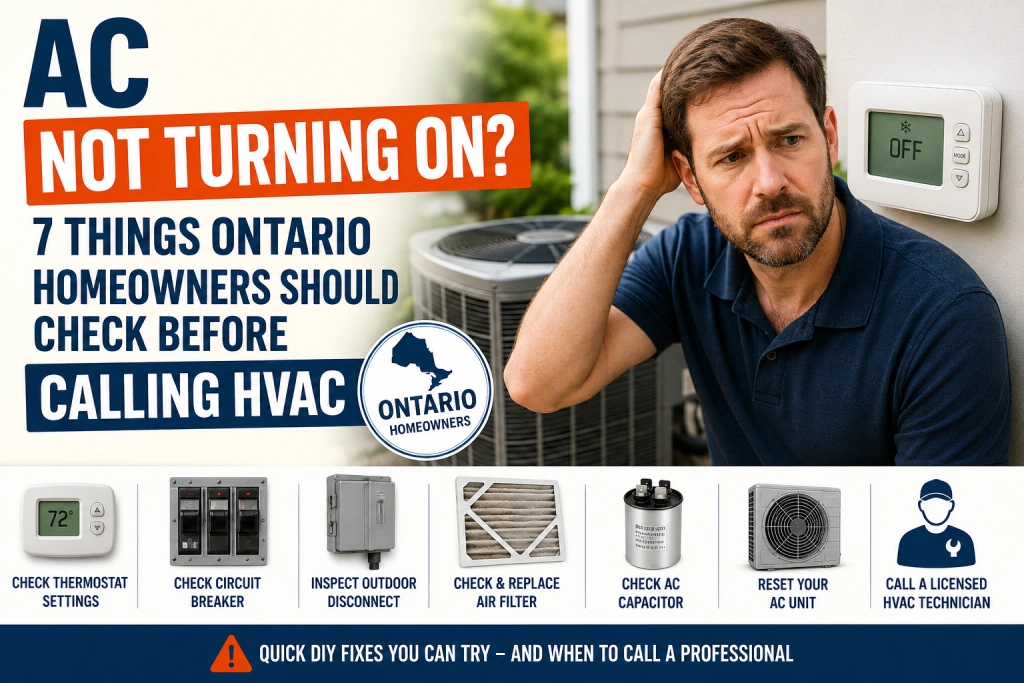
If your AC is not turning on, you don’t necessarily need to call a technician right away. This guide is written for Ontario homeowners who’ve walked over to their thermostat on a hot summer day, turned it down, and heard… nothing. No hum from the outdoor unit. No airflow from the vents. Just silence and rising heat.
By the FurnacePrices.com Editorial Team•Updated: June 2026
🔧
Reviewed by: Hans VaillancourtRed Seal Licensed HVAC Technician · 25+ Years Ontario Field Experience Specializes in Residential AC Diagnostics & Repair · Ontario Licensed Contractor✔ Verified Expert Review
Before spending $150–$300 on a service call, there are seven quick checks you can do yourself — many of which resolve the problem in under five minutes. We’ll walk through every common cause in order, from the simplest fixes to the ones that genuinely require a professional.
Match your symptom to the likely cause before reading further. This table is designed to get you to the right section immediately.
What You Hear / See
Most Likely Cause
DIY Fix?
Complete silence — nothing happens
Tripped breaker, dead thermostat, blown fuse
✔ Yes
One click, then silence
Contactor stuck or worn out
✘ Technician
Humming but outdoor fan won’t spin
Failed start capacitor
✘ Technician
Indoor air handler runs, outdoor unit dead
Capacitor, contactor, or refrigerant lockout
✘ Technician
Ice visible on lines or coil
Clogged filter / restricted airflow
✔ Yes (thaw first)
Water pooling near indoor unit
Blocked condensate drain line
✔ Yes
AC stopped right after a power outage or storm
Internal fault lockout — needs full reset
✔ Yes
AC runs but blows warm air only
Low refrigerant or compressor issue
✘ Technician
Burning smell or sparks near unit
Electrical fault
✘ Technician immediately
Fix 1 — Check the Thermostat
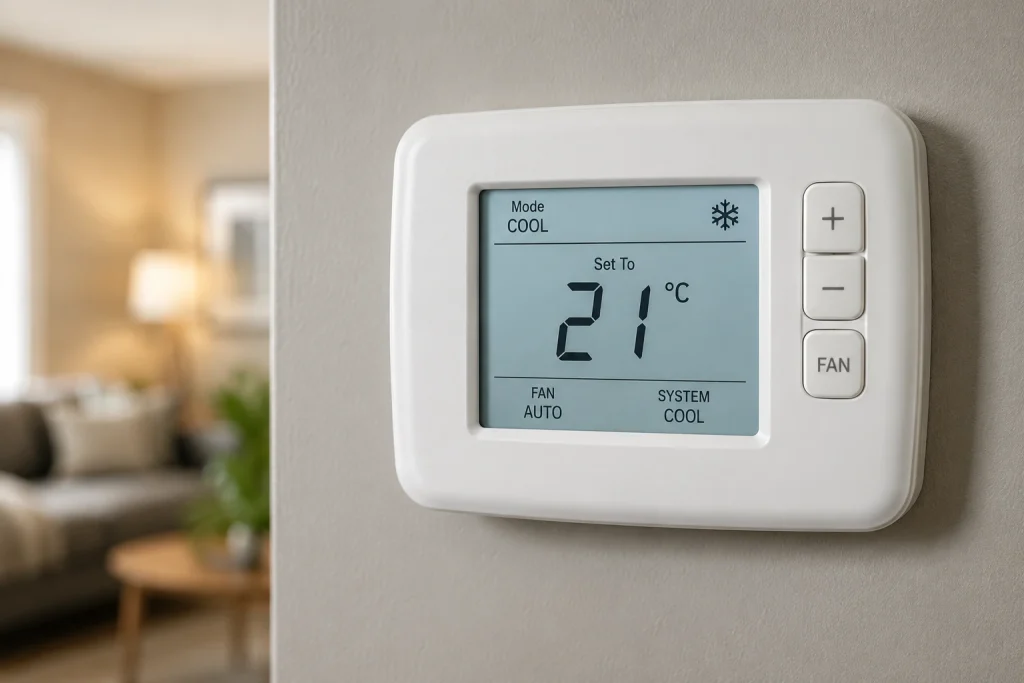
Thermostat issues are behind more no-start calls than homeowners realize. Before touching anything else:
Confirm it’s set to COOL, not HEAT or FAN ONLY. Someone may have switched it accidentally.
Set the temperature at least 3–5°C below the current room reading. A 1°C gap won’t trigger the system.
Replace the batteries. A weak battery in a wireless thermostat — especially after a winter sitting idle — is a surprisingly frequent culprit.
Check for a blank or unresponsive screen. If the display is off, the thermostat itself has lost power — not necessarily the AC.
💡 Pro Tip: If you have a smart thermostat (Ecobee, Nest, Honeywell Home), open the app and check for a “disconnected” or “offline” status. This usually means the thermostat has lost C-wire power — not that your AC is broken. A C-wire adapter fix resolves it without a service call.
Fix 2 — Check Your Electrical Panel for a Tripped Breaker
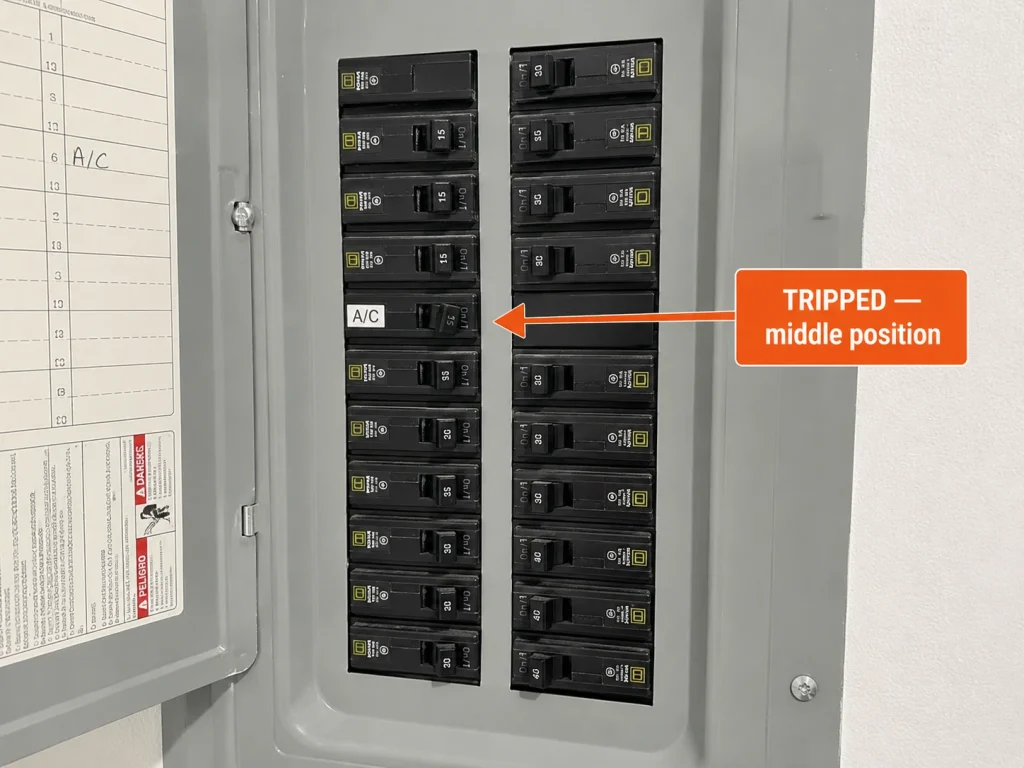
Air conditioners draw a significant surge of power on startup — especially on the first hot day after a long Ontario winter. A momentary power fluctuation or a stressed system can trip the circuit breaker as a protective measure.
Go to your electrical panel and look for a breaker in the middle position — neither fully ON nor fully OFF. Push it firmly to OFF first, then back to ON. Most central AC systems have two breakers: one for the outdoor condenser and one for the indoor air handler. Check both.
⚠️ Warning: If the breaker trips again immediately after you reset it, stop. Do not reset it a third time. A repeatedly tripping breaker signals a real electrical fault or an overloaded compressor — both require a licensed technician. One reset attempt is safe; more puts your equipment and home at risk.
Fix 3 — Check the Outdoor Disconnect Box
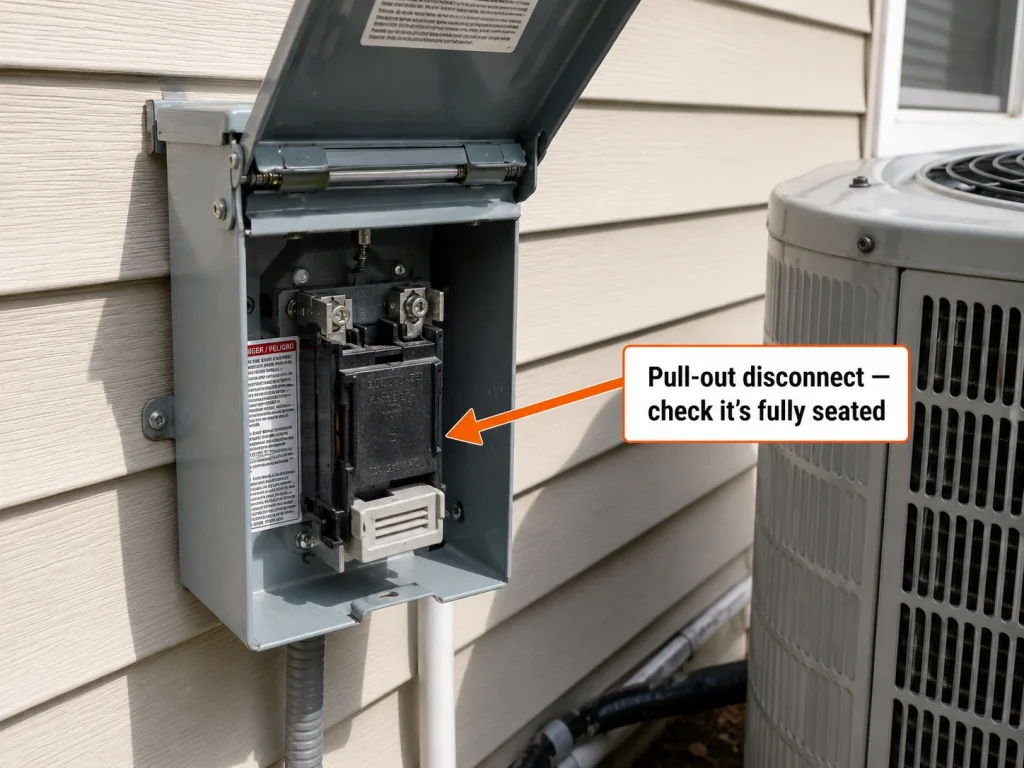
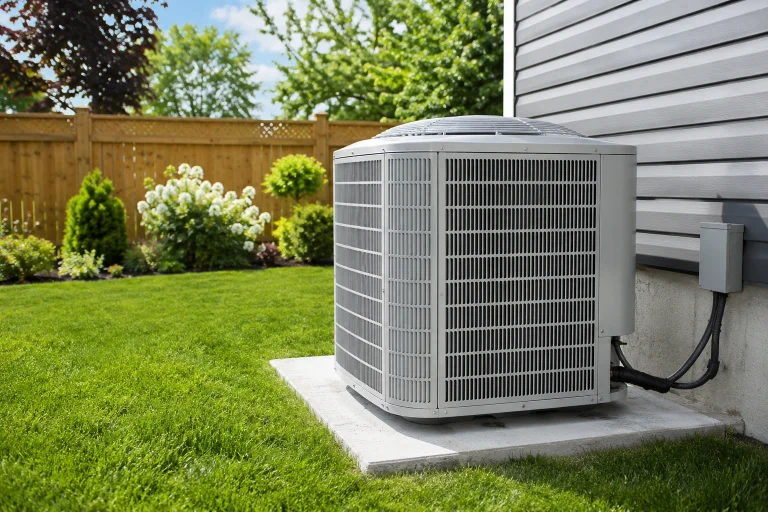
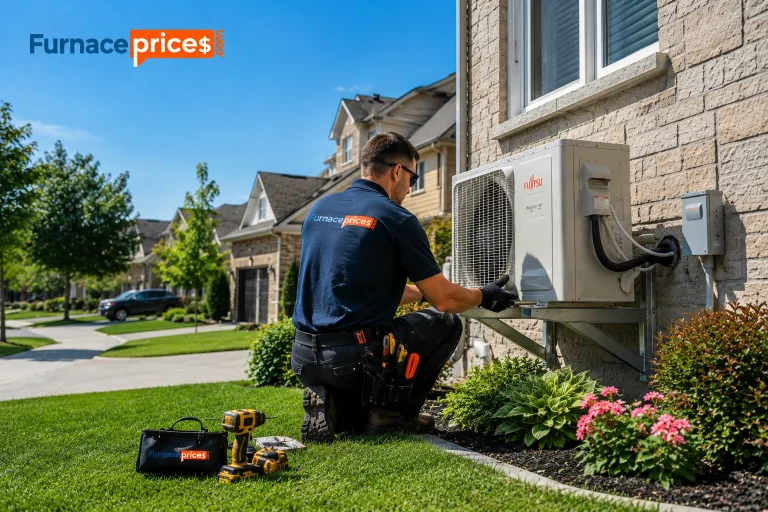
Next to your outdoor condenser there should be a metal box mounted on the wall — the disconnect box. It’s the local shutoff technicians use when servicing the unit, and it can occasionally be knocked loose or accidentally pulled.
Open the cover and check whether the disconnect block is fully seated. Push it firmly back in if it looks partially out, then retry the thermostat. Also inspect the fuses inside — a blown fuse shows a visible black mark or a broken wire through the glass tube. Replacement fuses are available at any hardware store.
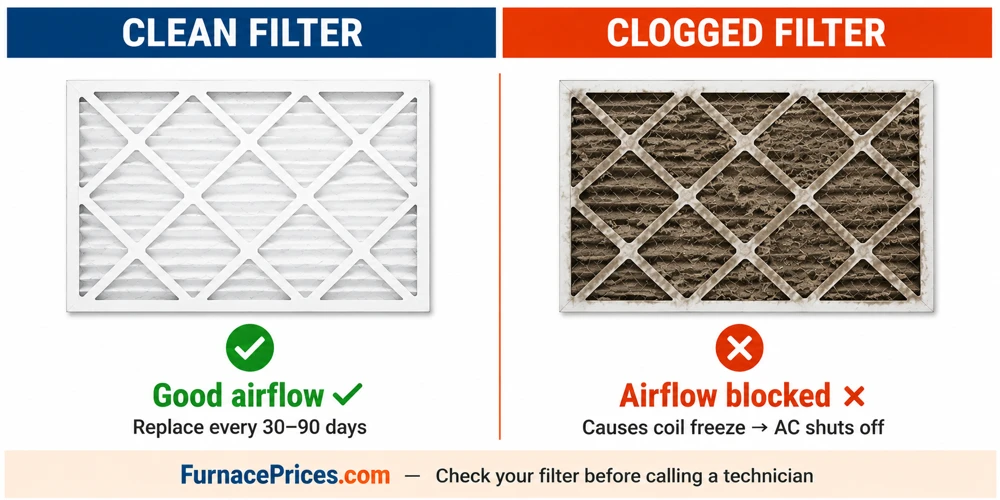
Fix 4 — Check the Air Filter (A Clogged Filter Can Trigger a Safety Shutoff)
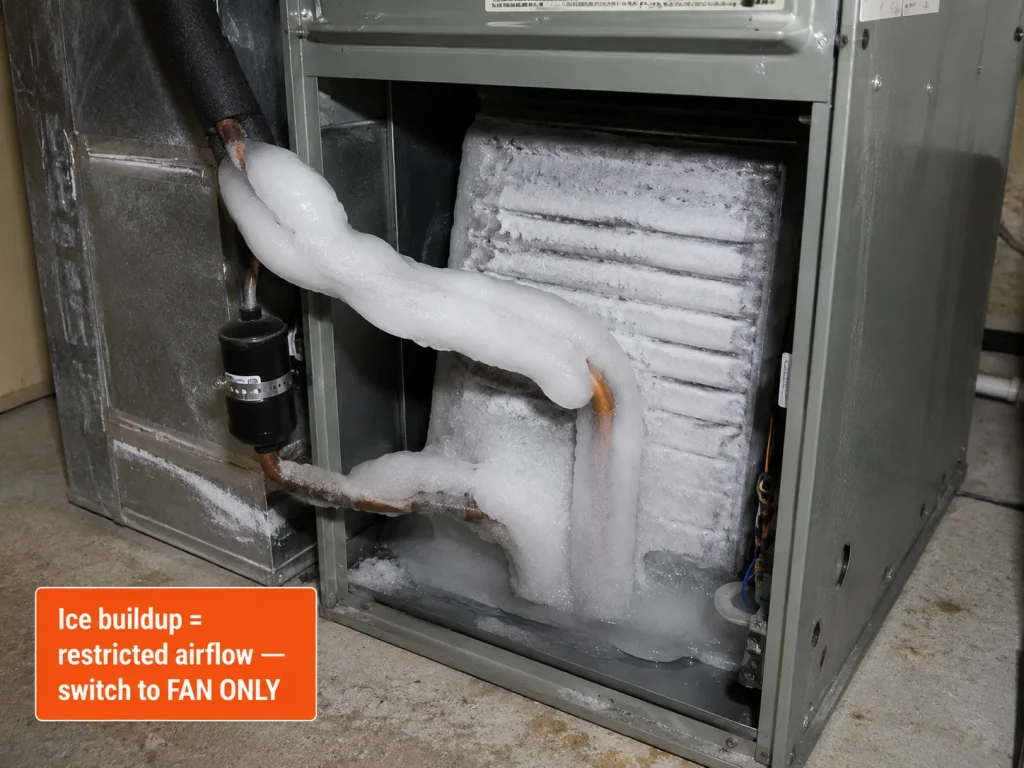
A severely clogged filter starves the evaporator coil of airflow, causing it to ice over. When that happens, a safety switch shuts the entire system down to protect the compressor — and your AC appears completely dead.
Pull out your air filter (located at the return air vent or inside the air handler). If it’s grey, packed with dust, or you can’t see light through it, replace it immediately. After replacing the filter, run the system on FAN ONLY for 30–60 minutes to thaw any ice on the coil, then switch to COOL mode and test. Check your filter every 30–90 days during cooling season — a $20 filter change prevents $1,500+ compressor repairs.
Fix 5 — Check the Condensate Drain Line
As your AC removes humidity from Ontario’s muggy summer air, it produces condensate water that flows out through a drain line. Algae and debris clog these lines over time. When water backs up, a float switch in the drain pan shuts the system off automatically to prevent water damage to your home.
If you notice water pooling near your indoor air handler and the AC has stopped, this is almost certainly the cause. A DIY fix: apply a wet-dry vacuum to the drain outlet, or flush the access point with a diluted bleach solution (1 part bleach to 16 parts water). A technician can flush the full line during a routine AC maintenance or repair visit.
Fix 6 — Listen to What the Outdoor Unit Is Telling You
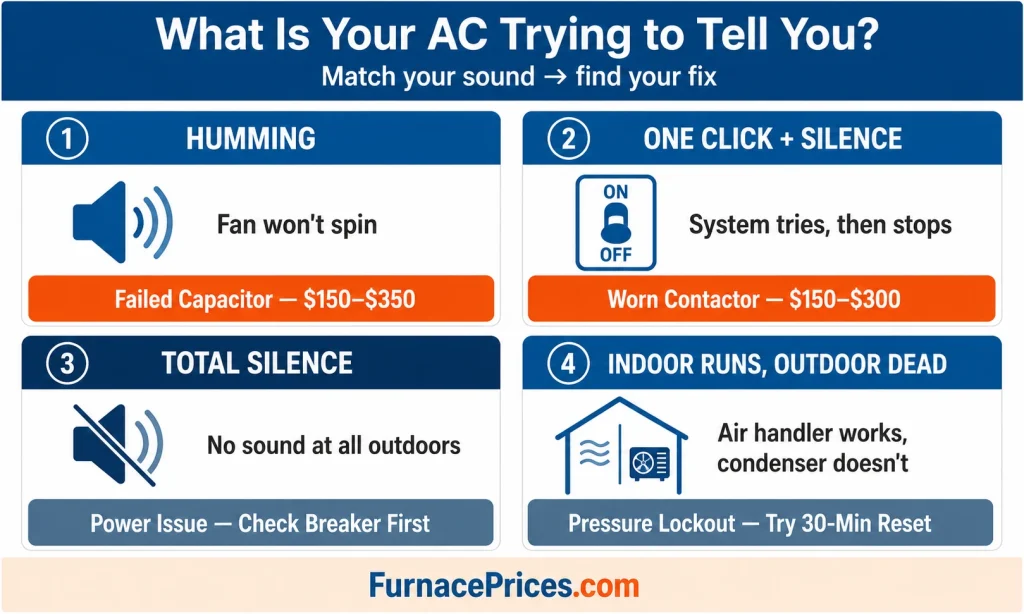
Go outside and pay attention for 30 seconds after triggering the thermostat. What you hear — or don’t hear — points directly at the failing component.
Humming but the fan won’t spin: The start capacitor has likely failed. This is one of the most common AC failures in Ontario every summer — and one of the least expensive to fix ($150–$350 all-in).
A single click, then silence: The contactor (relay that connects power to the compressor) is worn out or stuck. Minor repair, $150–$300.
Total silence outdoors: Power issue — breaker, disconnect fuse, or failed control board.
Indoor air handler runs but outdoor unit is completely dead: The compressor may have locked out on a pressure safety switch. A full system reset (Fix 7) often clears this.
Fix 7 — Perform a Full System Reset
Modern air conditioners have internal control boards that can enter a fault lockout state after a power outage, brownout, or voltage spike — common in Ontario during summer storms. A proper 30-minute reset clears these fault codes and pressure lockouts.
Set the thermostat to OFF.
Switch off both the indoor and outdoor AC breakers in your electrical panel.
Wait a full 30 minutes — not 5. This lets capacitor charge dissipate and protection timers fully reset.
Restore the breakers, wait 5 minutes, then set the thermostat to COOL.
This one step resolves a significant number of “AC not turning on after storm” and “AC stopped working overnight” situations without any service call.
What If Your AC Turns On But Isn’t Cooling?
This is a different but equally common problem — the system starts, the fan runs, but the air coming out of the vents is warm or barely cooler than the room. If your air conditioner is running but not cooling, the cause is almost always one of the following:
Low refrigerant (refrigerant leak): The most common reason an AC fan runs but the compressor won’t produce cold air. Refrigerant doesn’t deplete on its own — a leak must be found and sealed before recharging. This is a licensed technician job under Canadian regulations.
Dirty evaporator or condenser coils: A thick layer of dust and debris on the coils dramatically reduces heat transfer efficiency. The system runs but can’t keep up with demand, especially during Ontario heat waves.
AC compressor not starting (fan runs, compressor doesn’t): The fan motor works but the compressor — the heart of the cooling cycle — has failed or locked out. You’ll often hear the outdoor unit running with no cold air produced. This requires a technician diagnosis.
Undersized unit or extreme outdoor heat: On days above 35°C, some older or undersized units simply can’t keep up. Use our AC Size Calculator to check whether your unit is properly sized for your home.
💡 Quick Test: Hold your hand near the outdoor condenser unit’s top grille while the system is running. You should feel warm air being expelled. If the air coming out feels the same temperature as the surrounding air — or if no air is moving at all — the compressor is likely not engaging. This is a clear sign to call a technician.
Wondering how much it costs to run your AC when it’s working correctly — and how much you might be overspending on an inefficient unit? Our free AC Operating Cost Calculator shows you the real monthly and annual cost of your system based on your Ontario electricity rate and usage hours.
🔧
AC Operating Cost Calculator
Free — Use Right Here
Step 1 of 70%
⚡
Air Conditioner Operating Cost Calculator
Calculate the estimated monthly and annual operating cost of your air conditioner based on your usage, climate, and electricity rate.
What type of air conditioner do you have?
What is the size of the area you are cooling?
How well insulated is your space?
What is your climate region?
What temperature do you set your thermostat to?
Thermostat setting affects how hard your AC works.
22°C
17°C27°C
What is your average electricity rate? ($/kWh)
Check your electricity bill for your rate. Average is $0.12–$0.15/kWh.
$0.13/kWh
0.07/kWh0.3/kWh
Would you like to receive a free no-obligation estimate from our local contractor partners as well?
Great! Almost done, your result is on the next page.
Please enter your contact details so our Certified contractors can provide estimates as well.
This field is required.
Please enter a valid email address.
Please enter your phone number.
Please enter your city or postal code.
By submitting this form, you are giving your consent to receive phone calls and text messages from our contractor partners.
You’re almost done!
Please provide your details to see your results.
Name is required.
Email is required.
Please enter your city or postal code.
⚡ Costs Calculated
Your AC Operating Costs
Monthly Cost
—
Annual Cost
—
Reduce Your Energy Costs
A properly sized, high-efficiency AC keeps operating costs low. Get free quotes from certified contractors.
Specific Symptom Scenarios: What If Your AC Does This?
Some situations have specific causes worth calling out separately. Here's how to handle the most commonly searched scenarios Ontario homeowners face each summer.
🌱 AC Won't Turn On After Winter / First Use of the Season
Start with a full system reset (Fix 7). Then check the disconnect box, both breakers, and thermostat batteries. The most likely culprit is a start capacitor that degraded over winter or an internal fault from the last fall shutdown. If none of that works, book a spring startup inspection before the next heat wave arrives.
🌩️ AC Stopped Working After a Storm or Power Outage
This is almost always a control board fault lockout or a tripped breaker caused by a voltage spike. Perform the 30-minute full system reset (Fix 7) exactly as described. In most cases, this clears it completely. If the breaker trips again on reset, the compressor may have been damaged by the surge — call a technician.
🔘 AC Clicks But Won't Start
A single click followed by silence is the classic signature of a failed contactor. The thermostat signal is getting through but the contactor can't complete the circuit to power the compressor. Contactors cost $25–$60 in parts but require safe electrical isolation to replace — this is a technician job.
🌡️ Thermostat Works But the AC Won't Turn On
If the thermostat display is active and responding but the outdoor unit won't engage, the problem is downstream. Work through Fixes 2, 3, and 7 — breaker, disconnect, full reset — in order. If all check out, you likely have a failed capacitor or low-pressure lockout, both of which require a technician's refrigerant gauges to confirm.
🏠 Outside AC Unit Not Running (But Indoor Unit Works)
The indoor air handler and outdoor condenser are powered separately. If the indoor unit circulates air but the outdoor unit is completely dead, check the outdoor breaker first (Fix 2), then the disconnect box (Fix 3). If both are fine, the outdoor capacitor has likely failed — a common, inexpensive repair.
Why AC Failures Spike During Ontario Heat Waves
Ontario's climate creates a perfect storm for AC failures every summer. After months of sitting idle through a cold winter, air conditioners face sudden, heavy demand the moment a heat wave hits — often before homeowners have run a spring maintenance check.
Capacitors and contactors degrade over winter and fail under the first heavy electrical load of the season — often within the first few hours of running.
Refrigerant leaks that developed slowly over winter only show up when the system runs hard, appearing as an outside AC unit not running or producing warm air.
High humidity in southern Ontario — cities like Toronto, Hamilton, Mississauga, and London — causes condensate drains to clog much faster than in drier climates.
Grid fluctuations during peak demand periods — common during Ottawa and Toronto heat advisories — trip breakers and trigger internal fault lockouts on older systems.
Filters clogged from the heating season cause coil freeze-overs within hours of first summer use if never replaced in spring.
The single best prevention is a spring maintenance check — a technician inspection done in May before the heat arrives. According to Natural Resources Canada, well-maintained cooling equipment uses significantly less energy and lasts years longer than neglected systems. The Heating, Refrigeration and Air Conditioning Institute of Canada (HRAI) also recommends annual professional servicing as the industry standard for Ontario residential systems.
What Will It Cost? Realistic Ontario AC Repair Prices
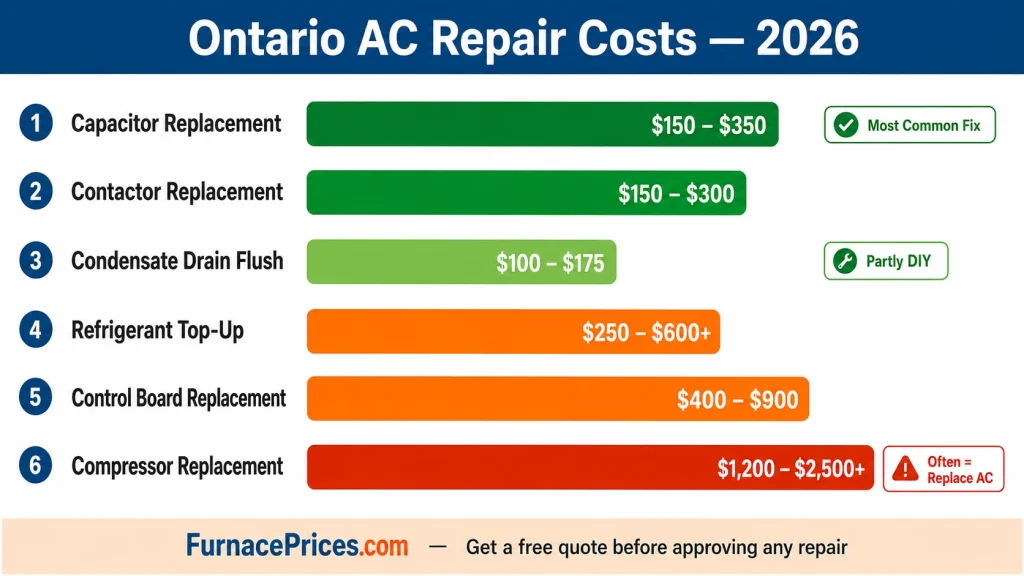
Go into a service call knowing the typical cost. Here are realistic 2026 ranges for the most common Ontario AC repairs, so you can sanity-check any quote you receive.
Repair Type
Typical Ontario Cost (2026)
DIY?
Capacitor replacement
$150 – $350 all-in
✘ No
Contactor replacement
$150 – $300
✘ No
Condensate drain flush
$100 – $175
✔ Partly
Refrigerant top-up
$250 – $600+
✘ No
Control board replacement
$400 – $900
✘ No
Compressor replacement
$1,200 – $2,500+
✘ No (often triggers replacement decision)
When repair costs start approaching 50% of a new unit's price — especially on a system over 10 years old — replacement is usually the smarter investment. Use our free AC Repair Cost Calculator to estimate your specific repair, and compare it against a new unit's cost before committing.
🔧
AC Repair Cost Calculator
Free — Use Right Here
Step 1 of 160%
🔧
A/C Repair Cost Calculator
How much will repairing your existing A/C cost? Answer a few questions about what you're experiencing and get a repair cost estimate.
How well has your A/C been cooling your home lately?
Have you noticed large indoor temperature fluctuations?
Is the thermostat on and appears to be functioning properly?
Have you noticed reduced airflow from vents even though the A/C is on?
Have you noticed air coming from vents feels warm?
Is the fan spinning very slowly or not at all on outdoor unit?
Does the air conditioner fan appear to never shut off (outdoor unit)?
Have you noticed strange odours coming from vents or near your furnace?
Have you noticed any unusual noises?
What best describes the unusual noise(s)?
Does your A/C turn on but shuts off soon after?
Does the breaker regularly trip or fuses repeatedly blow?
Have you noticed water damage or water leaking or pooling near your furnace?
Have you noticed ice build up on the refrigerant lines, copper tubing, or coil?
Have your electrical bills been significantly higher than usual lately?
Would you like to receive a free no-obligation estimate from our local contractor partners as well?
Great! Almost done, your result is on the next page.
Please enter your contact details so our Certified contractors can provide estimates as well.
This field is required.
Please enter a valid email address.
Please enter your phone number.
Please enter your city or postal code.
By submitting this form, you are giving your consent to receive phone calls and text messages from our contractor partners.
You're almost done!
Please provide your details to see your results.
Name is required.
Email is required.
Please enter your city or postal code.
🔧 Diagnosis Complete
Your A/C Repair Estimate
Estimated Repair Range
—
Likely Issue
—
Get an Accurate Repair Quote
A certified HVAC technician can diagnose the exact issue and provide a firm quote. Many offer free diagnostics.
When to Stop DIYing and Call a Licensed Technician
Some situations are beyond homeowner troubleshooting — and pushing further can damage your equipment or create safety hazards. Call a certified HVAC technician if any of the following apply:
The breaker trips again immediately after you reset it
You see ice on the refrigerant lines or outdoor unit and it returns after thawing
You smell burning plastic or any electrical odour near the unit
The system makes grinding, squealing, or banging sounds when attempting to start
The outdoor unit starts but only blows warm air (likely low refrigerant or compressor issue)
Your unit is over 10 years old and this is the second breakdown this season
If you've had two or more breakdowns in a single season, read our AC repair vs. replace guide before committing to another repair — it walks through the exact decision framework used by Ontario HVAC professionals. For urgent situations — failures during a heat advisory, households with elderly or young children, or anything that smells electrical — read our guide on warning signs you need emergency HVAC service.
Common Mistakes That Turn a Simple Problem Into an Expensive One
Repeatedly resetting the breaker. Two trips = stop. You're masking a real fault.
Running cooling mode on a frozen coil. Switch to FAN ONLY until fully thawed first — running the compressor against a frozen coil can cause permanent damage.
Skipping the filter check. It takes 30 seconds. A $20 filter prevents a $1,500+ compressor job.
Assuming it's the compressor. In Ontario, most "AC won't turn on" service calls resolve with a capacitor swap, breaker reset, or thermostat fix. Don't panic-replace a system that needs a $200 repair.
Skipping annual maintenance. A May tune-up catches failing capacitors, dirty coils, and low refrigerant before they become July emergencies.
Bottom Line: Most AC Issues Are Fixable — If You Catch Them Early
When your AC is not turning on, the problem is usually simpler than you fear. Work through the seven checks in this guide — thermostat, breaker, disconnect box, air filter, condensate drain, listening diagnostics, full reset — before picking up the phone. In our experience across Ontario, at least half of all "AC won't start" calls are resolved by the homeowner in under 30 minutes.
When you do need a technician, use the repair cost table and calculator above to benchmark any quote you receive. And if the repair cost is pushing toward what a new unit costs, our AC repair vs. replace guide will help you make the right call.
If you've worked through this entire list and nothing is working — don't wait it out in the heat. Get a free quote from a certified Ontario contractor and get your cooling back on today.
❄️ Still Not Working?
Get a Free Quote From a Certified Ontario HVAC Technician
Connect with a trusted local pro who can diagnose and fix your AC today — transparent pricing, no obligation. Takes less than 60 seconds.
🔒 Free · No obligation · Certified Ontario contractors
Frequently Asked Questions
Why is my AC not turning on at all?
The most common causes are a tripped breaker, dead thermostat battery, blown disconnect fuse, or a failed start capacitor. Work through each check in order — most are DIY-fixable before calling a technician.
What should I check first if my AC won't start?
Start with your thermostat — confirm it's set to COOL with the temperature at least 3°C below the room reading. Then check your electrical panel for a tripped breaker. These two steps resolve the majority of no-start issues.
Why won't my AC turn on after a power outage?
Power outages trigger internal fault lockouts on most modern AC systems. Perform a full reset: thermostat off, both AC breakers off, wait 30 minutes, restore power, then set to COOL. This clears most post-outage lockouts completely.
My AC turns on but isn't cooling — what's wrong?
If the AC runs but blows warm air, the most likely causes are low refrigerant, dirty condenser coils, or a compressor not engaging. These require a licensed technician — refrigerant handling is regulated in Canada.
When should I call a technician if my AC won't turn on?
Call a technician if the breaker trips again after one reset, if you smell burning, hear grinding or banging, or if the outdoor unit starts but only blows warm air. These go beyond what DIY troubleshooting can safely fix.
 Canadian