Fill out the form below to apply and get featured as one of our Top Contractors. Gain visibility, attract more clients, and showcase your expertise to a wider audience!
🔒 Your information is private and secure
Free to apply
Verified contractors only
Canada-wide visibility
No hidden charges
Free Service
No obligation
Get Your FREE HVAC Quote Today
Compare prices from top-rated local contractors in minutes
Is Your AC Acting Up? Here Are the Most Common Air Conditioner Problems — Solved
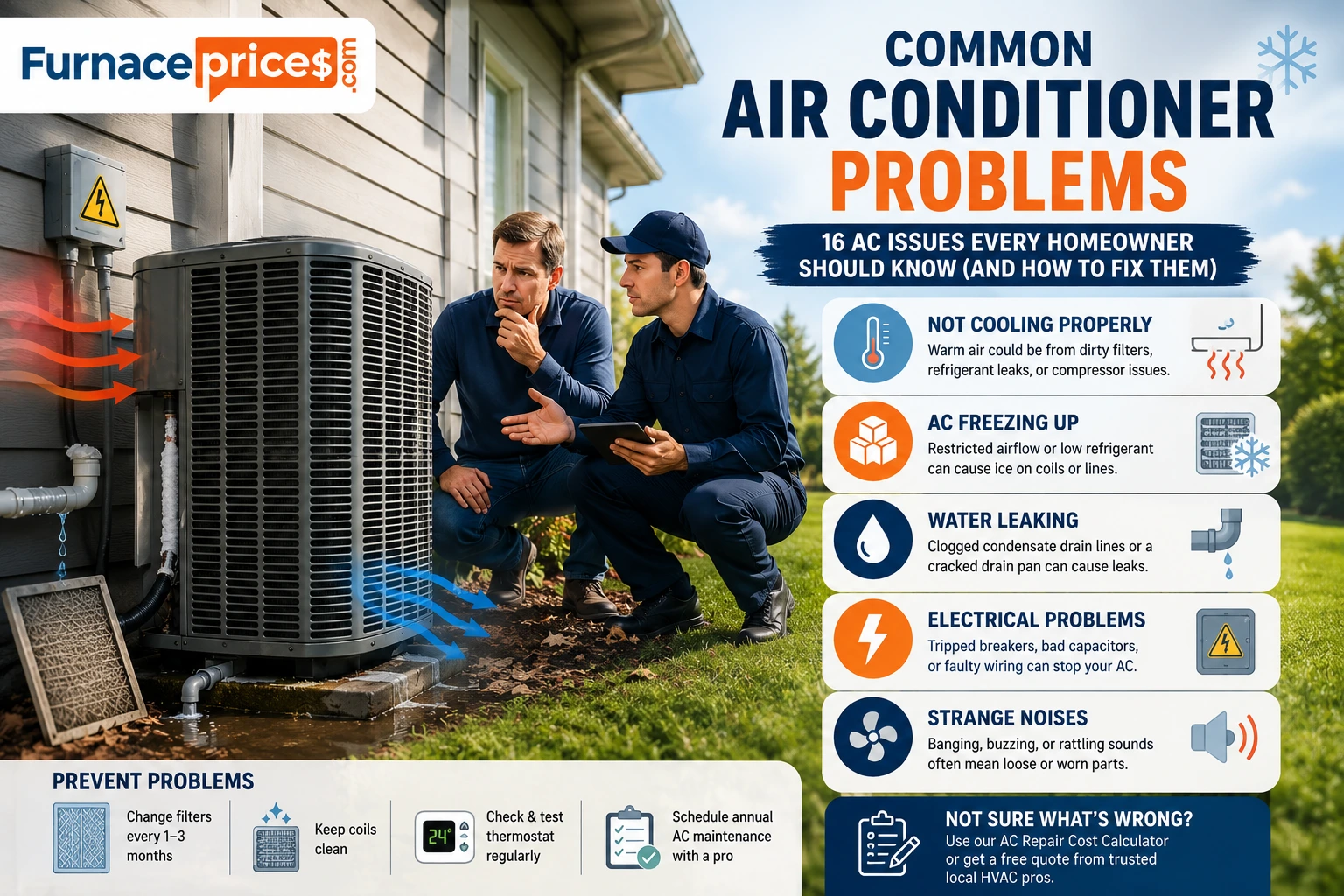
Common air conditioner problems catch homeowners off guard — usually on the hottest weekend of July. The good news? Most AC issues have clear warning signs and straightforward fixes. Whether your unit is blowing warm air, leaking, making strange noises, or running up your hydro bill, this guide covers all 16 problems with direct answers so you can act fast.
Quick Answer: The most common air conditioner problems include dirty air filters, refrigerant leaks, frozen evaporator coils, short cycling, clogged condensate drains, thermostat issues, electrical faults, and worn components. Many airflow and maintenance issues can be fixed by homeowners, while refrigerant leaks, electrical repairs, and compressor failures require a licensed HVAC technician.
Not sure if your system needs repair or full replacement? Use our AC Repair Cost Calculator to estimate costs before calling anyone.
Knowing the root cause saves you money. Let’s go through every problem one by one.
1. AC Not Cooling Properly — Why Is My Air Conditioner Blowing Warm Air?
This is the most searched common air conditioner problem for a reason. If your AC runs but the air coming out is warm or lukewarm:
Thermostat accidentally set to “heat” or “fan only”
Dirty air filter blocking airflow
Refrigerant leak (most serious cause)
Compressor failure
Outdoor unit not running
Fix it: Check your thermostat setting first. Then inspect and replace your air filter (every 1–3 months). If the outdoor unit’s fan isn’t spinning or you hear a hissing sound, you likely have a refrigerant leak — call a certified HVAC technician immediately.
2. AC Making Loud or Strange Noises — What Do They Mean?
Your AC should hum quietly. Anything louder is a warning sign.
Sound
Likely Cause
Banging
Loose fan blade, piston, or internal part
Buzzing
Loose wiring, dirty parts, or frozen coil
Clicking (repeated)
Faulty thermostat relay or contactor
Hissing
Refrigerant leak or high internal pressure
Rattling
Debris inside unit or loose screws
Squealing
Worn fan belt or dry motor bearings
Fix it: Clear debris from the outdoor unit. Tighten loose screws. Replace filters. For anything electrical or refrigerant-related, stop the unit and schedule a service call. Running a damaged AC makes repairs more expensive.
3. Air Conditioner Freezing Up — Ice on the Coils or Lines
A frozen AC seems counterintuitive, but it’s one of the more common air conditioner problems in Canada. The coil freezes when:
Airflow is restricted (dirty filter, blocked vents)
Refrigerant is low
Outdoor temperature is too cold for AC operation
Fan motor is failing
Fix it: Turn the AC off and switch the fan to “ON” (not auto) to defrost the coil — takes 1–3 hours. Replace the filter, open all vents, and restart. If it freezes again within a day, call a technician to check refrigerant levels and fan motor health.
freezes
4. AC Won’t Turn On — No Power, No Response
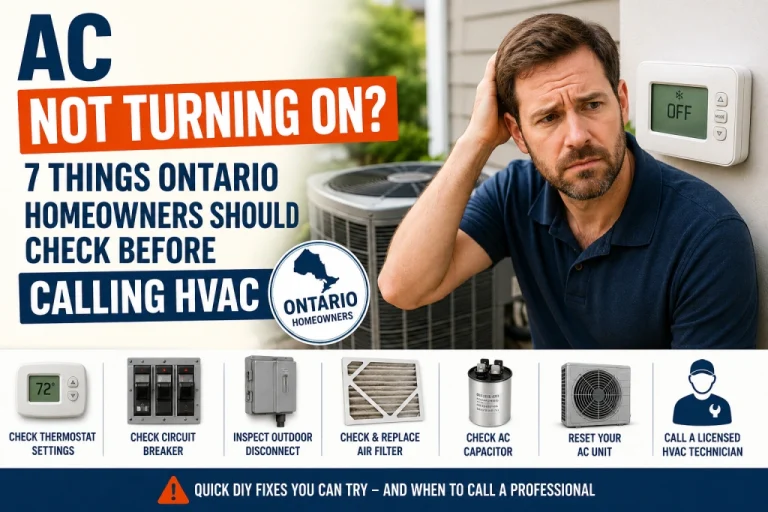
Nothing happens when you hit the thermostat? Try this checklist before calling anyone:
Check the circuit breaker — reset if tripped
Replace thermostat batteries
Inspect the disconnect switch near the outdoor unit
Check if a dirty filter has triggered a safety shutdown
Look for a flashing error code on the indoor unit
Fix it: Most “dead AC” cases are solved by steps 1–3. If the breaker trips again immediately, stop resetting it — there’s likely an electrical fault that needs a licensed electrician or HVAC tech.
5. AC Fuse Keeps Blowing — Repeated Electrical Trips
One blown fuse is a fluke. A second means something is drawing too much current:
Clogged filter forcing the motor to overwork
Failing capacitor
Frayed or shorted wiring
Incorrect fuse size installed
Fix it: Replace the filter first. Then have a certified tech check the capacitor and wiring. Never install an oversized fuse — it’s a fire hazard.
6. AC Turns On and Off Constantly — Short Cycling Explained
Short cycling (the unit starts, runs for 2–3 minutes, then stops) is hard on the compressor and dramatically shortens AC lifespan. Causes include:
Oversized unit for the home’s square footage
Refrigerant leak
Thermostat placed in direct sunlight or near a heat source
Frozen evaporator coil
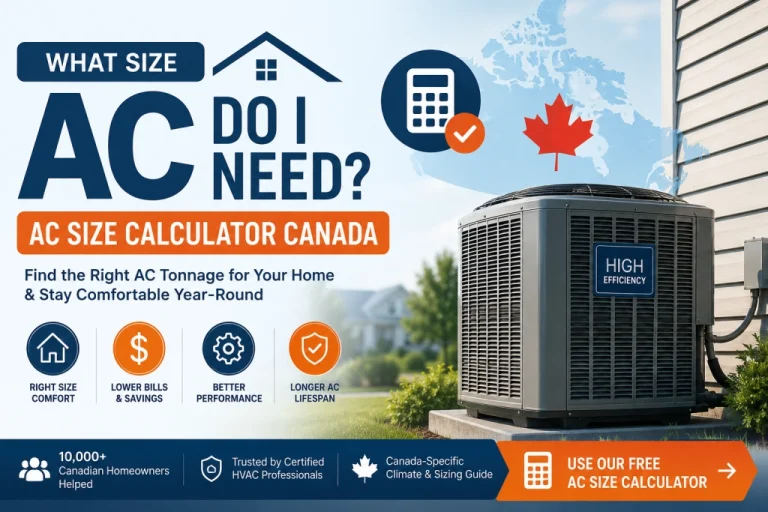
Fix it: Move objects away from the thermostat. Clean the filter and coil. If the unit is oversized, that’s a sizing problem — use our AC Size & Tonnage Calculator to verify your home needs. Oversizing requires replacement, not repair.
Step 1 of 30%
📐
A/C Size Calculator
This short quiz is designed to help homeowners estimate the correct central air conditioning system size and BTU rating for your home.
Select your home type
Approximate home square footage of finished living space
Would you like to receive a free no-obligation estimate from our local contractor partners as well?
Great! Almost done, your result is on the next page.
Please enter your contact details so our Certified contractors can provide estimates as well.
This field is required.
Please enter a valid email address.
Please enter your phone number.
Please enter your city or postal code.
By submitting this form, you are giving your consent to receive phone calls and text messages from our contractor partners.
You're almost done!
Please provide your details to see your results.
Name is required.
Email is required.
Please enter your city or postal code.
📐 Size Calculated
Your Recommended AC Size
Recommended Tonnage
—
BTU Output
—
Get a Confirmed Size from a Pro
A certified HVAC contractor performs a Manual J load calculation for exact sizing.
A small puddle under your indoor air handler is a red flag. Indoor leaks come from:
Clogged condensate drain line (most common cause)
Cracked or overflowing drain pan
Frozen evaporator coil thawing out
Disconnected drain pipe
Fix it: Pour a mix of distilled white vinegar and warm water down the drain line to clear the clog. If the pan is cracked or the leak persists, call a tech. Prolonged leaks can cause mold and structural damage.
8. Refrigerant Leak — A Serious Common Air Conditioner Problem
Refrigerant is the lifeblood of your AC. When it leaks, the entire system suffers. Signs:
Warm air despite AC running
Ice buildup on refrigerant lines
Hissing or bubbling sound
Higher energy bills
Longer cooling cycles
Important: In Canada, refrigerant handling is regulated under federal environmental law. Only licensed HVAC technicians can legally recover and recharge refrigerant. Do not attempt a DIY fix. Turn the unit off and call a pro.
9. AC Blowing Humid Air — Not Dehumidifying the Home
Your AC should remove humidity as it cools. If your home feels muggy even with the AC running:
Fan set to "ON" (should be "AUTO")
AC is oversized — it cools too fast and shuts off before removing humidity
Dirty evaporator coil
Low refrigerant
Fix it: Switch fan to "AUTO." Clean or replace the filter. Have the coils cleaned annually. If the unit is oversized, a tech can confirm this with a load calculation. See also our guide on boosting AC efficiency in Canada.
10. Bad Smells Coming from the AC Vents
Smell something off when the AC kicks on? Here's what it means:
Smell
Cause
Musty/mildew
Mold or mildew in drain pan or ducts
Dirty socks
Bacteria buildup on evaporator coil
Burning/electrical
Motor, capacitor, or wiring issue
Rotten eggs
Dead animal near or in the unit
Sweet/chemical
Refrigerant leak
Fix it: Replace the filter. Pour vinegar down the drain line. Schedule a coil cleaning service. For burning smells — turn the unit off immediately and call a technician.
11. AC Running but Not Reaching the Set Temperature
The thermostat says 72°F but the house is 80°F and the AC has been running for hours. Causes:
AC undersized for the home
Leaky ducts losing conditioned air
Poor insulation
Dirty condenser coils reducing efficiency
Outdoor unit in direct, unshaded sunlight
Fix it: Clean the outdoor condenser coils with a gentle hose rinse. Shade the unit if possible (without blocking airflow). Seal obvious duct leaks with metal foil tape. Not sure if your AC is the right size? Try our AC Size & Tonnage Calculator.
12. Uneven Temperatures — Some Rooms Are Too Hot or Too Cold
This is a comfort problem that's often structural, not mechanical:
Blocked or closed vents
Duct leaks in attic or walls
Poor home insulation
Single-zone system trying to serve a multi-level home
Fix it: Open all supply and return vents. Rearrange furniture that's blocking airflow. Use ceiling fans to circulate air. For persistent hot/cold zones, a zoning system or ductless mini-split can solve it. Read our Central AC vs Ductless AC guide for options.
13. Leaky or Poorly Sealed Ducts
Many older Canadian homes have duct systems that leak 20–30% of conditioned air into unconditioned spaces. Signs:
Rooms that never seem to cool down
Noticeably dusty air from vents
High hydro bills despite normal use
Fix it: Use metal foil tape (not cloth duct tape) to seal visible joints. For a full-home solution, ask about Aeroseal duct sealing. Refer to our HVAC Glossary for terms like "MERV rating" and "static pressure" that come up during duct evaluations.
14. AC Blinking Error Lights or Displaying Fault Codes
Modern AC units use LED blink patterns or digital error codes to communicate faults. Common codes point to:
Sensor failures
High pressure cutout
Communication errors between indoor and outdoor units
Low refrigerant
Fix it: Pull out your owner's manual and look up the specific code. Most manufacturers also post error code guides on their websites. If the code persists after resetting, a technician needs to diagnose the sensor or control board.
15. AC Bills Too High — Energy Costs Spiking Without Explanation
An inefficient AC doesn't just underperform — it bleeds money. Common causes of high AC operating costs:
Dirty air filter (makes the system work 15–25% harder)
Clogged condenser coils
Refrigerant leak
Aging unit with low SEER rating
Leaky ducts
No programmable or smart thermostat
Fix it: Replace filters monthly during peak season. Clean condenser coils annually. Upgrade to a smart thermostat. Close blinds on south and west-facing windows. If your unit is 12+ years old and expensive to run, calculate potential savings with a newer high-efficiency model using our AC Savings Calculator. Also check the benefits of buying a new air conditioner.
Step 1 of 80%
💚
New Air Conditioner Savings Calculator
How much can you save by upgrading your air conditioner? Get an instant estimate of your potential annual electricity cost savings.
What is the size of your home?
How would you rate your home's insulation & windows?
How many months per year do you use your AC?
Hours per day you run your AC (on average)
How old is your current central air conditioner?
The SEER rating of older units is used to calculate your current running costs.
What type of new AC are you considering?
What is your average electricity rate? ($/kWh)
Check your electricity bill. Average is $0.12–$0.15/kWh.
$0.13/kWh
0.07/kWh0.3/kWh
Would you like to receive a free no-obligation estimate from our local contractor partners as well?
Great! Almost done, your result is on the next page.
Please enter your contact details so our Certified contractors can provide estimates as well.
This field is required.
Please enter a valid email address.
Please enter your phone number.
Please enter your city or postal code.
By submitting this form, you are giving your consent to receive phone calls and text messages from our contractor partners.
You're almost done!
Please provide your details to see your results.
Name is required.
Email is required.
Please enter your city or postal code.
💚 Savings Calculated
Your Potential AC Savings
Annual Savings
—
Payback Period
—
Current Annual Cost
—
New Annual Cost
—
Start Saving — Get Free Quotes
These are estimates. Certified HVAC contractors can give you accurate savings projections based on your home.
16. AC Won't Turn Off — Runs Continuously Without Cycling Down
An AC that never shuts off wastes energy and burns out components faster. It usually means:
Thermostat set to "ON" instead of "AUTO"
Extreme heat overwhelming an undersized unit
Stuck relay or contactor
Low refrigerant keeping the unit in extended cooling mode
Fix it: Switch the thermostat fan setting to "AUTO." If that doesn't help, have a technician inspect the relay and contactor. Check whether the unit is properly sized for your home — our AC Recommendation Wizard can help.
Quick Reference: 16 Common AC Problems at a Glance
Problem
Most Likely Cause
DIY or Pro?
Blowing warm air
Dirty filter / refrigerant leak
DIY filter; Pro for refrigerant
Strange noises
Loose parts / debris
DIY minor; Pro for electrical
Freezing up
Blocked airflow / low refrigerant
DIY defrost; Pro if recurring
Won't turn on
Tripped breaker / dead batteries
DIY first; Pro if repeating
Fuse blowing
Failing capacitor / bad wiring
Pro always
Short cycling
Oversized unit / refrigerant
Pro to diagnose
Indoor water leak
Clogged drain line
DIY flush; Pro if persistent
Refrigerant leak
Coil or line damage
Pro only (regulated in Canada)
High humidity
Oversized unit / coil dirty
DIY setting; Pro for sizing
Bad smells
Mold, coil bacteria, electrical
DIY minor; Pro for burning smell
Won't reach set temp
Dirty coils / undersized unit
DIY coils; Pro for sizing
Uneven temperatures
Duct leaks / blocked vents
DIY vents; Pro for ducts
Leaky ducts
Age / poor sealing
DIY tape; Pro for full sealing
Error codes / blinking
Sensor / control board fault
Pro
High energy bills
Dirty system / aging unit
DIY maintenance; Pro for audit
Won't turn off
Stuck relay / bad thermostat
DIY setting; Pro for relay
When to Repair vs. When to Replace Your AC
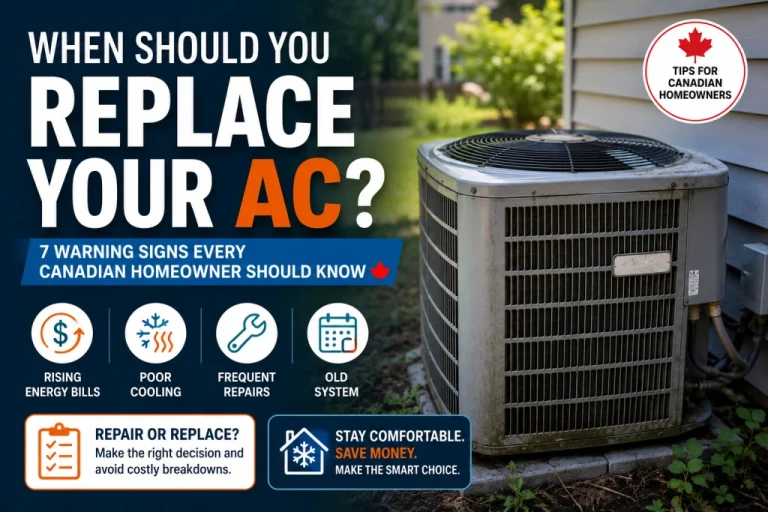
Not every AC problem is worth repairing. Use the 5,000 rule: multiply the repair cost by the unit's age. If the number exceeds $5,000, replacement is usually the smarter investment.
How to Prevent Common Air Conditioner Problems Before They Start
Prevention is cheaper than repair. Here's a proven annual maintenance checklist for Canadian homeowners:
Monthly (during cooling season):
Inspect and replace air filter
Check that all supply/return vents are open and unobstructed
Spring (before first use):
Clean outdoor condenser coils with a gentle hose rinse
Clear debris from around the outdoor unit (leave 2 feet clearance)
Test the thermostat and replace batteries
Check the condensate drain line
Annually (professional service):
Refrigerant level check
Electrical connections and capacitor test
Blower motor and fan blade inspection
Full coil cleaning
FAQ About Common Air Conditioner Problems
Q1: Why is my AC running but not cooling the house?
A dirty filter, refrigerant leak, or compressor issue are common causes. Replace the filter first and schedule service if needed.
Q2: How do I know if my AC has a refrigerant leak?
Look for warm air, ice on coils, hissing sounds, or rising energy bills. A technician can confirm and repair the leak.
Q3: Why does my air conditioner freeze up in summer?
Low airflow or low refrigerant levels are the usual causes. Let it thaw, replace the filter, and call a technician if it happens again.
Q4: What causes an air conditioner to short cycle?
An oversized unit, refrigerant issues, or thermostat problems can cause frequent on-off cycling.
Q5: Is it normal for an AC to drip water outside?
Yes, outdoor condensation is normal. Water leaking indoors usually indicates a drain problem.
Q6: How often should I change my AC air filter?
Every 1–3 months, or monthly if you have pets, allergies, or a dusty home.
Q7: My AC smells musty when it turns on. What do I do?
A musty smell often means mold or mildew. Replace the filter and schedule a professional cleaning if needed.
Q8: When should I replace my AC instead of repairing it?
Consider replacement if the unit is 12–15+ years old or repair costs exceed 50% of replacement value.
Get Expert Help for Your Air Conditioner
Most common air conditioner problems start small but become expensive if ignored. Regular maintenance, timely repairs, and the right system size can prevent breakdowns and lower energy bills. If you're unsure whether your system should be repaired or replaced, compare repair costs, estimate operating expenses, and get quotes from trusted Canadian HVAC contractors before making a decision.
 Canadian