Fill out the form below to apply and get featured as one of our Top Contractors. Gain visibility, attract more clients, and showcase your expertise to a wider audience!
🔒 Your information is private and secure
Free to apply
Verified contractors only
Canada-wide visibility
No hidden charges
Free Service
No obligation
Get Your FREE HVAC Quote Today
Compare prices from top-rated local contractors in minutes
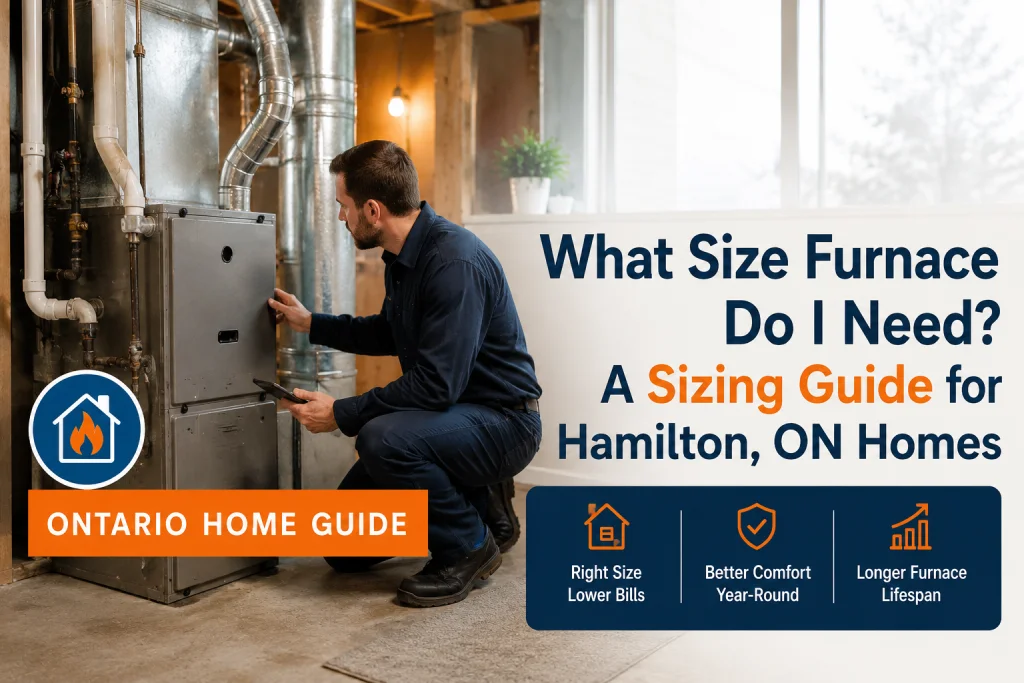
What size furnace do I need? For a well-insulated Hamilton-area home, budget roughly 30–35 BTUs per square foot — so if you’re asking what size furnace you need for a 1,500 sq ft house, that works out to a furnace rated between 45,000 and 52,500 BTUs. Because Hamilton sits in Climate Zone 6 with a winter design temperature near -18°C, most local homes land at the higher end of that range. Below, this furnace sizing guide walks through the full BTU-by-square-foot chart, the exact formula, and a free calculator to get your home-specific number.
📍 Serving: Hamilton, Burlington, Oakville, Milton, Brantford, and Cambridge, Ontario. Looking for coast-to-coast BTU benchmarks instead? See our national Furnace Sizing Guide for Canadian Homes — this page goes deeper on the Golden Horseshoe specifically.
🧮 Free Sizing Tool
Skip the Math — Get Your BTU Estimate Instantly
Answer a few quick questions about your home and get a personalized furnace size recommendation in under a minute.
Step 1 of 70%
📐
Furnace Size & BTU Calculator
Not sure what size furnace you need? Answer a few questions about your home and we'll calculate the right BTU output for your situation.
Select your home type
Approximate home square footage of finished living space
What year was your home built?
How well-insulated is your home?
Does your home have lots of large windows, patio doors, skylights, or a sunroom?
Which part of Canada/North America do you live in?
Would you like a free no-obligation estimate from our local contractor partners?
Great! Almost done, your result is on the next page.
Please enter your contact details so our Certified contractors can provide estimates as well.
This field is required.
Please enter a valid email address.
Please enter your phone number.
Please enter your city or postal code.
By submitting this form, you are giving your consent to receive phone calls and text messages from our contractor partners.
You're almost done! Where do we send the results?
Please provide your details to see your results.
Name is required.
Email is required.
Please enter your city or postal code.
📐 BTU Calculation Complete
Your Recommended Furnace Size
Recommended Furnace Output
—
BTUs per hour
What This Means
Get Free Quotes from Local Pros
Certified HVAC contractors in your area will confirm the right size and provide accurate pricing.
What Size Furnace Do I Need for My Hamilton-Area Home?
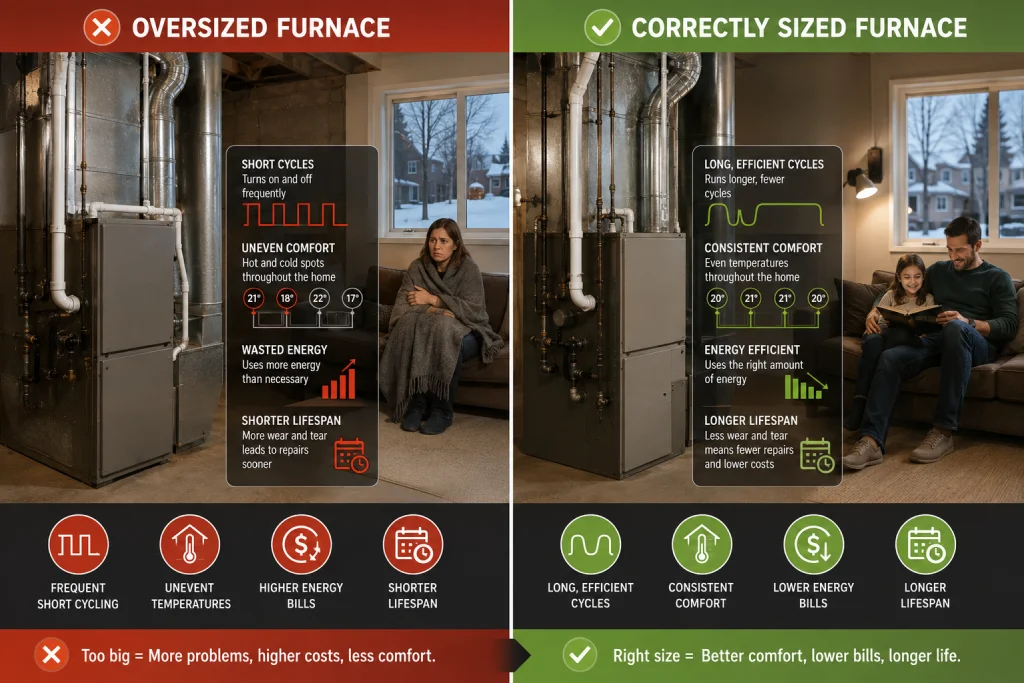
Furnace size is measured in BTUs (British Thermal Units) — the amount of heat the unit can produce per hour. Get this number wrong in either direction and you pay for it: an undersized furnace runs constantly and never quite catches up, while an oversized furnace short-cycles, wearing out components faster and heating your home unevenly.
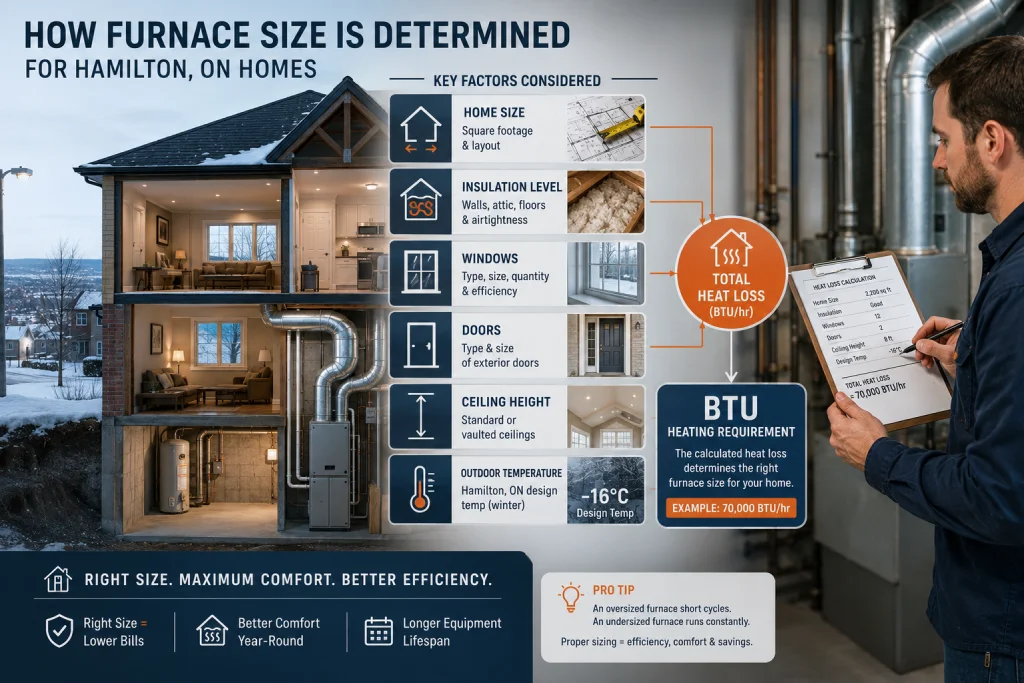
Your furnace BTU requirements depend on four core factors — this is how to determine furnace size correctly rather than guessing:
Home size — total square footage of heated living space.
Insulation quality — how well your home retains heat.
Local climate — Hamilton's design temperature and Climate Zone.
Air leakage — how much conditioned air escapes through gaps, older windows, and doors.
Hamilton's Climate: Why Furnace Sizing Matters More Here Than in Milder Regions
Hamilton and the surrounding Golden Horseshoe fall within Climate Zone 6 under Canada's building code, with a winter design temperature of roughly -18°C. That's meaningfully colder than the generic "Ontario average" most national sizing guides quote — which is exactly why a furnace sized off a national rule of thumb often runs undersized once a real Hamilton cold snap hits. Homeowners in Burlington, Oakville, Milton, Brantford, and Cambridge fall in the same or a closely comparable zone, so the same design-temperature logic applies across the region.
📌 Source Note: Climate zone and design temperature data referenced from Natural Resources Canada and the Ontario Building Code. Always confirm current figures for your specific municipality with your HVAC contractor before finalizing a system size.
How to Determine Furnace Size: Step-by-Step
This basic formula gives you a solid starting estimate of your furnace BTU sizing. It is not a substitute for a professional Manual J load calculation, but it's accurate enough to sanity-check any quote you receive.
Find your square footage. Example: a single-story home with a 1,500 sq ft footprint.
Apply the BTU-per-square-foot guideline for your insulation level:
30 BTUs/sq ft — well-insulated homes
35 BTUs/sq ft — average insulation
40 BTUs/sq ft — poor insulation
Multiply. A 1,500 sq ft home with average insulation: 1,500 × 35 = 52,500 BTUs required.
📐 Example: What Size Furnace Do I Need for a 1,500 Sq Ft House? Applying Hamilton's Zone 6 climate, a 1,500 sq ft house needs roughly 45,000 BTUs if well-insulated, up to 60,000 BTUs if poorly insulated — with 52,500 BTUs being the typical mid-range figure for average insulation. This is why "one number fits every 1,500 sq ft home" answers you'll see elsewhere are only a starting point, not a final spec.
Furnace Size Chart by Square Feet (Hamilton-Area Homes)
Home Size (sq ft)
Well-Insulated
Average Insulation
Poor Insulation
1,000
30,000 BTU
35,000 BTU
40,000 BTU
1,500
45,000 BTU
52,500 BTU
60,000 BTU
2,000
60,000 BTU
70,000 BTU
80,000 BTU
2,500
75,000 BTU
87,500 BTU
100,000 BTU
3,000
90,000 BTU
105,000 BTU
120,000 BTU
This furnace size chart is a guideline, not a substitute for an in-home assessment. If you're still asking "how many BTUs do I need for my furnace" after checking the table, get an instant, home-specific number from the Furnace Size & BTU Calculator — it factors in ceiling height and insulation level automatically.
What Else Affects Furnace Size Beyond Square Footage?
Furnace size by square feet is the starting point, not the finish line. These factors can shift your furnace BTU requirements significantly:
Ceiling height — higher ceilings mean more air volume to heat, increasing BTU needs.
Number and type of windows — more windows, or older single-pane windows, increase heat loss.
Finished basements and attics — conditioned space adds to your total heating load.
Home age and construction era — see the section below on older Hamilton and Cambridge housing stock.
💰 Compare the Full Picture
Not Just Size — What Will It Cost?
Once you have a BTU range, compare installed costs and expected monthly running costs before you talk to a contractor.
Does Your Home's Age Affect Furnace Sizing in Hamilton and Cambridge?
Yes — and it's one of the most overlooked factors in this region. Hamilton, Cambridge, and Brantford all have a meaningful share of century homes and pre-1980s housing stock with irregular insulation, older windows, and additions that weren't part of the original heating design. A flat BTU-per-square-foot rule tends to under- or over-shoot on these homes more than it does on newer builds. If your home falls into this category, treat the chart above as a rough starting range and prioritize a professional Manual J load calculation over the DIY formula.
Can I Downsize My Furnace If I Improve My Insulation?
Yes, in many cases. Homes with strong insulation retain heat more effectively, consume less energy, and need fewer BTUs to hold a comfortable temperature. If you're planning an insulation upgrade before a furnace replacement, mention it to your HVAC contractor first — sizing the new furnace to your post-upgrade insulation level (rather than your current level) can mean a smaller, less expensive unit with lower operating costs. If you're unsure of your current insulation quality, a professional energy audit will identify weak points before you size anything.
Should I Install a Two-Stage or Modulating Furnace?
For many Hamilton-area homes, yes — two-stage and modulating furnaces adjust their output to match real-time heating demand instead of running at full blast every cycle. That means better comfort during shoulder-season temperatures (October, March) and less energy waste compared to a single-stage furnace sized for the coldest day of the year. They typically cost more upfront, so it's worth comparing the total cost of ownership rather than the sticker price alone — our Complete Furnace Buying Guide breaks down single-stage vs. two-stage vs. modulating pricing in more detail.
Is Bigger Really Better? Common Furnace Sizing Myths
Myth
Reality
Bigger is better
An oversized furnace short-cycles, causing uneven heating and higher energy bills — not better comfort.
High BTU rating = efficient
Efficiency depends on correct sizing and installation, not the BTU number alone.
Brand matters more than size
Even a premium brand underperforms if it's the wrong size for your home.
All homes are the same
Age, insulation, layout, and local climate mean every home needs its own calculation.
Do You Need a Zoning System?
Larger homes, multi-story layouts, or homes with a finished basement often have sections that need different heating levels. A zoning system directs heat to specific areas independently instead of treating the whole house as one unit. If parts of your home are consistently colder or warmer than others, ask your contractor whether zoning — rather than simply upsizing the furnace — solves the problem more efficiently. If you're weighing a heat pump instead of a straight furnace replacement, our Heat Pump vs. Furnace comparison covers how sizing logic differs between the two.
🔧 From Our Work With Hamilton-Area Homeowners: A large share of the oversizing complaints we see trace back to a furnace that was replaced "like-for-like" with the original builder-grade unit, without re-checking whether that original unit was ever correctly sized in the first place. If your current furnace short-cycles or runs constantly, that's worth flagging to your technician before simply swapping in the same size again.
What Rebates Are Available for High-Efficiency Furnaces in Ontario?
Enbridge Gas has periodically offered rebates for qualifying high-efficiency furnace upgrades (96%+ AFUE) — but program availability and rebate amounts change. For the current rundown of Ontario-specific programs, see our full Furnace Rebates & Prices in Ontario guide rather than relying on figures quoted here.
When to Call a Professional for a Manual J Load Calculation
The square-footage formula above gets you close. A Manual J load calculation gets you exact — it factors in orientation, window sizing, local climate data, and construction details the basic formula can't account for. Bring in a professional for this step if:
Your home is a century home or has an irregular layout or multiple additions.
You're planning renovations or an expansion that changes your heated square footage.
Your current furnace short-cycles, runs constantly, or heats rooms unevenly — see our Furnace Not Working guide if you're also seeing outright failures, not just sizing symptoms.
Already have a furnace and unsure if it's the right size? Run it through the Repair or Replace Quiz to see whether a repair, a resize, or a full replacement makes the most financial sense.
Furnace Sizing Across Hamilton, Burlington, Oakville, Milton, Brantford & Cambridge
The BTU math above applies consistently across the region since these communities share a closely comparable climate zone. A few local notes worth factoring in:
Hamilton & Cambridge — higher share of older, century-home housing stock; lean toward a professional load calculation.
Burlington & Oakville — larger, newer builds are common; ceiling height and finished basements often push totals above the base chart.
Milton — rapid new construction means many homes fall cleanly into the "well-insulated" column, but always confirm against your build year.
Brantford — a mix of older core neighbourhoods and newer subdivisions; treat sizing on a home-by-home basis rather than a blanket city average.
🔥 Get Started Today with FurnacePrices.com
Ready to Size and Price Your Next Furnace?
Compare BTU estimates, installed costs, and financing options — all tailored specifically for Hamilton-area homeowners. Free to use, no obligation.
📩 Questions? Reach out at contact@furnaceprices.com
For more detailed guidance on energy efficiency standards, visit Natural Resources Canada, which provides trusted tools and heating advice for Canadian homeowners.
✍️ About This Guide: Reviewed by the FurnacePrices.com editorial team, drawing on furnace BTU sizing patterns, calculator data, and homeowner questions collected across Hamilton, Burlington, Oakville, Milton, Brantford, and Cambridge. This guide is educational — always confirm final sizing with a licensed HVAC professional before purchase.
 Canadian