Fill out the form below to apply and get featured as one of our Top Contractors. Gain visibility, attract more clients, and showcase your expertise to a wider audience!
🔒 Your information is private and secure
Free to apply
Verified contractors only
Canada-wide visibility
No hidden charges
Free Service
No obligation
Get Your FREE HVAC Quote Today
Compare prices from top-rated local contractors in minutes
AC Size Calculator Canada showing central air conditioner sizing guide and AC tonnage calculator for Canadian homes
Last Updated: June 2026 · Reviewed by a Certified HVAC Professional
Using an AC Size Calculator Canada homeowners can trust is the most important step before buying or replacing a central air conditioner. — and most homeowners skip it entirely. The result? An oversized unit that short-cycles and leaves your home clammy, or an undersized system that runs non-stop and still can’t keep up on a 34°C afternoon in Ontario.
Our AC Size Calculator Canada tool helps homeowners estimate the correct AC tonnage before requesting quotes from HVAC contractors — whether you’re in Toronto, Hamilton, Ottawa, Calgary, Kelowna, or anywhere in between.
You’ll learn exactly how AC tonnage sizing works, what factors matter most in the Canadian climate, how to read real examples for different home sizes, and how to use a proper AC sizing calculator so you never overpay for the wrong unit.
By the end, you’ll walk into any contractor conversation fully informed — or at minimum, have a reliable baseline to pressure-test any quote you receive.
Skip the guesswork. Use our free AC Size & Tonnage Calculator built for Canadian homes — then get a free, no-obligation quote from a local certified HVAC contractor.
✅ Free to use · No signup required · Results in 60 seconds · Canadian climate data
10,000+Homeowners Helped
60 secTo Size Your Home
CanadaClimate Adjusted
FreeNo Obligation
Why AC Sizing Matters More in Canada
Canada has a split personality when it comes to climate. Winters are brutal, but summers — especially across Ontario, Quebec, and the Prairie provinces — regularly push above 30°C with high humidity. That combination puts serious demand on any cooling system.
Unlike mild-climate regions where approximate sizing is forgiving, Canadian homes need to handle both extremes: peak summer heat and the fact that the same ductwork is shared with your furnace in winter. Getting the tonnage right isn’t just about comfort — it directly affects energy bills, humidity control, and how long your equipment lasts.
A correctly sized AC unit will:
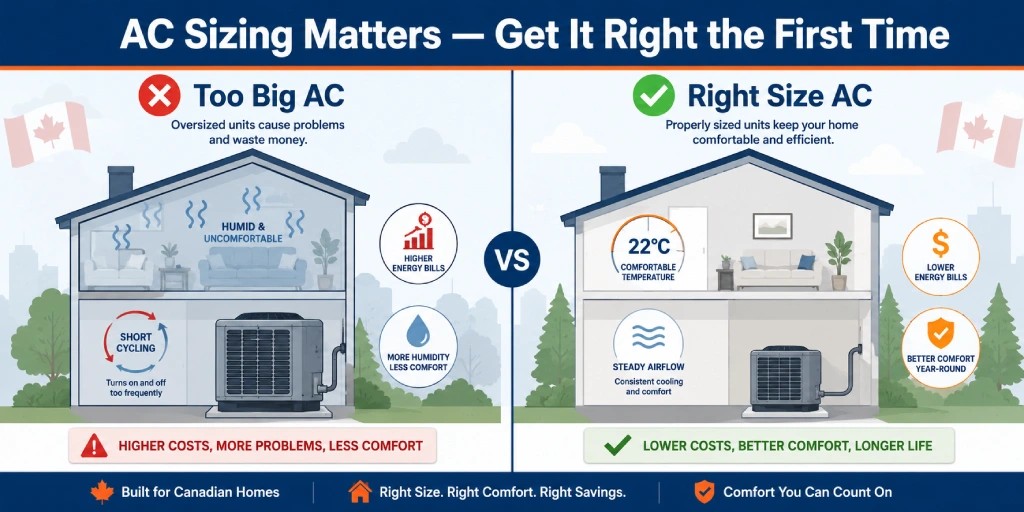
Run in longer, efficient cycles — removing humidity far better than a short-cycling oversized unit
Reach set temperature without straining the compressor
Operate within its designed efficiency range, keeping your Hydro or utility bill predictable
Last significantly longer — typically 15–20 years vs. 10–12 for an improperly sized system
💡 Canadian Context:Natural Resources Canada recommends that AC systems be sized using a proper heat-gain calculation — not just square footage. Most big-box store “rules of thumb” underestimate heat gain in older Ontario homes with poor insulation and south-facing windows.
What Does AC Size Mean? Tons and BTUs Explained
When HVAC contractors talk about AC size, they’re referring to cooling capacity measured in tons or BTUs per hour (BTU/h). One ton of cooling equals 12,000 BTU/h — enough to remove that amount of heat from your home every hour.
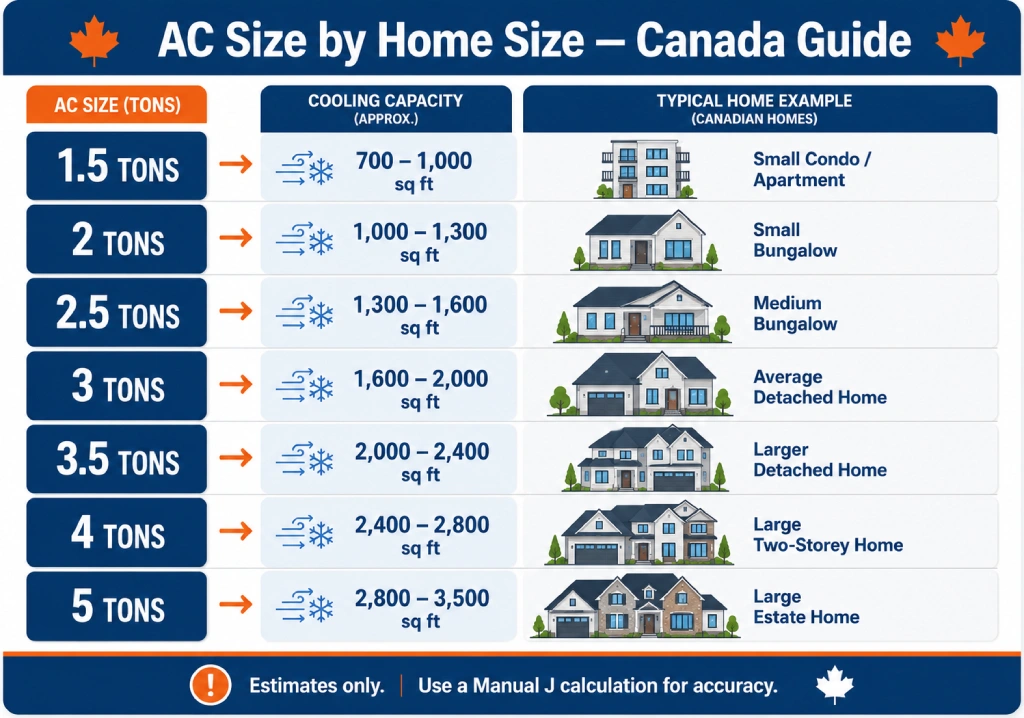
Residential central air conditioners in Canada typically range from 1.5 tons to 5 tons, with most single-family homes falling between 2 and 4 tons. You’ll also see units listed in kilowatts (kW) — 1 ton equals roughly 3.5 kW of cooling capacity.
AC Size (Tons)
BTU/hr
Approx. kW
Typical Home Size (Canadian)
1.5 tons
18,000
~5.3 kW
700–1,000 sq ft
2 tons
24,000
~7 kW
1,000–1,300 sq ft
2.5 tons
30,000
~8.8 kW
1,300–1,600 sq ft
3 tons
36,000
~10.5 kW
1,600–2,000 sq ft
3.5 tons
42,000
~12.3 kW
2,000–2,400 sq ft
4 tons
48,000
~14 kW
2,400–2,800 sq ft
5 tons
60,000
~17.6 kW
2,800–3,500 sq ft
Important: These are starting estimates only. A 2,000 sq ft home in Ottawa with a 1970s brick exterior and new triple-pane windows needs a different tonnage than the same square footage in Mississauga with vaulted ceilings and large west-facing glass. That’s why a proper load calculation always beats a square footage shortcut — and why our AC size and tonnage calculator factors in your specific province and home characteristics, not generic US-based rules.
Real AC Sizing Examples for Canadian Homes
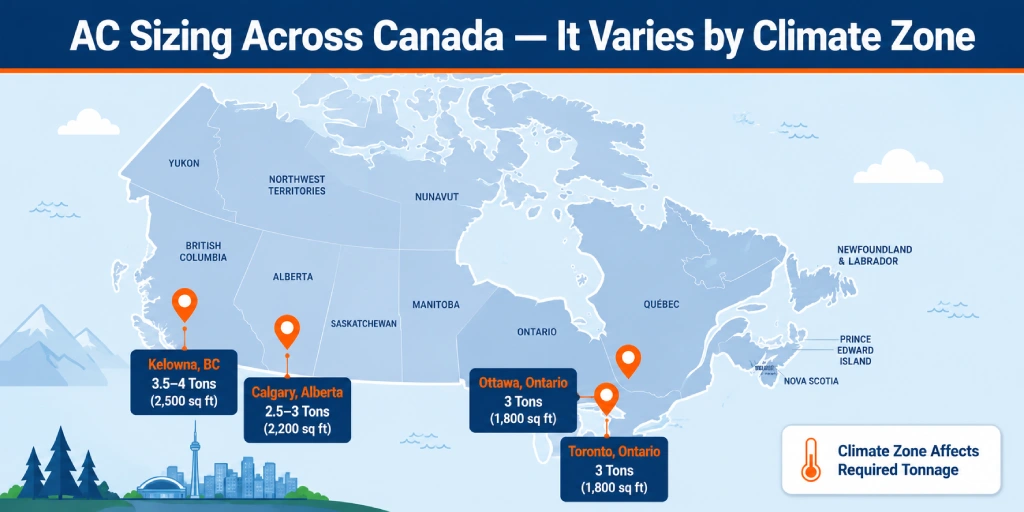
These examples show how an AC Size Calculator Canada estimate can vary depending on climate zone, insulation levels, and home design.
Theory is useful, but real examples are what actually help homeowners make decisions. Below are four practical sizing scenarios for different Canadian home types and provinces. Use these to cross-check your own situation before calling a contractor.
📍 Toronto, Ontario
1,200 sq ft semi-detached bungalow · 8 ft ceilings · Built 1985 · Average insulation · Some south-facing windows
2 – 2.5 TonsRecommended AC Size
High humidity zone. If older windows haven’t been replaced, lean toward 2.5 tons. Variable-speed compressor strongly recommended for humidity control.
📍 Ottawa, Ontario
1,800 sq ft two-storey detached · 9 ft ceilings · Built 2005 · Well-insulated · Double-pane windows
3 TonsRecommended AC Size
Ottawa summers are hot and humid but shorter than Windsor. At 1,800 sq ft with good insulation, 3 tons is the right call. Avoid oversizing — short-cycling is common in this range if you go to 3.5.
📍 Calgary, Alberta
2,200 sq ft detached two-storey · 9 ft ceilings · Built 2012 · Good insulation · Triple-pane windows
2.5 – 3 TonsRecommended AC Size
Calgary’s dry heat reduces humidity load significantly. A well-insulated 2,200 sq ft home often performs fine at 2.5 tons — you don’t need the extra capacity for humidity removal like you would in Ontario.
📍 Kelowna, BC
2,500 sq ft rancher · 9 ft ceilings · Built 2000 · Moderate insulation · Large south and west windows
3.5 – 4 TonsRecommended AC Size
BC Interior heat is dry but extreme — Kelowna regularly sees 38°C+ in July. Large west-facing windows add serious solar heat gain. Never undersize in this region; sizing at the top of the range is the safe call.
💡 How to Use These Examples: Find the scenario closest to your home and climate zone, then run it through our AC size calculator with your actual inputs to refine. If your contractor’s quote differs by more than half a ton from these benchmarks without a clear explanation — ask why.
🔧
AC Size & Tonnage Calculator
Find the right AC size before you buy and avoid costly sizing mistakes.
Step 1 of 30%
📐
A/C Size Calculator
This short quiz is designed to help homeowners estimate the correct central air conditioning system size and BTU rating for your home.
Select your home type
Approximate home square footage of finished living space
Would you like to receive a free no-obligation estimate from our local contractor partners as well?
Great! Almost done, your result is on the next page.
Please enter your contact details so our Certified contractors can provide estimates as well.
This field is required.
Please enter a valid email address.
Please enter your phone number.
Please enter your city or postal code.
By submitting this form, you are giving your consent to receive phone calls and text messages from our contractor partners.
You’re almost done!
Please provide your details to see your results.
Name is required.
Email is required.
Please enter your city or postal code.
📐 Size Calculated
Your Recommended AC Size
Recommended Tonnage
—
BTU Output
—
Get a Confirmed Size from a Pro
A certified HVAC contractor performs a Manual J load calculation for exact sizing.
How to Use an AC Size Calculator Canada vs. Manual J
The gold standard for sizing any cooling system is a Manual J load calculation. A full load calculation accounts for every factor that affects how much heat your home gains on a peak summer day, including orientation, insulation values, window area, occupancy, internal heat sources, infiltration rate, and local design temperatures.
Natural Resources Canada recommends proper load calculations rather than relying solely on square footage estimates when selecting heating and cooling equipment.
A properly performed Manual J by a trained HVAC contractor is always the most accurate method. So how does an online air conditioner size calculator compare?
Method
Accuracy
Cost
Best Use
Manual J (Full)
Highest
Included in contractor quote
Before any installation
Online AC Size Calculator
Good (±0.5 tons)
Free
Pre-shopping research & quote validation
Square Footage Rule of Thumb
Low
Free
Very rough ballpark only
Our online HVAC load calculation tool uses simplified Manual J inputs — province, square footage, ceiling height, insulation level, and window type — to generate a Canada-specific estimate accurate enough to validate contractor quotes and make an informed pre-purchase decision.
🔬 How Our AC Size Calculator Works
Climate data input: We apply real Canadian design temperatures for your province — not US-based ASHRAE data that under-estimates Ontario or BC heat loads.
Heat gain calculation: The tool estimates solar gain through windows, conduction through walls and ceiling, and infiltration losses based on your insulation and construction year inputs.
Occupancy & internal loads: Standard occupancy and appliance heat loads are added automatically based on home size.
Tonnage output: Results are displayed as a recommended range (e.g., 2.5–3 tons) rather than a single number — reflecting real-world variability and contractor discretion.
Accuracy note: Results are a validated estimate, not a certified Manual J. Always confirm with a licensed contractor before purchase.
Key Factors in Proper HVAC Load Calculation
Total conditioned floor area — the starting point, but not the whole picture
Window area, type, and orientation — south and west-facing glass is the single biggest variable in most Canadian homes
Local climate zone — Windsor, ON faces far more cooling load than Edmonton, AB
Air leakage (infiltration) — older homes with drafty basements lose efficiency fast
Number of occupants — each person adds roughly 230–250 BTU/h of heat gain
Internal heat sources — home offices with multiple monitors, kitchen appliances, heat-generating equipment
Shading — mature trees on the south and west side can reduce cooling load by 10–15%
💡 Red Flag Alert: If a contractor quotes you a size without asking about your insulation, window types, or ceiling heights — that's a warning sign. A proper sizing conversation should take at least 10–15 minutes before any in-home assessment. Any contractor who immediately says "you need a 3-ton" based solely on square footage hasn't done their job.
🔧
Ready to calculate your home's cooling requirements?
Use the tool below.
Step 1 of 30%
📐
A/C Size Calculator
This short quiz is designed to help homeowners estimate the correct central air conditioning system size and BTU rating for your home.
Select your home type
Approximate home square footage of finished living space
Would you like to receive a free no-obligation estimate from our local contractor partners as well?
Great! Almost done, your result is on the next page.
Please enter your contact details so our Certified contractors can provide estimates as well.
This field is required.
Please enter a valid email address.
Please enter your phone number.
Please enter your city or postal code.
By submitting this form, you are giving your consent to receive phone calls and text messages from our contractor partners.
You're almost done!
Please provide your details to see your results.
Name is required.
Email is required.
Please enter your city or postal code.
📐 Size Calculated
Your Recommended AC Size
Recommended Tonnage
—
BTU Output
—
Get a Confirmed Size from a Pro
A certified HVAC contractor performs a Manual J load calculation for exact sizing.
AC Size by Square Footage — Canada Quick Reference
These are the most commonly searched sizing questions we see from Canadian homeowners. Use these as a starting point — then verify with the AC size calculator using your specific inputs.
What Size AC for 1,200 sq ft?
A 1,200 sq ft Canadian home typically needs a 2 to 2.5 ton AC. Older homes with minimal insulation or large windows lean toward 2.5 tons. A well-insulated post-2000 build with modest windows can often run comfortably on 2 tons.
What Size AC for 1,500 sq ft?
For a 1,500 sq ft home in most Canadian provinces, the range is 2.5 to 3 tons. Southern Ontario homes — especially those with high humidity exposure and older construction — should default to 3 tons. Alberta and drier BC climates may be fine at 2.5 tons.
What Size AC for 2,000 sq ft?
A 2,000 sq ft home in Canada generally requires 3 to 3.5 tons. This is where climate zone makes the biggest difference: a 2,000 sq ft home in Windsor, ON with high humidity load will need 3.5 tons; the same footprint in a drier Alberta city may be comfortable at 3 tons.
What Size AC for 2,500 sq ft?
Homes around 2,500 sq ft typically need 3.5 to 4 tons. If the home has vaulted ceilings, a finished basement included in the cooling zone, or significant west-facing glass, size at 4 tons. Well-insulated newer builds in moderate climates may perform well at 3.5 tons.
For anything above 2,500 sq ft, use our AC tonnage calculator directly — larger homes have too many variables for a simple rule of thumb to be reliable.
Oversized vs. Undersized AC — The Real Cost
This is where most homeowners make a costly mistake — and where understanding proper central air conditioner sizing pays for itself many times over.
Problems With an Oversized AC
An oversized AC reaches the set temperature too quickly and shuts off — a pattern called short cycling. This sounds efficient, but it causes real problems:
Poor humidity removal — the unit doesn't run long enough to pull moisture out of the air, leaving your home clammy at 22°C. This is a major problem in high-humidity Ontario summers.
Higher energy bills — compressors use the most electricity at startup; frequent on-off cycling is far less efficient than steady long runs
Accelerated wear — compressor startups are mechanically stressful; short-cycling can cut equipment life nearly in half
Uneven temperatures — rooms at the far end of the duct run never fully cool before the unit shuts off
Problems With an Undersized AC
Constant runtime on peak days — during a heat wave, the unit never shuts off, driving your electricity bill up significantly
Inability to reach setpoint — on days above 32°C, an undersized system simply can't cool the home to the desired temperature
Premature failure — running continuously under heavy load causes the compressor to overheat and wear out faster
⚠️ Both oversizing AND undersizing cost you money every month. The only right answer is correct sizing. Use the AC size calculator before any purchase, and use the AC operating cost calculator to compare annual running costs between correctly and incorrectly sized units.
🔧
AC Operating Cost Calculator
See how much your air conditioner could cost to run each year.
Step 1 of 70%
⚡
Air Conditioner Operating Cost Calculator
Calculate the estimated monthly and annual operating cost of your air conditioner based on your usage, climate, and electricity rate.
What type of air conditioner do you have?
What is the size of the area you are cooling?
How well insulated is your space?
What is your climate region?
What temperature do you set your thermostat to?
Thermostat setting affects how hard your AC works.
22°C
17°C27°C
What is your average electricity rate? ($/kWh)
Check your electricity bill for your rate. Average is $0.12–$0.15/kWh.
$0.13/kWh
0.07/kWh0.3/kWh
Would you like to receive a free no-obligation estimate from our local contractor partners as well?
Great! Almost done, your result is on the next page.
Please enter your contact details so our Certified contractors can provide estimates as well.
This field is required.
Please enter a valid email address.
Please enter your phone number.
Please enter your city or postal code.
By submitting this form, you are giving your consent to receive phone calls and text messages from our contractor partners.
You're almost done!
Please provide your details to see your results.
Name is required.
Email is required.
Please enter your city or postal code.
⚡ Costs Calculated
Your AC Operating Costs
Monthly Cost
—
Annual Cost
—
Reduce Your Energy Costs
A properly sized, high-efficiency AC keeps operating costs low. Get free quotes from certified contractors.
The AC Size Calculator Canada tool automatically adjusts recommendations based on provincial climate data.
Canada spans multiple climate zones, and cooling load varies dramatically across them. The same square footage requires different tonnage depending on where you live — because humidity is just as important as heat.
Southern Ontario (Windsor, London, Hamilton, GTA): High heat and high humidity in summer. Plan for the upper end of the sizing range. Humidity removal is critical — seriously consider a 2-stage or variable-speed compressor.
Ottawa / Eastern Ontario: Hot, humid summers but shorter cooling season. Standard sizing applies; lean slightly toward mid-range.
Quebec (Montreal, Quebec City): Similar to Ottawa with humid July heat. Don't undersize.
Alberta (Calgary, Edmonton): Hot but significantly drier summers. Lower humidity load means you can often size at the lower end of the range for your square footage. Calgary especially gets dry Chinook winds that reduce cooling demand.
BC Interior (Kelowna, Kamloops, Vernon): Dry heat with potential for 38°C+ days. Undersizing here means suffering through heat waves. Size at the top of the recommended range.
Coastal BC (Vancouver, Victoria): Historically mild, but the 2021 heat dome changed the calculus permanently. Don't assume coastal means low load — size for the worst-case event, not the historical average.
Our AC size calculator Canada applies provincial design temperature data so your estimate reflects real regional conditions — not generic continental averages.
SEER Ratings and AC Size — What You Need to Know
AC efficiency (SEER — Seasonal Energy Efficiency Ratio) and tonnage are closely linked decisions. In Canada, the minimum SEER rating for new central AC units is 13 SEER in most provinces, but higher-efficiency models (SEER 16–22) are increasingly common and often eligible for rebates through provincial utility programs like NRCan's Greener Homes.
Here's the key connection to sizing: a higher-SEER variable-speed unit is more forgiving of minor sizing errors because it can ramp output up or down. A single-stage budget unit at the wrong size has no such flexibility — it's either fully on or fully off, which is why getting the tonnage right matters especially for entry-level systems.
Use our AC savings calculator to see how much a high-efficiency upgrade saves over 10 years, and our AC recommendation wizard to match the right efficiency tier to your home and budget.
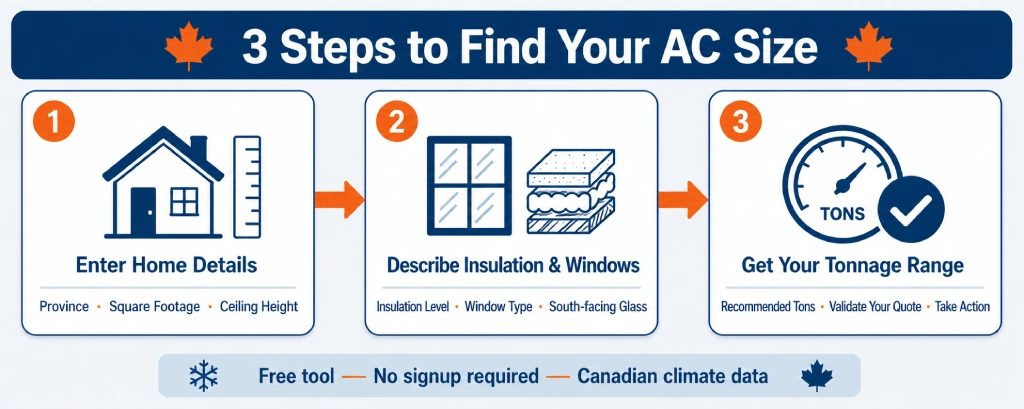
How to Use the FurnacePrices.com AC Size Calculator Canada Tool
Our free Calculator tool calculate your AC size is built specifically for Canadian homes. Here's how to use it:
Step 1: Enter Your Province and Home Details
Select your province — this applies the correct local design temperatures for heat gain calculations. Then enter your total conditioned square footage and ceiling height. Include your finished basement if it's part of your cooling zone.
Step 2: Describe Your Insulation and Windows
Select your insulation level (basic, standard, or well-insulated) and window type. If you have large glass areas on the south or west side, flag this — it's the single biggest variable in Canadian solar heat gain calculations and can shift your recommendation by half a ton.
Step 3: Review Your Tonnage and Take Action
The calculator returns a recommended tonnage range and explains the key factors driving it. Cross-check this against any contractor quote you've received. Then use the supporting tools below to build a complete picture before you buy.
In most Canadian homes, your central AC and furnace share the same air handler and ductwork. This creates an important dependency — if your furnace blower is oversized, it may push too much air through the evaporator coil and freeze it. If it's undersized, restricted airflow hurts AC performance even if the tonnage is technically correct.
If you're replacing both systems at once — which is recommended for efficiency, warranty alignment, and system matching — make sure both are sized together. Our furnace sizing guide covers this in detail, including how furnace BTU output and blower CFM interact with AC tonnage across Southern Ontario homes.
Common AC Sizing Mistakes Canadian Homeowners Make
Mistake 1: Replacing Like-for-Like Without Recalculating
If you're replacing a 15 or 20-year-old system, never assume the old size is right. Insulation upgrades, window replacements, extensions, and finished basements all change your cooling load. Always recalculate — the old unit may have been wrong from day one.
Mistake 2: Not Accounting for Basement Cooling
Many Ontario families use finished basements as primary living space. If your AC is expected to cool the basement, that square footage must be in the calculation. Basement zones often have poor airflow from the main duct system, adding both a load and a distribution challenge.
Mistake 3: Ignoring the Urban Heat Island Effect
Homes in dense urban cores — especially in the GTA, Hamilton, or Ottawa — experience 2–4°C higher ambient temperatures than rural properties. This is a real sizing factor, not a theory. If you're in a dense neighbourhood with little green space, use the upper end of your recommended range.
Mistake 4: Jumping to Replacement Without Considering Repair
Before sizing a new system, confirm replacement is actually the right call. If your current AC is under 10 years old with a specific fixable issue, our AC repair cost calculator can help you weigh whether a repair makes more financial sense. Replacing a repairable unit is one of the most common expensive mistakes Canadian homeowners make.
If you're not sure what's wrong with your current system, use the AC troubleshooting wizard to diagnose the issue before calling anyone.
🔧
AC Troubleshooting Wizard
Diagnose common AC problems before calling a technician.
Step 1 of 50%
🔍
AC Troubleshooting Wizard
Which AC issue are you having? Answer a few quick questions to help identify the most likely cause of your air conditioner problem and what to do next.
When you check your thermostat, what do you notice?
What sound do you hear from your AC unit?
How is the airflow from your vents?
When did you last have professional maintenance?
Would you like to receive a free no-obligation estimate from our local contractor partners as well?
Great! Almost done, your result is on the next page.
Please enter your contact details so our Certified contractors can provide estimates as well.
This field is required.
Please enter a valid email address.
Please enter your phone number.
Please enter your city or postal code.
By submitting this form, you are giving your consent to receive phone calls and text messages from our contractor partners.
You're almost done!
Please provide your details to see your results.
Name is required.
Email is required.
Please enter your city or postal code.
🔍 Diagnosis Ready
AC Troubleshooting Results
Most Likely Cause
—
Get a Certified Tech to Confirm
Our diagnosis is a starting point. A certified HVAC technician can confirm the issue and fix it right the first time.
This is one of the most common replacement questions we see — and the answer is: only if a proper load calculation confirms you actually need 3 tons.
In many cases, upgrading from 2.5 to 3 tons when your home only needs 2.5 tons creates an oversized system that short-cycles and causes humidity problems. The fact that 3 tons is "more" doesn't make it better — it makes it worse for your specific load.
The scenario where going up half a ton makes sense: your original 2.5 ton was undersized from day one (common in older installations), or you've finished a basement that adds meaningful square footage to the cooling zone since the original install.
Run your current inputs through the AC tonnage calculator to confirm whether your existing size is correct before spending money on a larger unit.
🔧
AC Recommendation Wizard
Get a personalized AC recommendation based on your home and budget.
Step 1 of 110%
🏆
AC Recommendation Wizard
Which air conditioner should you buy? Find out which air conditioning system is ideal for your home, needs, and budget.
What region do you live in?
How large is your home?
How well insulated is your home?
How often do you run your AC in the summer?
How important is energy efficiency to you?
What is your budget preference?
How long are you planning on staying in your home?
Do you want smart/advanced features?
Do you have central ductwork?
How many people live in your home?
Would you like to receive a free no-obligation estimate from our local contractor partners as well?
Great! Almost done, your result is on the next page.
Please enter your contact details so our Certified contractors can provide estimates as well.
This field is required.
Please enter a valid email address.
Please enter your phone number.
Please enter your city or postal code.
By submitting this form, you are giving your consent to receive phone calls and text messages from our contractor partners.
You're almost done!
Please provide your details to see your results.
Name is required.
Email is required.
Please enter your city or postal code.
🏆 Recommendation Ready
Your Recommended AC System
Best Match For You
—
Get Expert Advice & Free Quotes
A certified HVAC contractor can confirm the best unit for your specific home and climate.
Once you've confirmed your tonnage, a central AC installation in Canada typically involves:
Refrigerant recovery from the old unit — legally required; only a licensed technician can handle refrigerant under Canadian federal regulations
Removal of the old condenser and indoor evaporator coil
Installation of the new outdoor condenser on a level pad
Installation of the new evaporator coil on top of the furnace air handler
Refrigerant line connections, electrical hookup, system evacuation and charge
Commissioning and airflow balancing — a good installer checks static pressure and supply airflow before signing off
A typical installation takes 4–8 hours. Before your install, verify the contractor is licensed under your provincial HVAC trade certification and carries valid liability insurance. In Ontario, look for a registered HVAC technician under the Ontario College of Trades. Use our AC installation cost calculator to understand fair pricing in your area before any conversation.
🔧
AC Cost Calculator
Estimate your AC installation cost in minutes.
Step 1 of 70%
❄️
Air Conditioner Cost Calculator
How much is adding or upgrading your existing A/C going to cost? Get a new air conditioner price estimate instantly with this short quiz.
What size AC unit do you need (tons)?
1 ton = 12,000 BTU. Most homes need 2–3 tons.
2.5 tons
1 tons5 tons
Which efficiency rating do you prefer (SEER)?
Higher SEER = more efficient = lower energy bills, but higher upfront cost.
Do you need additional ductwork installation?
Do you need installation included?
Do you want a smart thermostat included?
Do you want noise reduction upgrade?
Would you like to receive a free no-obligation estimate from our local contractor partners as well?
Great! Almost done, your result is on the next page.
Please enter your contact details so our Certified contractors can provide estimates as well.
This field is required.
Please enter a valid email address.
Please enter your phone number.
Please enter your city or postal code.
By submitting this form, you are giving your consent to receive phone calls and text messages from our contractor partners.
You're almost done!
Please provide your details to see your results.
Name is required.
Email is required.
Please enter your city or postal code.
❄️ Estimate Ready
Your Air Conditioner Cost Estimate
Equipment Cost
—
Total Estimated Cost
—
Get Accurate Quotes from Local Pros
These are estimates. Get precise quotes from certified HVAC contractors in your area — for free.
You've done the sizing homework — now connect with a certified local HVAC contractor for a free, no-pressure quote. Get honest pricing from a professional who knows your area and your climate.
🔒 Free service · No obligation · Local certified contractors · Canada-wide network
FreeNo Obligation
LocalCertified Pros
CanadaWide Network
FastResponse
Conclusion: Size Right, Stay Comfortable All Summer
Choosing the right AC size for your Canadian home is not complicated — but it requires more than a square footage rule of thumb. The climate zone you live in, your insulation level, window orientation, and how you use your home all play a real role in what tonnage will actually keep you comfortable and your energy bills predictable.
The key takeaways from this guide:
Always size with a proper tool or Manual J calculation — never rely on what was there before or a contractor's gut feel
Oversizing is just as harmful as undersizing — short cycling kills efficiency and comfort
Canadian climate zones vary dramatically — what works in Calgary won't work in Windsor
Real examples and calculator tools give you the baseline to validate any quote you receive
If replacing both AC and furnace, size them together for matched performance
Before purchasing a new system, use an AC Size Calculator Canada tool to verify the recommended tonnage for your home.
Use the AC size calculator, get at least two contractor quotes, and make sure whoever installs your system can explain exactly why they chose that tonnage. A well-sized AC hums quietly in the background, keeps your home exactly where you want it, and you never think about it again. That's the goal.
Frequently Asked Questions
1. How do I use an AC size calculator in Canada?
Enter your province, home size, ceiling height, insulation level, and window type. The calculator estimates the recommended AC tonnage for your home.
2. What size AC do I need for a 1,500 sq ft home in Ontario?
Most 1,500 sq ft Ontario homes need a 2.5 to 3-ton AC, depending on insulation, windows, and home layout.
3. Is it better to oversize or undersize an AC in Canada?
Neither. Oversized units short-cycle, while undersized units struggle to cool your home. Proper sizing is essential.
4. Can I replace my 2.5 ton AC with a 3 ton unit?
Only if a load calculation shows your home needs more cooling capacity.
5. How accurate is an online AC size calculator compared to Manual J?
A quality calculator provides a reliable estimate, but a professional load calculation is the most accurate method.
6. Does AC size affect my electricity bill in Canada?
Yes. Correct sizing improves efficiency, comfort, and long-term operating costs.
 Canadian